Effect of Lens Shape and Thickness on the Accommodative Range in Adults Aged 40-50 Years
Abstract
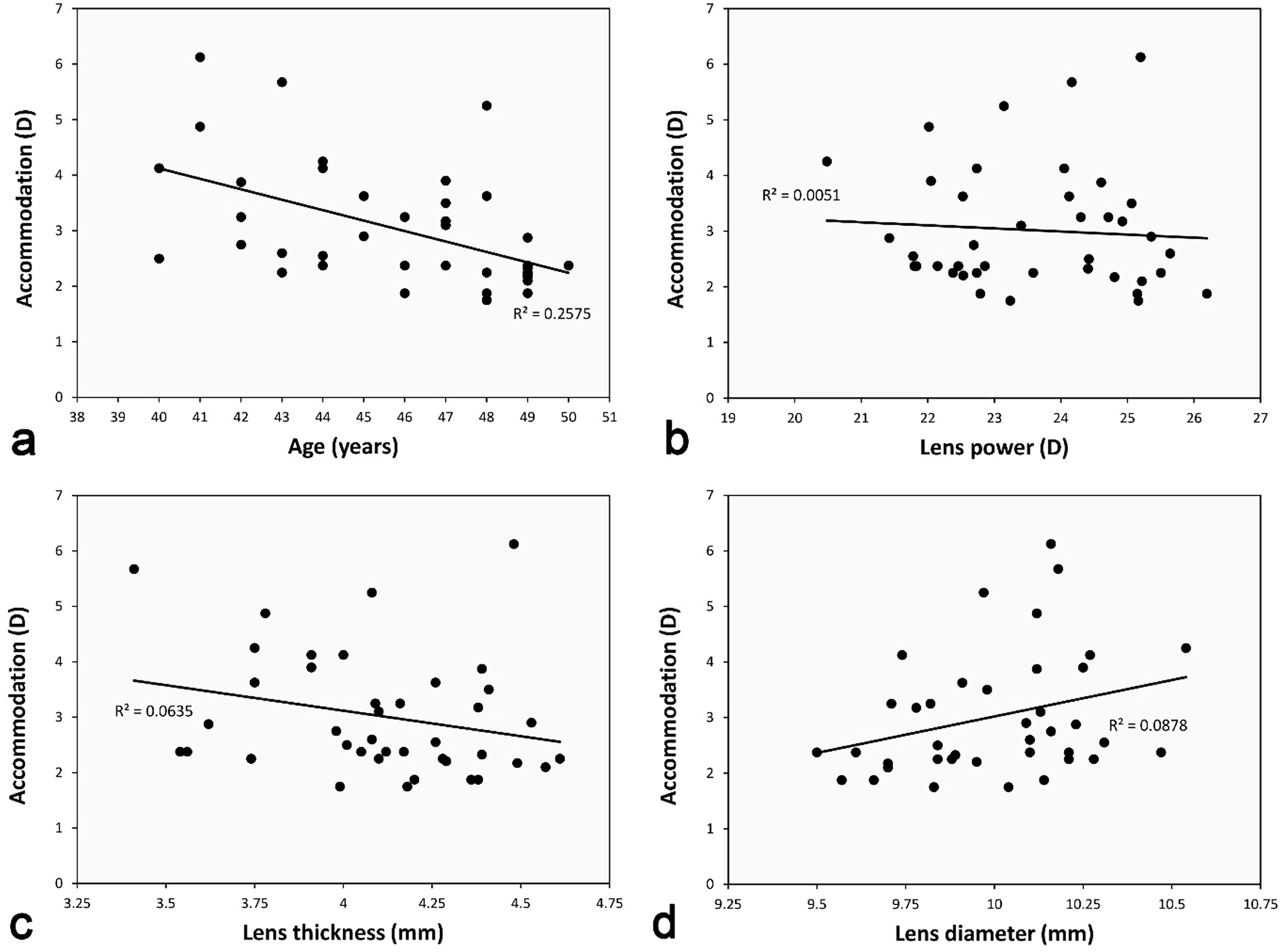
PURPOSE: To investigate the influence of lens shape on accommodative range in individuals aged 40-50 years, a period during which accommodative loss becomes clinically relevant. METHODS: Accommodation was measured in 40 participants aged 40-50 years using the RAF Convergence Rule and the Negative Lens Test. Crystalline lens geometry and power, as well as corneal power, axial length and anterior chamber depth, were assessed under cycloplegia using an autorefractor, Pentacam, Lenstar and Casia II OCT. Associations between accommodative range and lenticular parameters were analysed through correlation analysis, with and without corrections for age, sex and refractive error. RESULTS: No significant correlation was observed between the lenticular dimensions and the accommodative range. The change in accommodative amplitude with age was correlated with corneal power and axial length. After correcting for sex and age, these latter two correlations were no longer significant. An additional correction for the spherical equivalent refractive error did not change this result. CONCLUSIONS: The geometry of the crystalline lens does not affect the accommodative range in early presbyopic eyes, suggesting that changes in baseline lens shape are not the primary contributor to presbyopia. In contrast to expectations based on geometrical considerations, thicker or more curved lenses did not exhibit reduced accommodation.
The paper
Antwerp University Hospital; University of Antwerp
Ophthalmic & Physiological Optics, 14 Oct 2026

