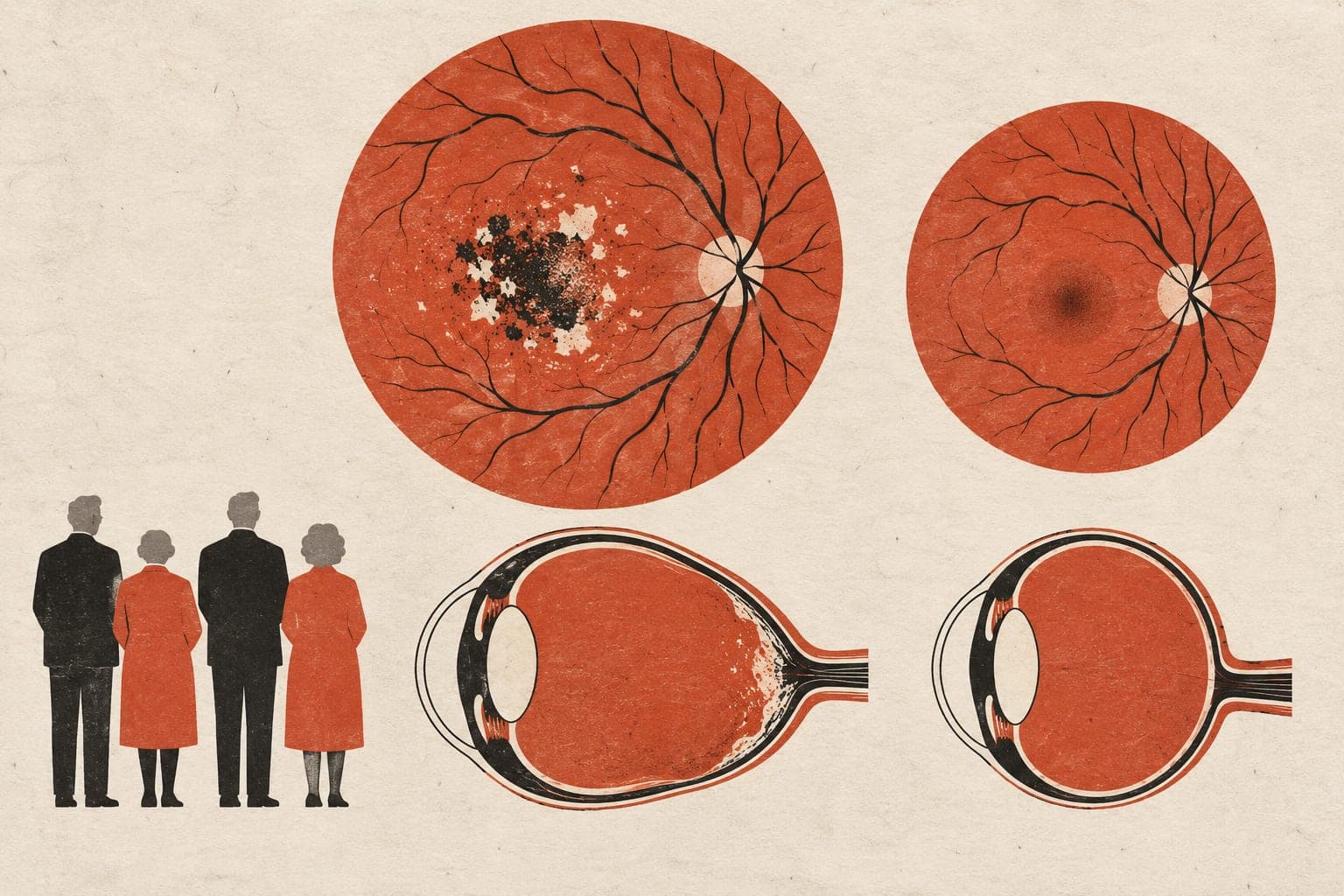
Myopic macular degeneration risk rises with eye length and age
For an eye length of 28 millimetres, probability of stage 3 or higher damage rose from 8.3% at age 30 to 57.5% at age 75.
Researchers analysed data from 14,108 people aged 30 and older across four population-based investigations. They assessed axial length, the front-to-back measurement of the eyeball, to calculate the probability of myopic macular degeneration, retinal damage linked to severe short-sightedness.
The team split 27,607 eyes equally into development and validation subgroups to create probability equations. In the validation subgroup, the equations distinguished stage 2 or higher and stage 3 or higher damage with areas under the curve of 0.996 and 0.998. Applying the equations, the probability of stage 2 or higher damage for an eye length of 28 millimetres increased from 55.0% at age 30 to 88.1% at age 75. For stage 3 or higher damage, the probability increased from 8.3% to 57.5% at 28 millimetres, and from 81.8% to 98.5% at 30 millimetres.
Why it matters
The mathematical approach helps clarify how the probability of myopic macular degeneration shifts across adult life, highlighting how an anatomical trait relates to degenerative changes in the aging eye.
Caveats
The researchers noted that the equations provide only a rough estimate of probability at present and at older age.
The paper
Show 4 more authors
Gyulli M Kazakbaeva, Ellina M Iakupova, Ya Xing Wang, Vinay Nangia,Rothschild Foundation Hospital
Acta Ophthalmologica, 9 Oct 2026