Central and peripheral vascular recovery following resistance exercise with and without blood flow restriction across age groups: a parallel group crossover randomized trial
Registered NCT06596304
Abstract
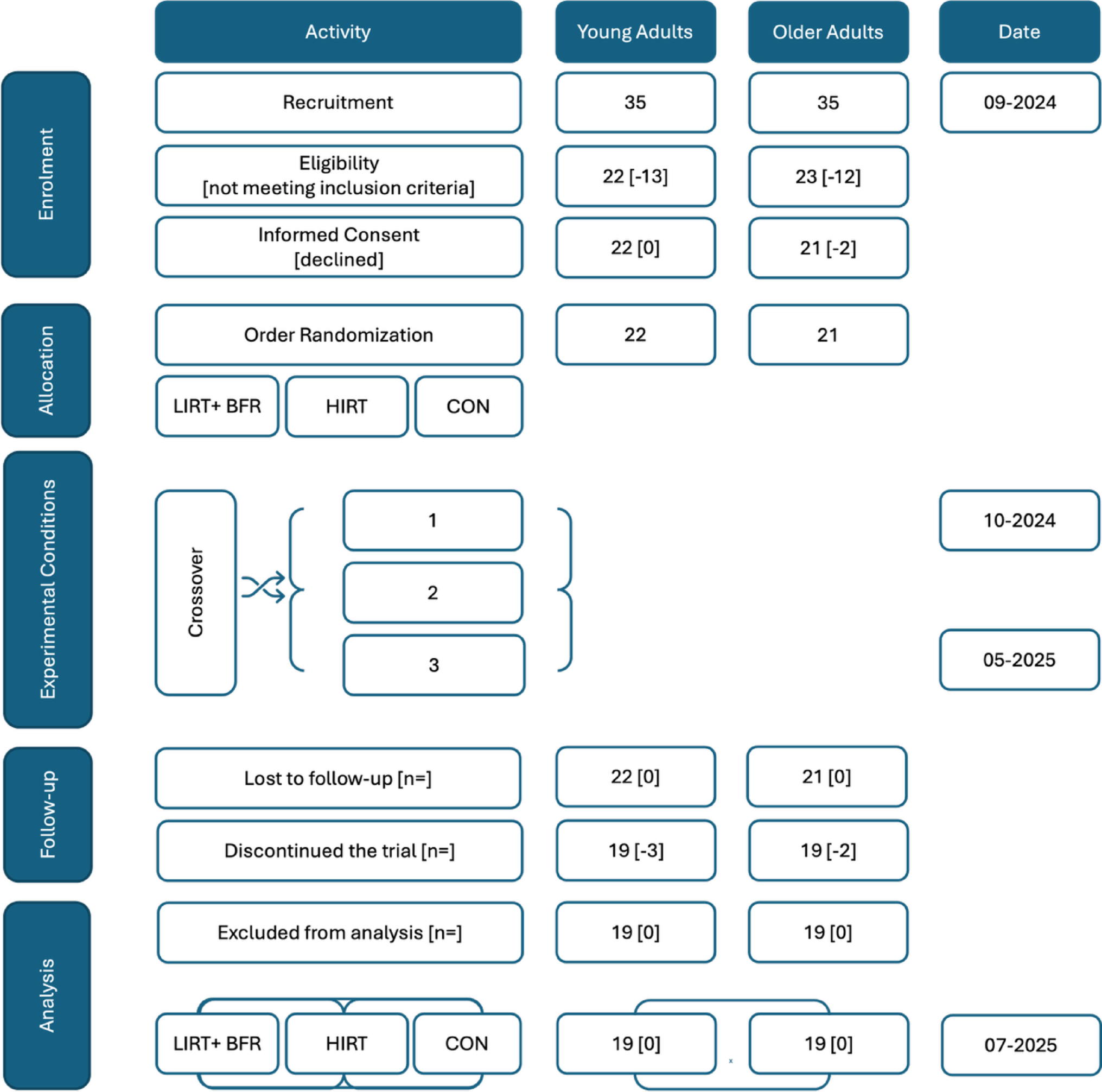
BACKGROUND: High-intensity resistance training (HIRT) benefits musculoskeletal and vascular health but may be poorly tolerated by older adults. Low-intensity resistance training (LIRT) is an alternative, yet evidence on arterial stiffness is mixed, and it often fails to improve vascular health due to insufficient stimulus. Blood flow restriction (BFR) enhances hemodynamic stimulus, but its acute cardiovascular effects in older adults remain unclear. PURPOSE: To compare central and peripheral vascular responses following acute LIRT with BFR versus HIRT across age groups. METHODS: In a randomized crossover design, 19 young (22±3 years) and 19 older (70±9 years) adults completed three sessions: HIRT (3 × 10 reps at 75%1RM), LIRT+BFR (4 × 20 reps at 30%1RM with continuous cuff occlusion), and no exercise. Central and peripheral vascular function were assessed via oscillometric pulse wave analysis at rest, 5-min (RECOV1), and 30-min (RECOV2) post-exercise. RESULTS: In older adults, neither HIRT nor LIRT+BFR altered total peripheral resistance (TPR), aortic reservoir function, or subendocardial viability ratio (SEVR) throughout post-exercise, with no differences observed between conditions. Conversely, young adults exhibited reductions at RECOV1 following HIRT in TPR (Δ = - 0.176 PRU), reservoir function (Δ = - 11.9%), and SEVR (Δ = - 47.1%), persisting at RECOV2 (all p < 0.05). LIRT+BFR elicited minor changes. Most variables normalized within 30 min for both groups. CONCLUSION: In older adults, LIRT+BFR elicits post acute central vascular responses comparable to HIRT, with stable coronary perfusion and rapid recovery supporting the short-term tolerability of both modalities. LIRT+BFR thus represents a viable alternative to HIRT for older population. TRIAL REGISTRATION: ClinicalTrials.gov (ID: NCT06596304).
- Blood flow restriction
- High-intensity resistance training
- Low-intensity resistance training with blood flow restriction
- Aortic reservoir function
- Subendocardial viability ratio
- Humans
The paper
Egas Moniz Center for Interdisciplinary Research (CiiEM); Manning College of Nursing & Health Sciences
European Journal of Applied Physiology, 13 Oct 2026