The Mediating Effect of Sleep Quality on the Relationship Between Frailty and Cognitive Impairment Among Community-Dwelling Older Adults: A Cross-Sectional Study
Abstract
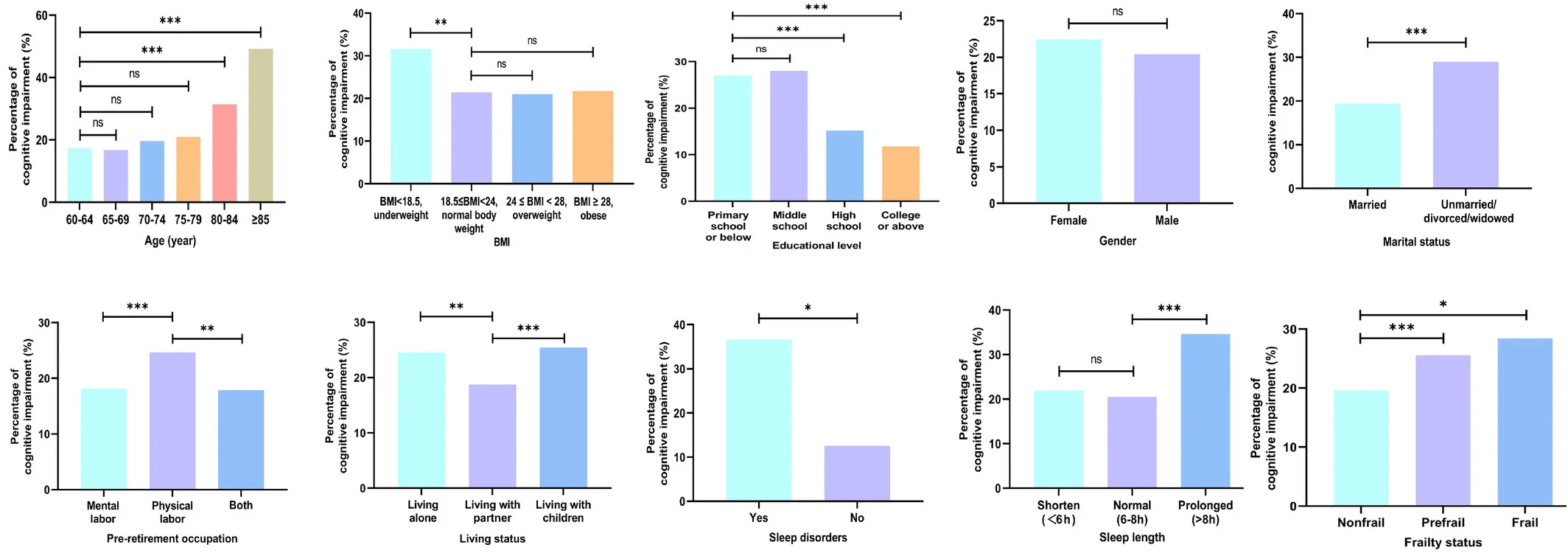
AIMS: To investigate the relationship between physical frailty and cognitive impairment among community-dwelling older adults and the mediating role of sleep quality in that relationship. DESIGN: Cross-sectional study. METHODS: A convenience sample of 2830 participants aged 60 years and above from Xi'an, China was assessed using the FRAIL scale, Mini-Mental State Examination (MMSE) and Pittsburgh Sleep Quality Index (PSQI). Comprehensive data on sociodemographic and health-related covariates were collected. Statistical analyses included chi-square tests, multivariate binary logistic regression, Spearman's correlation and mediation analysis using PROCESS (Model 4) with 5000 bootstraps. RESULTS: The prevalence of cognitive impairment was 21.77%. Cognitive function was negatively correlated with physical frailty and sleep quality, whereas physical frailty was positively correlated with sleep quality. Age ≥ 85 years, middle school education, sleep duration > 8 h and stroke were independently associated with higher odds of cognitive impairment. Sleep quality partially mediated the frailty-cognition relationship, accounting for 12.37% of the total effect. CONCLUSION: Sleep quality partially mediates the relationship between physical frailty and cognitive impairment, highlighting a critical opportunity for nurses to implement targeted sleep hygiene interventions alongside physical frailty management to potentially mitigate cognitive decline in the growing community-dwelling geriatric population. PATIENT OR PUBLIC CONTRIBUTION: No patient or public contribution. IMPLICATIONS FOR NURSING PRACTICE: Nurses should incorporate routine sleep quality screening into standard geriatric health assessments, particularly for frail older adults. In community settings, nurses can take the lead in delivering targeted sleep hygiene education, coordinating multidisciplinary management for underlying sleep disorders, and tailoring interventions to match each patient's frailty severity. IMPACT: These findings highlight the importance of integrating sleep quality assessment into routine geriatric care. For the growing aging population, nurses working in community settings can play a critical role in delivering targeted sleep hygiene interventions and managing physical frailty to potentially help preserve older adults' cognitive function.
The paper
Shaanxi Provincial People's Hospital
Nursing Open, 1 Oct 2026