Xerogenic medications and clinical markers of salivary hypofunction
Abstract
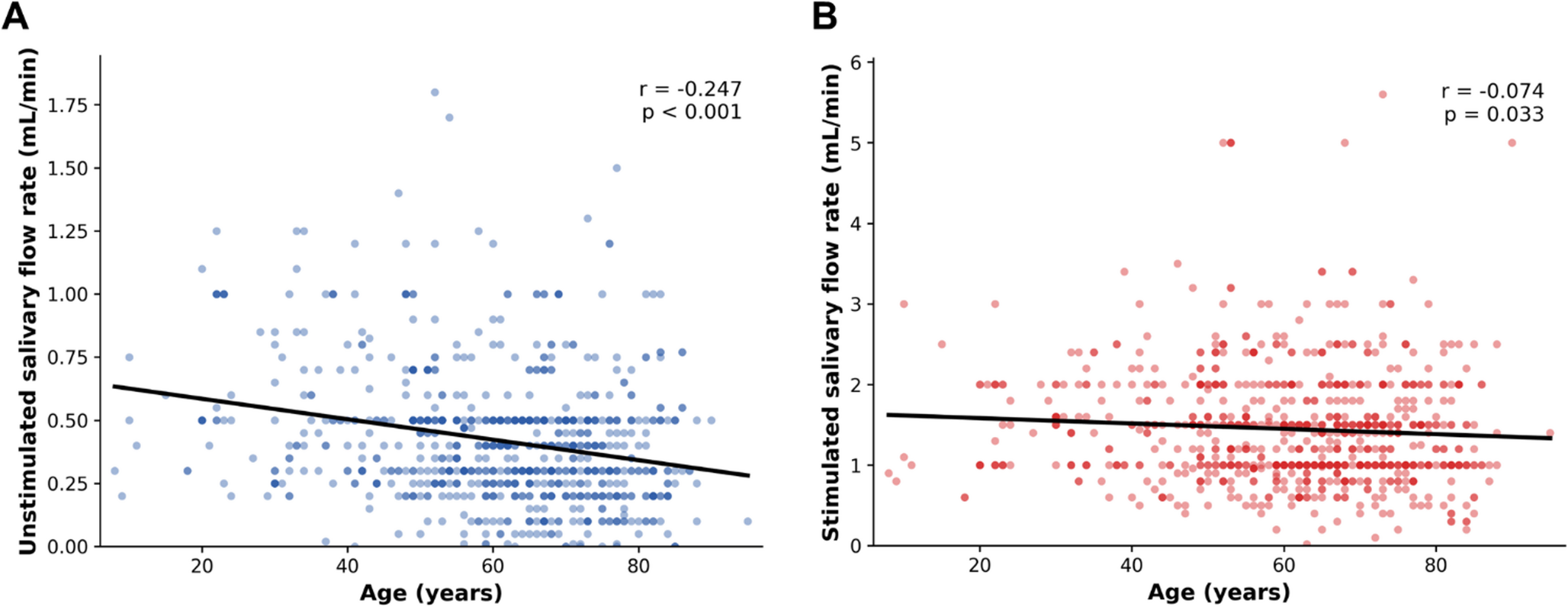
OBJECTIVES: To determine whether xerogenic medication-class exposure and chair-side salivary markers contribute to risk stratification of objective salivary hypofunction across a broad clinical age spectrum, using conventional regression and explainable machine-learning approaches. MATERIALS AND METHODS: This retrospective cross-sectional study included 850 patients (mean age, 60.8 ± 15.6 years; 657 [77.3%] female) who underwent salivary flow assessment and oral clinical evaluation at Kyung Hee University Dental Hospital. Patients were categorized into four age groups: <40, 40-64, 65-79, and ≥ 80 years. Unstimulated salivary flow rate (UFR), stimulated salivary flow rate (SFR), and flow-rate-defined hyposalivation were analyzed using age-group comparisons, multivariable regression models, incremental gradient boosting models, and SHapley Additive exPlanations (SHAP)-based model interpretation. RESULTS: Mean UFR was significantly lower in older age groups, ranging from 0.57 ± 0.30 mL/min in patients aged < 40 years to 0.36 ± 0.24 mL/min in those aged ≥ 80 years (p < 0.001), whereas age-group differences in SFR were less pronounced. SFR-defined hyposalivation was most frequent in the ≥ 80-year group (17.3%; p = 0.007). In adjusted models, the ≥ 80-year group had lower UFR than the < 40-year group (β = -0.194; 95% CI, - 0.272 to - 0.115; p < 0.001) and higher odds of SFR-defined hyposalivation (OR = 5.47; 95% CI, 1.44-20.78; p = 0.013). Female sex was associated with lower UFR (β = -0.055; p = 0.009) and SFR (β = -0.369; p < 0.001). High-confidence xerogenic medication-class count was independently associated with SFR-defined hyposalivation (OR = 1.63; 95% CI, 1.12-2.36; p = 0.010). In incremental machine-learning models, adding salivary pH and buffer capacity produced the largest improvement in discrimination. AUROC increased from 0.468 to 0.723 for UFR-defined hyposalivation (ΔAUROC = 0.255; DeLong p < 0.001) and from 0.608 to 0.725 for SFR-defined hyposalivation (ΔAUROC = 0.116; DeLong p = 0.005). SHAP analysis ranked salivary buffer capacity as the leading contributor for both outcomes, with salivary pH also among the top predictors. CONCLUSIONS: Objective salivary hypofunction was not fully explained by age, systemic disease burden, or medication burden alone. Instead, chair-side salivary functional markers, particularly salivary pH and buffer capacity, captured clinically relevant information about current salivary status. These findings support a practical, layered approach to identifying patients who may require objective salivary flow assessment. CLINICAL RELEVANCE: Chair-side salivary pH and buffer capacity may help clinicians identify patients who warrant objective salivary flow assessment, particularly when considered together with age, sex, and xerogenic medication-class exposure.
From the paper
- Participants
A total of 850 patients were included in the analysis (mean age, 60.8 ± 15.6 years; 77.3% female).
Results, Patient characteristics and salivary outcomes across age groups
- Result
In adjusted models, the ≥ 80-year group had lower UFR than the < 40-year group (β = −0.194; 95% CI, − 0.272 to − 0.115; p < 0.001) and higher odds of SFR-defined hyposalivation (OR = 5.47; 95% CI, 1.44–20.78; p = 0.013).
- Limitation
First, the retrospective cross-sectional design does not allow causal inference or temporal assessment of systemic disease, medication exposure, salivary functional markers, and salivary flow outcomes.
Quoted word for word from the full text on link.springer.com.
- Xerogenic medications
- Machine learning
- Salivary hypofunction
- Hyposalivation
- SFR-defined hyposalivation
- Humans
The paper
Seoul National University; Hanyang University
Clinical Oral Investigations, 13 Oct 2026