Silent spinal fractures were common in UK Biobank adults
Scans identified moderate or severe spinal fractures in 14.6% of 2,446 symptom-free UK Biobank participants aged 40–79, including people with normal bone density.
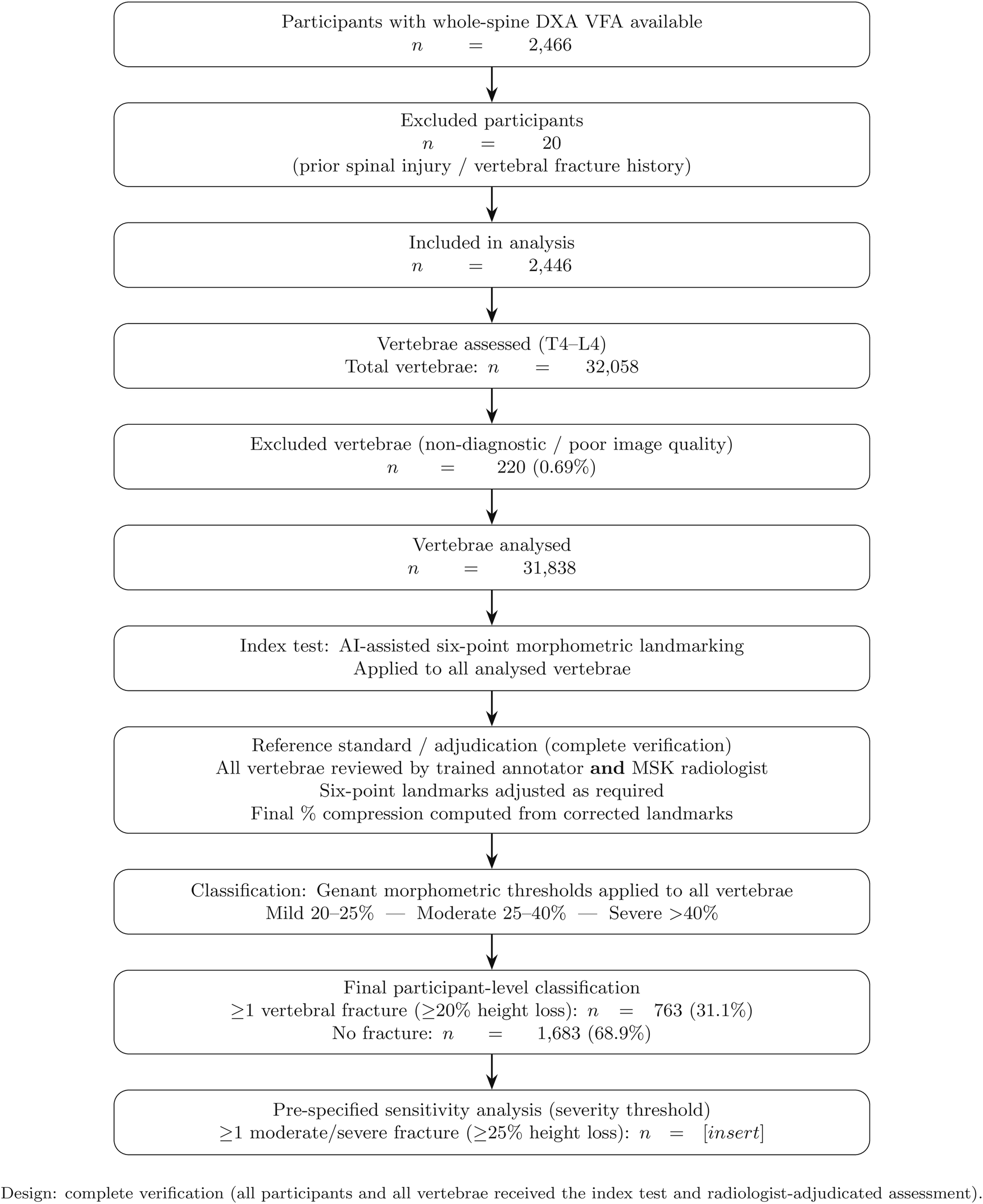
A retrospective observational study analysed spine images from bone-density scans of 2,446 symptom-free UK Biobank participants aged 40–79. The group included 1,151 men. Researchers used an artificial-intelligence-assisted method, with manual corrections and radiologist confirmation, to identify moderate or severe fractures. They defined these as deformities involving at least 25% loss of a spinal bone’s height.
They identified fractures in 356 participants, or 14.6%. The share with fractures was 9.4% among those aged 40–49 and 19.6% among those aged 70–79. Fractures were more common in men than women: 18.8% versus 10.8%. They frequently occurred in people with normal bone density. Bone density and most conventional clinical risk factors offered limited help in identifying affected participants.
Why it matters
Recognising fractures that cause no symptoms is a challenge for assessing bone health in midlife and older age. The study bears on how to identify bone damage that might otherwise go unnoticed.
Caveats
This retrospective observational study could identify associations, not causes. Its findings do not necessarily apply beyond symptom-free UK Biobank participants aged 40–79.
From the paper
- Participants
A total of 2446 participants (mean age 62.0 ± 7.4 years; 1151 men) were analysed.
- Result
Fractures were more common in men than women (18.8% vs. 10.8%; adjusted OR 0.51 for women vs. men, 95% CI 0.40–0.66; p < 0.001).
- Limitation
The UK Biobank cohort comprises volunteers and may not be fully representative of the general population.
Quoted word for word from the full text on link.springer.com.
- Silent vertebral compression fractures
- Back pain
- Body mass index
- Bone mineral density
- Vertebral height loss
- Humans
The paper
Imperial College London
European Radiology, 13 Oct 2026