Frailty and sleep quality in elderly living in old age homes of Kathmandu Valley: a cross-sectional study
Abstract
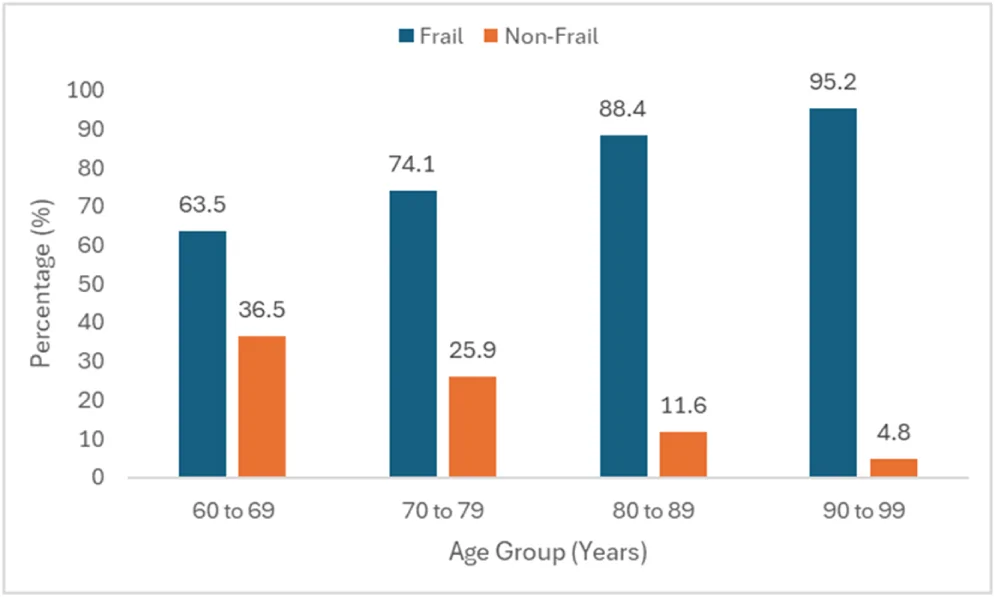
BACKGROUND: Frailty is a clinical syndrome characterized by age-related decline in strength, endurance, and physiological function that increases vulnerability to adverse health outcomes. Sleep disturbances are also common among older adults, particularly in long-term care settings, and may contribute to worsening frailty and reduced quality of life. However, limited evidence exists regarding the relationship between frailty and sleep quality among institutionalized elderly populations in Nepal. METHODOLOGY: A cross-sectional study was conducted among 219 individuals aged ≥60 years residing in old-age homes in Kathmandu Valley. Participants were selected through convenience sampling. Frailty was assessed using the Groningen Frailty Indicator, and sleep quality was evaluated using the Pittsburgh Sleep Quality Index. RESULTS: The mean age of participants was 73.81 years (range 60-99 years), and 62.6% were female. Frailty was present in 75.3% (n = 163) of participants, with prevalence increasing from 63.5% in the 60-69 age group to 95.2% among those aged 90-99 years. Poor sleep quality was observed in 85.8% (n = 188) of participants. Among frail individuals, 95.8% had poor sleep quality. A significant association was found between frailty and poor sleep quality (r = 0.497, P < 0.001) and in adjusted analysis poor sleep quality was strongly associated with frailty (AOR = 22.58, 95% CI: 8.10-62.94, P < 0.001) . CONCLUSION: These findings highlight a strong association between frailty and poor sleep quality among elderly living in old age homes in Kathmandu valley, underscoring the need for integrated screening and management of sleep disturbances within frailty care.
The paper
Nepalese Army Institute of Health Sciences
Annals of Medicine and Surgery, 9 Sep 2026