Digital development and health in China: a serial pathway model through internet use and physical exercise in repeated cross-sectional surveys
Abstract
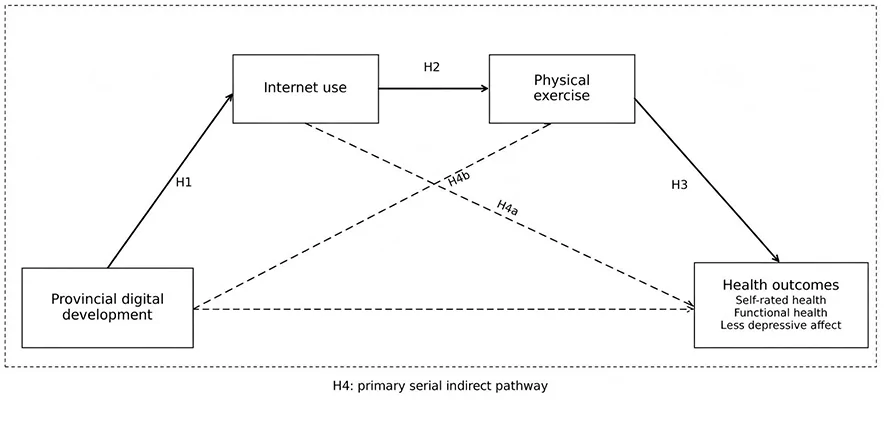
BACKGROUND: Digital exclusion extends beyond access to whether digital participation is associated with health-promoting behavior and health-related outcomes. Physical exercise may form one behavioral link between digital participation and health, but the strength of this sequence may differ across sociodemographic groups. METHODS: We harmonized the 2013, 2018, and 2023 Chinese General Social Survey, including 29,295 adults across 31 provincial-level units. These waves were deliberately selected at approximately 5-year intervals to provide repeated cross-sectional snapshots across a 10-year period. Provincial digital development was measured using a 21-indicator province-year composite index. Survey-weighted population-average path models were supplemented by constrained-model comparisons, formal between-group heterogeneity tests, and multilevel structural equation models separating within- and between-province-year associations. The multilevel models used 87 observed province-year clusters and additionally adjusted for province-year sports-facility resources. RESULTS: Provincial digital development increased from 0.117 in 2013 to 0.176 in 2018 and was 0.162 in 2023. Internet use increased from 2.132 to 3.593, while physical exercise increased from 2.091 to 2.537. In population-average models, digital development was positively associated with internet use, internet use with physical exercise, and exercise with all three health outcomes; the complete serial indirect associations were statistically supported but small. Multilevel decomposition showed robust within-cluster internet use → exercise → health indirect associations. At the between-cluster level, digital development → internet use and internet use → exercise were supported, whereas exercise → health and the complete digital development → internet use → exercise → health indirect associations were not. Formal heterogeneity tests indicated selective, stage-specific differences by age, hukou, marital status, and education, with weaker evidence for household economic position and no clear evidence for sex. CONCLUSIONS: Digital expansion did not automatically correspond to comparable growth in physical exercise or multidimensional health. The findings support a use-to-benefit perspective while showing that the proposed sequence is level-dependent: individual internet use was consistently linked to exercise and health within province-year contexts, but the complete between-cluster serial association was not supported. Public-health strategies should connect inclusive digital participation with behaviorally specific support and accessible offline opportunities for physical activity.
The paper
Hunan University of Technology
Frontiers in Public Health, 28 Sep 2026, Open access