Cardiovascular risk linked to mild cognitive impairment
Greater estimated cardiovascular risk was linked to higher odds of mild cognitive impairment; reported odds ratios ranged from 2.62 to 4.22 across models.
Researchers analysed baseline data from people without cognitive impairment and people with mild cognitive impairment, meaning mild difficulties with thinking or memory. This cross-sectional observational study used the community-based Health and Aging Brain Study–Health Disparities cohort, which included diverse racial and ethnic groups. Researchers estimated ten-year risk of heart and blood vessel disease caused by fatty deposits in arteries and measured Alzheimer’s-related blood markers.
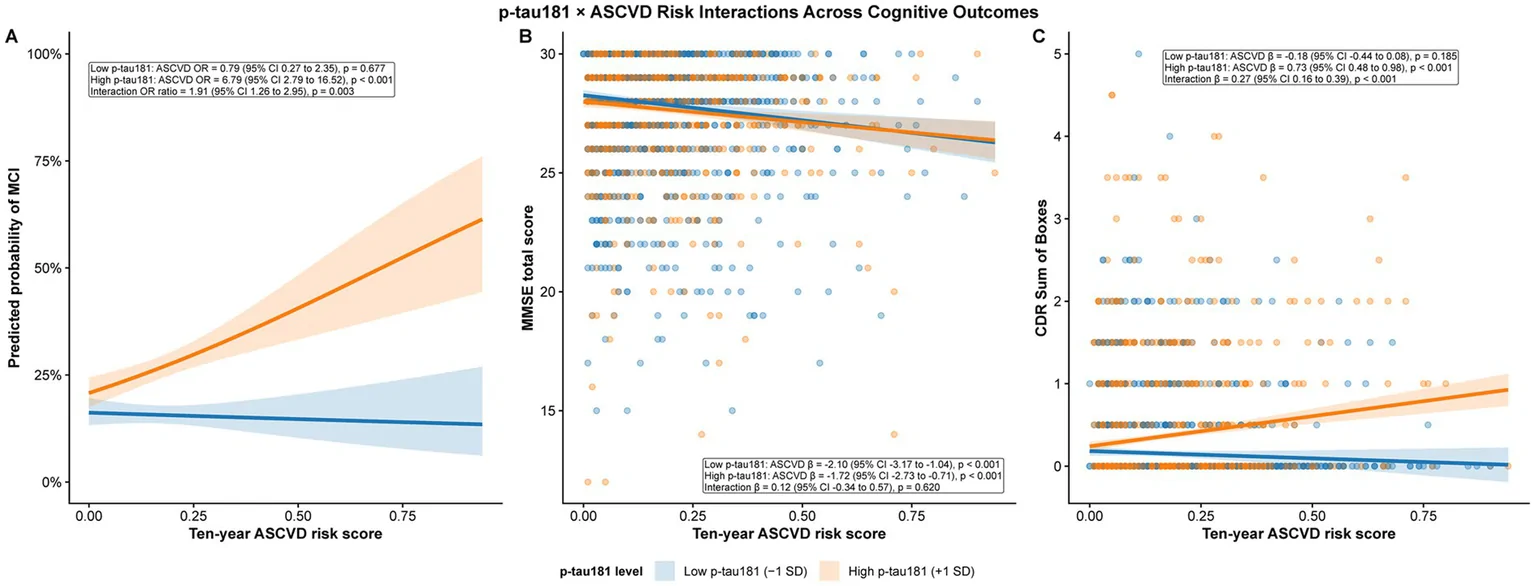
Greater estimated risk was associated with mild cognitive impairment, poorer cognitive test scores and higher scores on a scale of cognitive and daily-function difficulties. These associations remained after accounting for the blood markers. The links with mild cognitive impairment and the rating scale differed according to levels of phosphorylated tau 181, a chemically modified protein measured in blood. The strength of associations also varied across racial and ethnic groups.
Why it matters
Cognitive impairment is a concern in aging. The results support studying cardiovascular risk alongside Alzheimer’s-related blood markers rather than examining either in isolation.
Caveats
These cross-sectional associations cannot establish cause and effect or whether cardiovascular risk preceded cognitive impairment. The abstract did not specify the risk increment used for the reported odds ratios.
From the paper
- Participants
Among the 2,292 participants included in the analyses (mean age: 64.8 (SD = 8.41), 63.7% female), ten-year ASCVD risk spanned a wide range (median = 0.13; range = 0–0.94).
- Result
Ten-year ASCVD risk was consistently associated with increased odds of MCI across all five models, with ORs ranging from 2.62 (95% CI: 1.31 to 5.17; p = 0.006) to 4.22 (95% CI: 2.04 to 8.64; p < 0.001).
Results, Plasma biomarker and ten-year ASCVD risk associations with mild cognitive impairment
- Limitation
First, the cross-sectional design precludes inference regarding temporality or causality between ten-year ASCVD risk, plasma biomarkers, and cognitive impairment.
Quoted word for word from the full text on frontiersin.org.
- Mild cognitive impairment
- Amyloid-β42/40 ratio
- Atherosclerotic cardiovascular disease
- Clinical Dementia Rating Sum of Boxes score
- Mini-Mental State Examination score
- Humans
The paper
University of California San Diego; University of Kentucky
Frontiers in Aging Neuroscience, 28 Sep 2026