The effect of exercise snacks on cardiorespiratory fitness, body composition, metabolic health, and muscle strength in sedentary individuals: a systematic review and meta-analysis
Preregistered CRD420261347411
Abstract
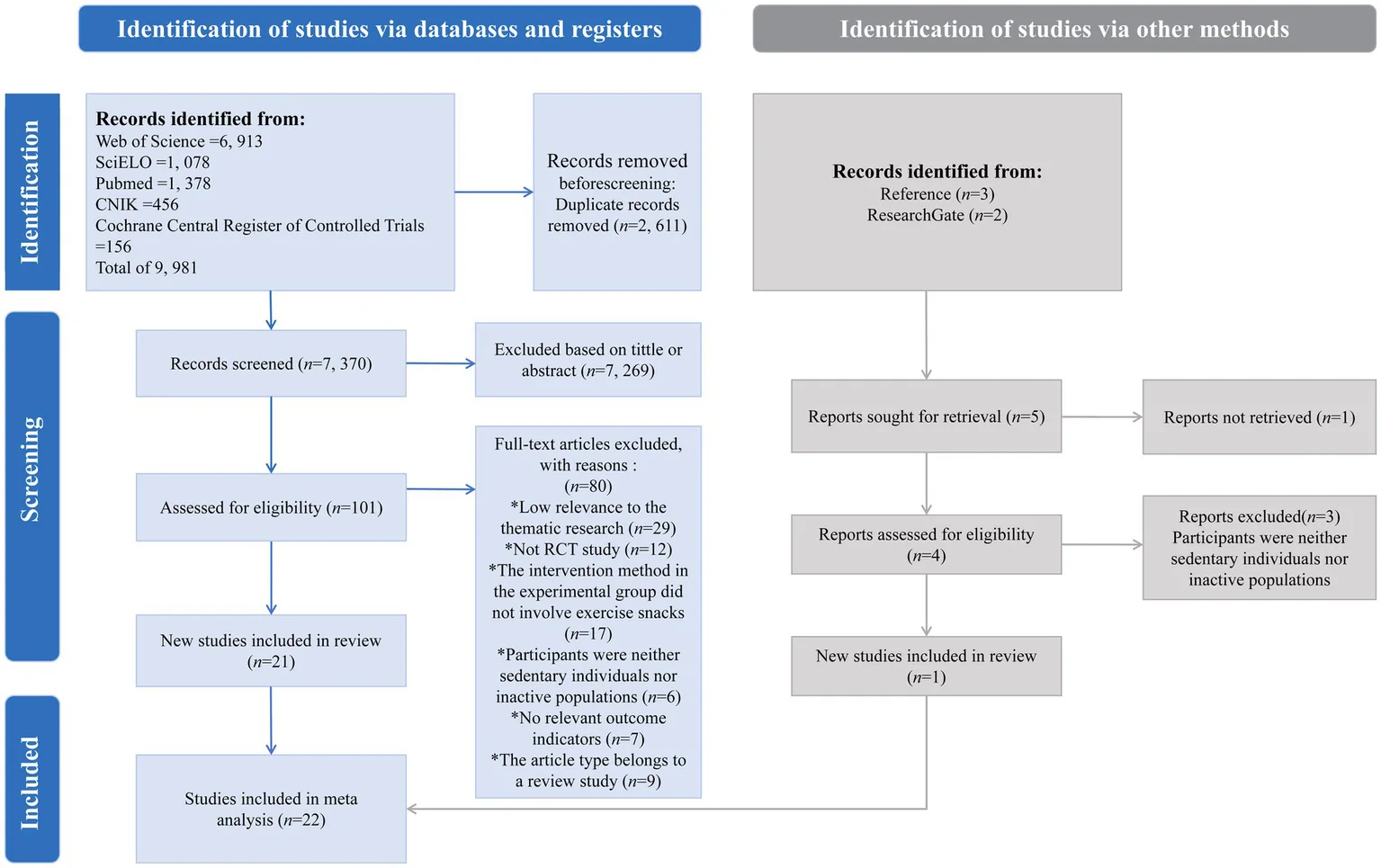
OBJECTIVE: This systematic review and meta-analysis aimed to investigate the effects of exercise snacks (ES) on cardiorespiratory fitness, body composition, metabolic health, and muscle strength in sedentary individuals. METHODS: From database inception to February 5, 2026, four international databases (PubMed, Web of Science, SciELO, and the Cochrane Central Register of Controlled Trials) and one Chinese database (China National Knowledge Infrastructure) were searched. The GRADE approach was used to assess the certainty of evidence, while the Cochrane Risk of Bias tools (RoB 2) and Risk of Bias In Non-randomized Studies of Intervention (ROBINS-I) were applied to evaluate the quality of randomized controlled trials and non-randomized studies, respectively. The pooled effects of study outcomes were estimated using a random-effects model based on meta-analysis. Subgroup analyses and meta-regression were conducted to explore potential moderating variables. RESULTS: A total of 22 studies involving 994 participants were included. The meta-analysis showed that ES significantly improved VO2max (Hedges' g = 1.24, 95% CI: 0.53 to 1.95, p < 0.001, I² = 75.0%, τ² = 1.13), VO2peak (Hedges' g = 0.63, 95% CI: 0.05 to 1.22, p < 0.05, I² = 55.0%, τ² = 0.19), triglycerides (Hedges' g = 1.05, 95% CI: 0.05 to 2.06, p < 0.05, I² = 84.0%, τ² = 0.65), and blood glucose (Hedges' g = -0.83, 95% CI: -1.51 to -0.15, p < 0.05, I² = 78.0%, τ² = 0.69) in sedentary populations. However, significant publication bias was detected for VO2max, and the trim-and-fill analysis yielded an adjusted effect estimate that was no longer statistically significant (Hedges' g = 0.62, 95% CI: -0.59 to 1.83, p = 0.32). No significant differences were observed in body fat, muscle mass, strength, or insulin levels. CONCLUSION: As a short-duration, high-frequency intervention, ES may improve cardiorespiratory fitness and certain metabolic health indicators in sedentary individuals. However, the finding for VO2max should be interpreted cautiously because the trim-and-fill adjusted estimate was not statistically significant, suggesting that publication bias may have influenced the observed effect. It provides a potentially sustainable and effective exercise intervention strategy for sedentary individuals. SYSTEMATIC REVIEW REGISTRATION: PROSPERO (CRD420261347411).
From the paper
- Participants
The participants were all sedentary and inactive individuals, with a total of 994 participants.
- Limitation
Currently, research on the application of ES interventions in sedentary individuals is still limited, and there are significant differences in the types of interventions and outcome measures, which affects the comparability and interpretability of the results.
Quoted word for word from the full text on frontiersin.org.
The paper
Nanjing Sport Institute
Frontiers in Nutrition, 28 Sep 2026, Open access