Parental obesity and offspring cardiometabolic trajectories from childhood to adulthood
Abstract
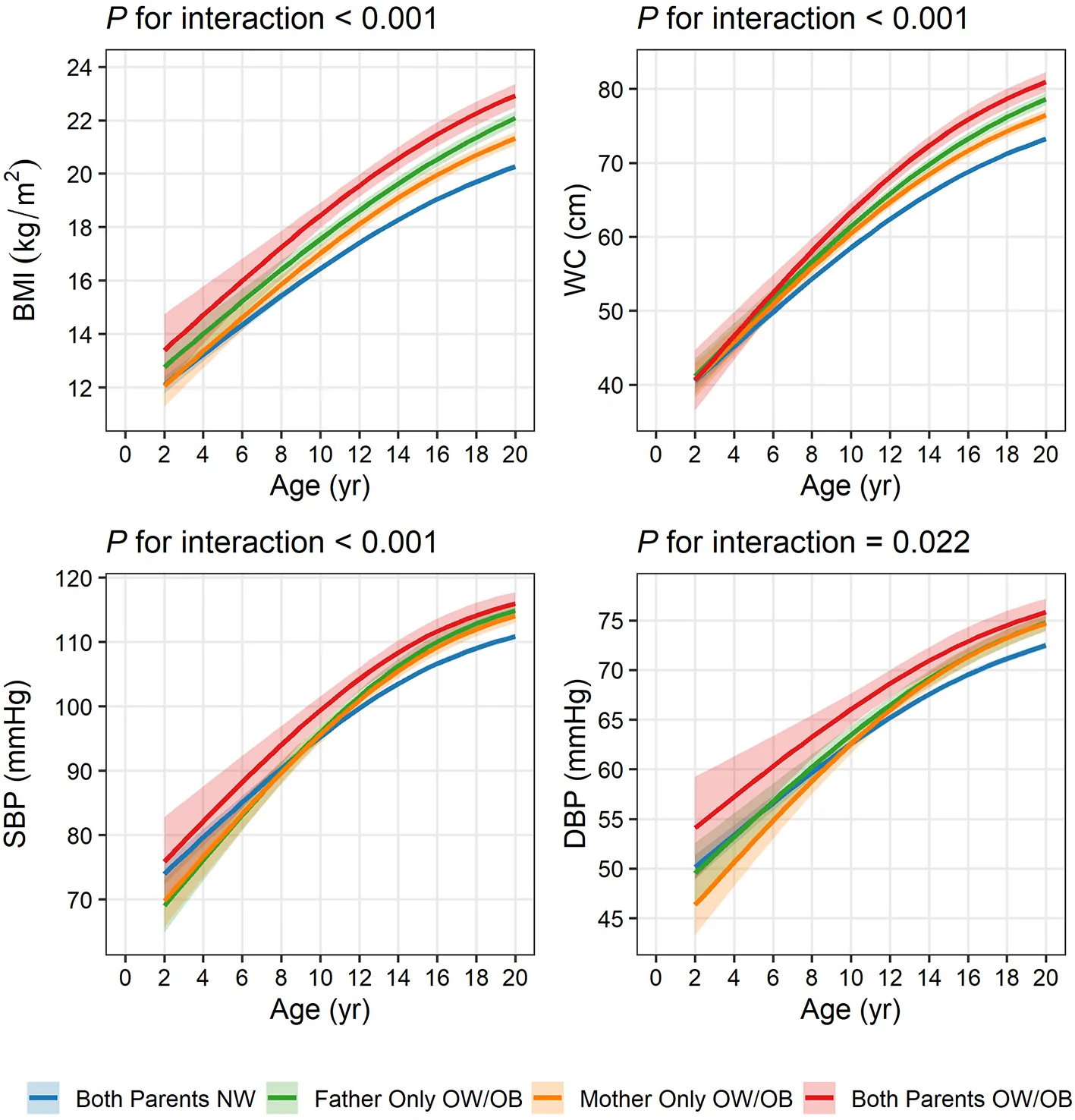
OBJECTIVES: Parental obesity is a strong risk factor for childhood adiposity. However, evidence regarding its association with longitudinal cardiometabolic disease progression in offspring remains limited. We aimed to examine whether parental obesity is associated with adverse cardiometabolic trajectories in offspring from childhood to adulthood. METHODS: We analyzed prospective data from the China Health and Nutrition Survey (1989-2015). Offspring aged ≥2 years were categorized according to parental overweight/obesity status: neither parent affected (Group 1, reference), only father affected (Group 2), only mother affected (Group 3), and both parents affected (Group 4). We used linear mixed-effects models with polynomial age terms to estimate longitudinal trajectories and annual changes in body mass index, waist circumference, and blood pressure. Cox proportional hazards models were used to assess hazard ratios for incident overweight/obesity, central obesity, and hypertension. RESULTS: Among 4,982 offspring, those with both parents affected (group 4) had the highest baseline levels; however, annual rates of increase were not consistently higher. Male offspring in group 4 had the highest risks for incident overweight/obesity (HR = 3.72; 95% CI, 1.73-7.99) and central obesity (HR = 2.46; 95% CI, 1.31-4.62); the association with hypertension was elevated but did not reach statistical significance (HR = 1.55; 95% CI, 0.86-2.77). Female offspring in group 4 had the highest risk for incident overweight/obesity (HR = 4.60; 95% CI, 1.93-10.94). Formal interaction tests for sex × parental obesity were not significant for any outcome (all P interaction > 0.05). CONCLUSIONS: Parental obesity, particularly when both parents are affected, is associated with higher baseline cardiometabolic risk levels and substantially higher disease risk in offspring, though the annual rates of increase do not consistently differ across groups. These findings underscore the family unit as a critical target for early preventive strategies.
From the paper
- Participants
We included 4,982 participants who had measured anthropometric and blood pressure data at baseline, at least one follow-up assessment with the same measurements, and concurrently available measured anthropometric data for both parents.
- Result
Formal pairwise contrasts for male are provided in Supplementary Table S3, Group 2 had significantly faster annual increases than Group 1 in BMI (Δβ = 0.109, 95% CI 0.038 to 0.179, P < 0.001), WC (Δβ = 0.291, 95% CI 0.048 to 0.534, P = 0.011), and SBP (Δβ = 0.481, 95% CI 0.061 to 0.901, P = 0.017).
Results, 3.3 Parental adiposity status and annual rate of change in offspring outcomes
- Limitation
First, the analytical sample included participants with a broad baseline age range (≥2 years), and the baseline age distribution differed across parental groups, particularly with the highest mean age in the dual-affected group.
Quoted word for word from the full text on frontiersin.org.
- Cardiometabolic disease
- Central obesity
- Hypertension
- Incident central obesity
- Incident hypertension
- Humans
The paper
Capital Medical University
Frontiers in Public Health, 28 Sep 2026