Association Between CT-Based Rectal Stool Attenuation and Activities of Daily Living in Hospitalized Older Adults
Abstract
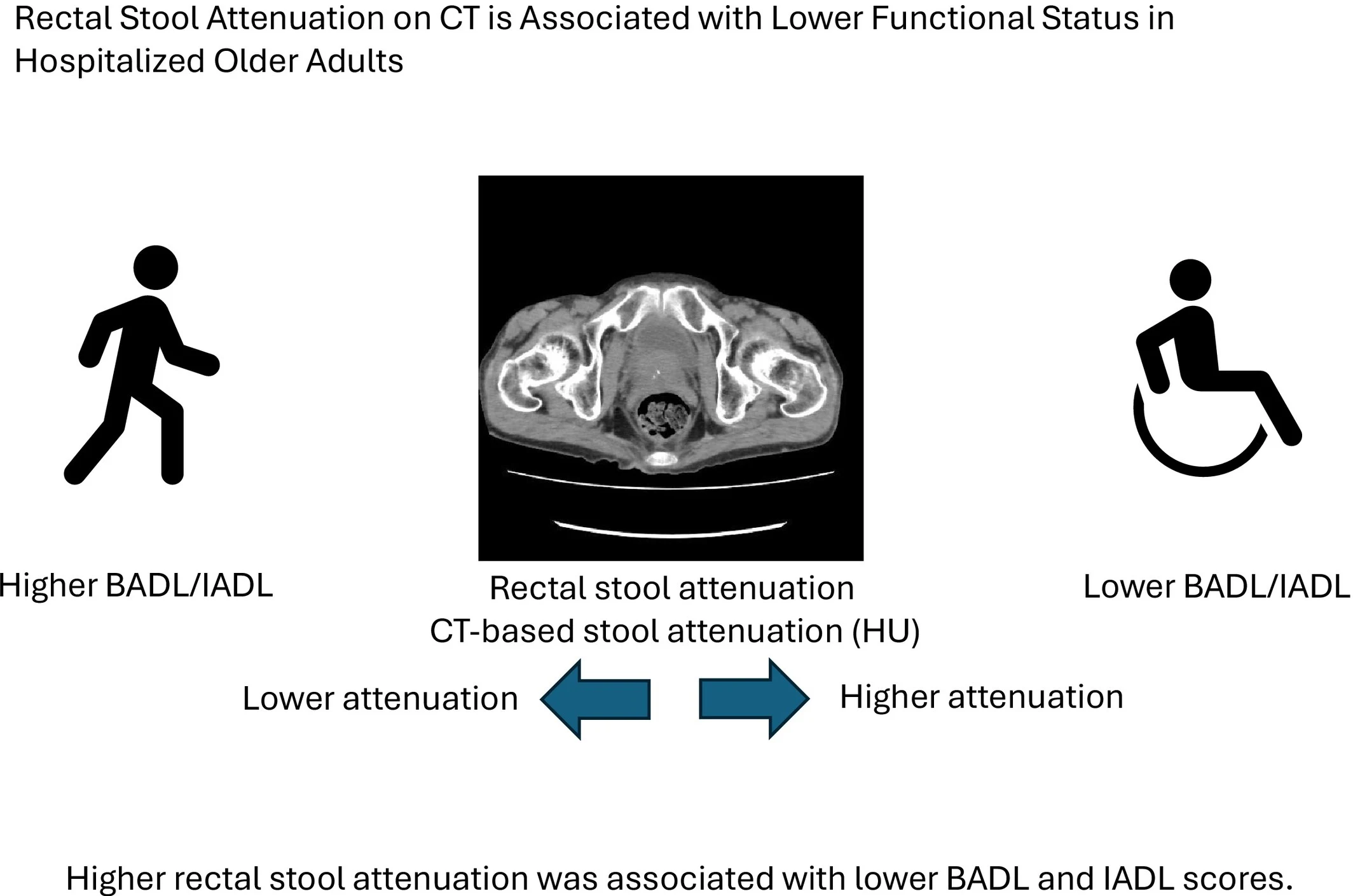
OBJECTIVES: To explore the association between rectal stool characteristics measured by computed tomography (CT), particularly stool attenuation, and activities of daily living (ADL) in hospitalized older adults who had previously undergone abdominal CT for clinical reasons. METHODS: This single-center exploratory cross-sectional study included adults aged ≥ 65 years admitted to the geriatric ward of Nagoya University Hospital who underwent abdominal CT within 1 month before or during hospitalization. Basic ADL (BADL) and instrumental ADL (IADL) were assessed using the Barthel Index and the Lawton and Brody IADL scale, respectively. Rectal stool attenuation, rectal lumen area, stool area, and gas area were measured on the axial slice with the largest rectal cross-section. High-attenuation stool was defined as > 100 HU, and 10 cm² was used as the threshold for rectal area parameters. Correlations between continuous CT parameters were examined using Spearman's rank correlation. Associations between CT findings and ADL were first examined by comparing mean ADL scores between groups defined by CT parameters; multivariable logistic regression was then used to evaluate factors independently associated with high-attenuation stool. Odds ratios (ORs) and 95% confidence intervals (CIs) were calculated. RESULTS: Among 116 participants (mean age, 85.8 years), 31.0% had high-attenuation stool. High-attenuation stool was associated with significantly lower BADL scores (55.4 ± 38.0 vs. 74.4 ± 27.5) and IADL scores (2.4 ± 2.9 vs. 3.9 ± 2.8). Stool attenuation was positively correlated with stool area (r = 0.34) and negatively correlated with gas area (r = -0.31). In multivariable analysis, lower BADL (OR, 0.983; 95% CI, 0.970-0.997) and lower IADL (OR, 0.840; 95% CI, 0.715-0.986) were independently associated with high-attenuation stool. When analyzed as a continuous variable, stool attenuation was negatively correlated with both BADL (r = -0.224, p = 0.015) and IADL (r = -0.199, p = 0.032). CONCLUSION: High rectal stool attenuation on CT was significantly associated with lower ADL in hospitalized older adults. These exploratory findings suggest that CT-based rectal stool attenuation may provide supplementary imaging information regarding functional vulnerability in older adults who have previously undergone abdominal CT. However, the cross-sectional design, CT-selected study population, and lack of contemporaneous assessment of constipation symptoms, bowel habits, or stool form preclude conclusions regarding causality or clinical utility.
From the paper
- Participants
Therefore, 116 patients were included in the final analysis.
- Result
In multivariable analysis, lower BADL (OR, 0.983; 95% CI, 0.970–0.997) and lower IADL (OR, 0.840; 95% CI, 0.715–0.986) were independently associated with high-attenuation stool.
- Limitation
First, the cross-sectional design precludes causal inference regarding the relationship between high-attenuation rectal stool and lower ADL.
Quoted word for word from the full text on onlinelibrary.wiley.com.
The paper
Nagoya University Hospital; Nagoya University Graduate School of Medicine
Geriatrics & Gerontology International, 1 Oct 2026