Validity of Cognitive Performance-Based Screening Tools for Older Adults: Dual Tasks Combining Cognition and Hand Function
Abstract
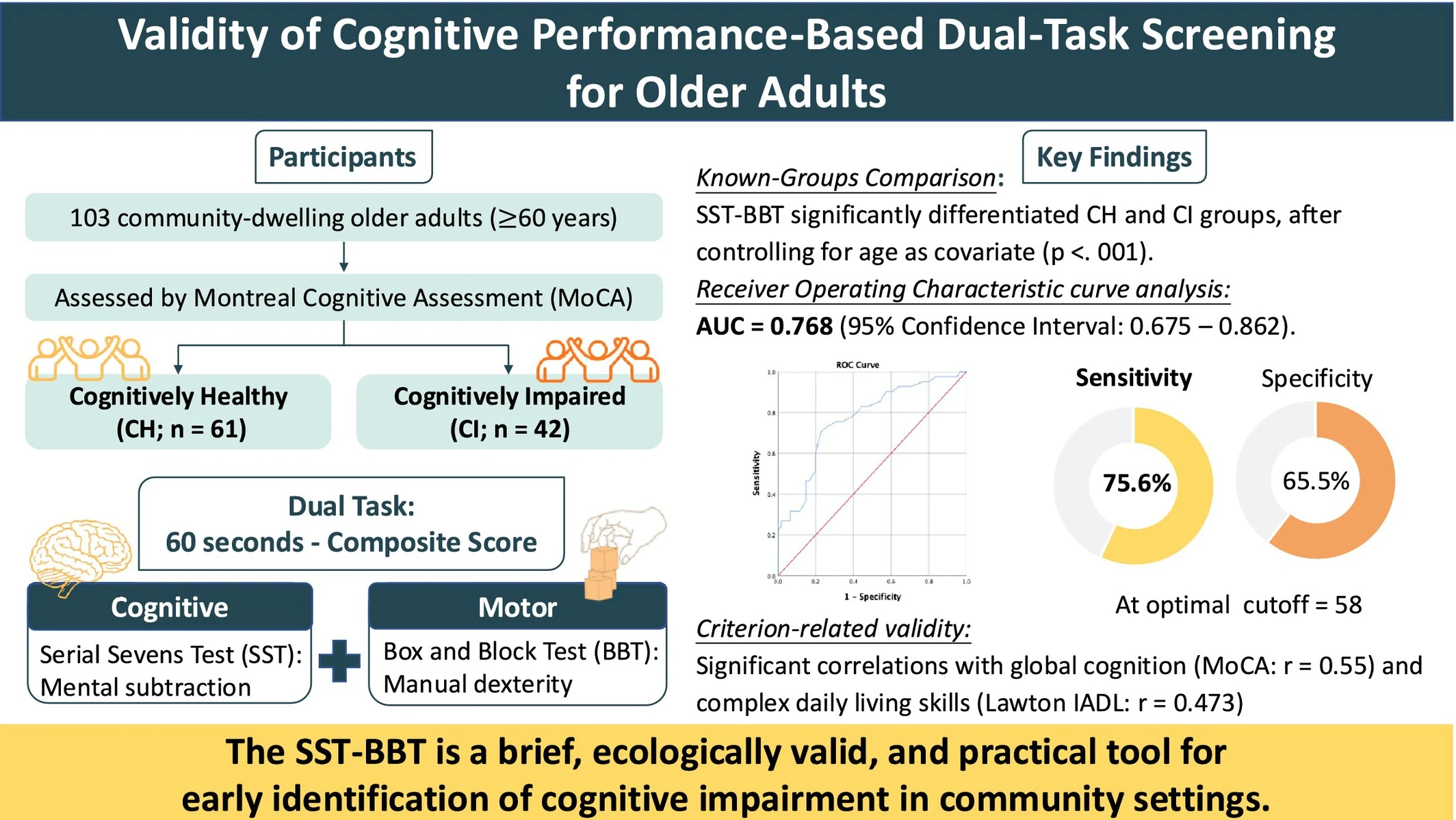
BACKGROUND: Early detection of cognitive decline in older adults is essential for timely interventions to preserve independence in instrumental activities of daily living (IADLs). Existing cognitive screening tools often lack ecological validity or require extensive administration. Dual-task paradigms combining cognitive and motor demands may provide a practical and sensitive alternative. OBJECTIVE: This study aimed to validate two dual-task measures integrating cognition and hand function as cognitive screening tools for older adults. METHODS: A total of 103 community-dwelling older adults (≥ 60 years) were recruited and categorized into cognitively healthy (CH, n = 61) and cognitively impaired (CI, n = 42) groups based on Montreal Cognitive Assessment (MoCA) scores. Two dual tasks were proposed: (1) Serial Sevens Test with the Box and Block Test (SST-BBT) and (2) Frequency Discrimination with the Box and Block Test (FD-BBT). Construct validity was examined using known-groups comparisons and receiver operating characteristic (ROC) analyses. Criterion-related validity was assessed via correlations with the Mini-Mental State Examination, MoCA, Stroop Color and Word Test, and Lawton Instrumental Activities of Daily Living scale. RESULTS: After controlling for age as a covariate, the SST-BBT dual task significantly differentiated CH and CI groups (p < 0.001), with an area under the ROC curve (AUC) of 0.768 (95% CI: 0.675-0.862). The FD-BBT dual task also showed group differences (p = 0.003) but demonstrated lower sensitivity and specificity (AUC = 0.713, 95% CI: 0.610-0.815). When applying the established dual-task cutoffs, the SST-BBT successfully discriminated performance across all criterion measures independent of age (Fs > 4.15, ps < 0.045, partial η 2 > 0.039), whereas the FD-BBT failed to discriminate executive function. Both dual-task measures demonstrated fair-to-good correlations with established cognitive and functional assessments (rs = 0.356-0.551), supporting their criterion-related validity. CONCLUSIONS: The SST-BBT dual task demonstrated acceptable validity, sensitivity, and ecological relevance, supporting its potential as a practical screening tool for detecting CI in older adults. Future studies should replicate these findings in larger, more diverse samples and examine longitudinal outcomes to establish predictive validity. TRIAL REGISTRATION: CLINICALTRIALS. GOV IDENTIFIER: NCT0468977.6.
- Cognitive impairment
- Box and Block Test
- FD-BBT
- Frequency Discrimination
- Lawton Instrumental Activities of Daily Living Scale
- Humans
The paper
Chang Gung University
Geriatrics & Gerontology International, 1 Oct 2026