One year after spaced retrieval training: enduring memory enhancement for older adults with and without mild cognitive impairment
Controlled
Abstract
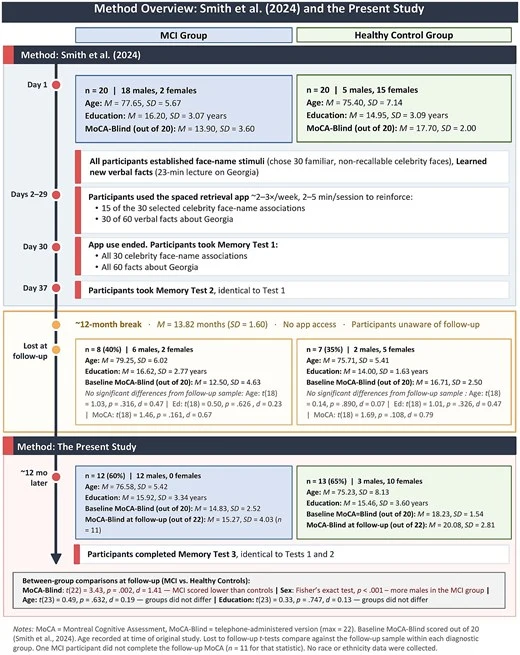
OBJECTIVE: Spaced retrieval training (SRT) can enhance memory in older adults with and without cognitive impairment, but the durability of these memories remains unclear. This study examined whether memory benefits from an app-based SRT program persisted one year after training in older adults with mild cognitive impairment (MCI) due to Alzheimer's disease (AD) and healthy controls. METHOD: We recruited participants from a prior study in which they used a mobile app to engage in SRT for half of two sets of stimuli, verbal facts and face-name associations, across a four-week intervention. One year later, with no experimentally manipulated exposure to the stimuli, 12 participants with MCI and 13 controls completed follow-up memory testing of studied and nonstudied items. Memory accuracy was assessed separately for the two sets of stimuli. RESULTS: Facts and face-name associations that were studied via SRT one year prior were remembered more accurately than nonstudied information in both participants with MCI and controls. We did not observe any significant interactions. CONCLUSIONS: Our 4-week, app-based SRT program produced memory benefits that endured for one year in older adults with and without MCI due to AD. These findings highlight the promise of delivering SRT to older adults with and without MCI in an accessible, low-burden format that produces lasting memory benefits.
- Spaced retrieval training
- Mild cognitive impairment
- Alzheimer's disease
- Face-name association memory accuracy
- Verbal fact memory accuracy
- Humans
The paper
Butler University; Center for Translational Cognitive Neuroscience
Archives of Clinical Neuropsychology, 9 Sep 2026