Paracrine Bone-Derived Senescent Secretome is Associated with Spatially Patterned ECM Remodeling and Altered Biomechanics in Human Brain Organoids
Abstract
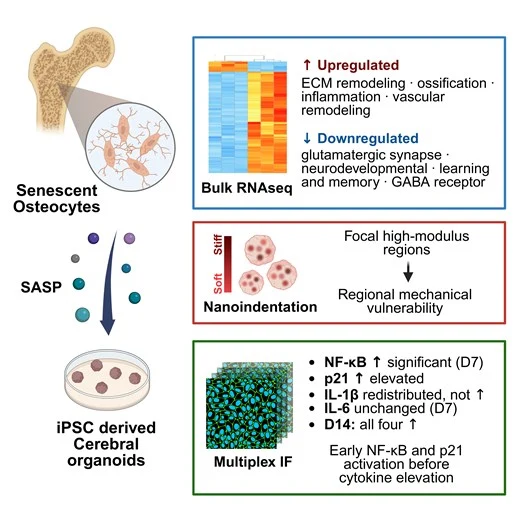
Aging is increasingly recognized as a systemic process, yet the mechanisms by which signals from senescent peripheral cells accelerate brain aging remain poorly defined. Here, we used chronic exposure of human cerebral organoids to the secretome of senescent osteocytes to investigate how peripheral aging signals from bone reshape brain tissue architecture. We combined spatially resolved optical fiber-based interferometry nanoindentation with transcriptomic and immunofluorescence profiling, revealing distinct mechanical features across complementary measurements, including lower apparent modulus in intact organoids and spatially localized regions of elevated modulus in cryosectioned specimens. This spatially heterogeneous biomechanical remodeling was accompanied by upregulation of extracellular matrix, inflammatory, and senescence pathways, and suppression of neurodevelopmental and synaptic gene networks. Our results suggest that chronic paracrine exposure to senescent osteocyte-derived secretome is associated with localized extracellular matrix-related remodeling and mechanical vulnerability in human brain tissue, providing insight into how peripheral cellular senescence may contribute to regional brain fragility during aging. These pilot-scale findings were obtained using a single iPSC line and a single conditioned-medium batch, with one to six experimental replicates per condition across assays; the mechanical analyses were exploratory.
- Senescent osteocyte-derived secretome
- Cellular senescence
- Extracellular matrix remodelling
- Apparent modulus
- Extracellular matrix, inflammatory, and senescence pathway expression
- Humans
The paper
The University of Texas at Austin
Stem Cells, 12 Oct 2026