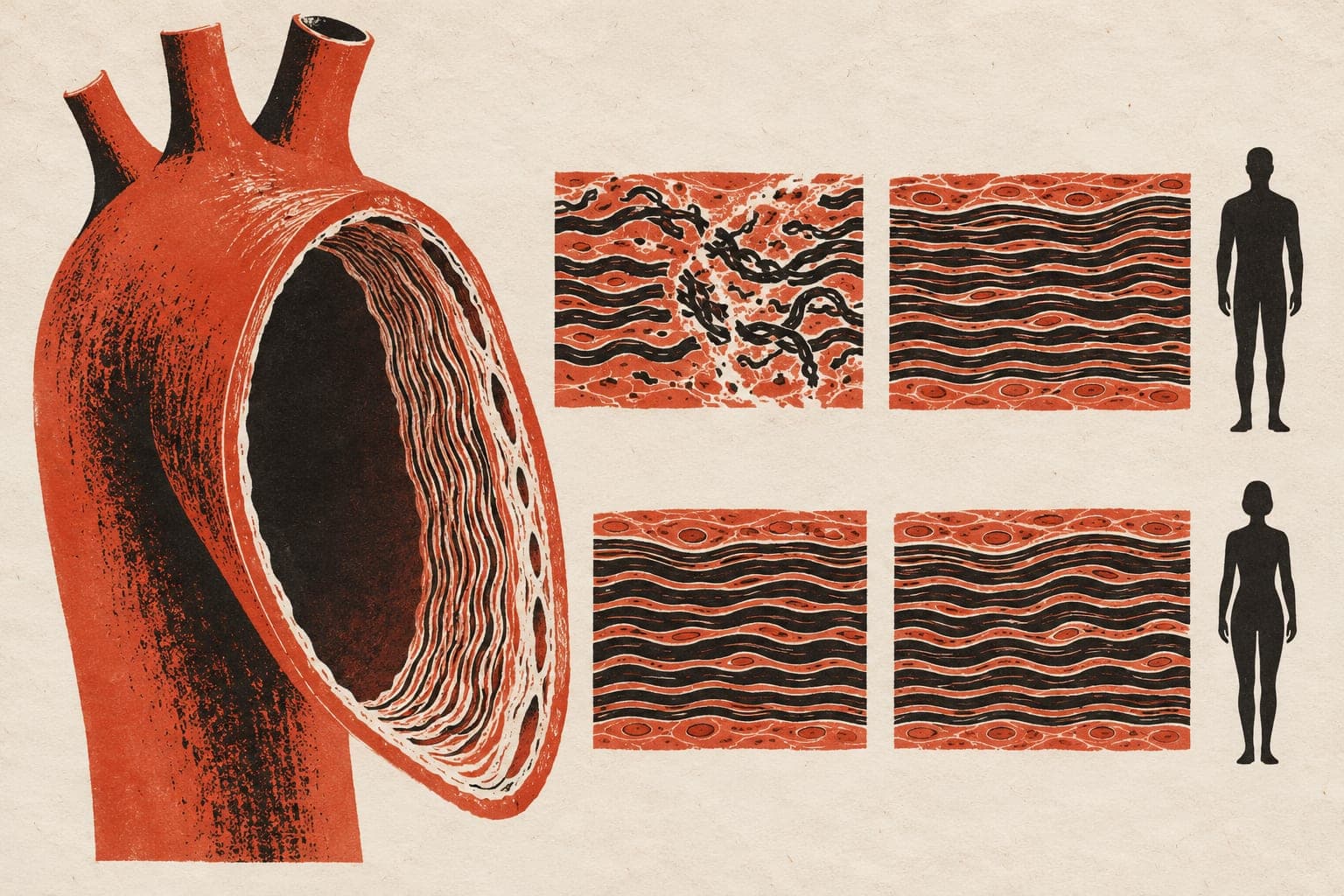
Support cells worsened disease features in lab-grown human vessels
Experiments with three-layer vessels built from human cells found that support cells increased several vascular disease features in a model of Hutchinson-Gilford progeria syndrome.
Science Advances
In lab-grown human blood vessel models, researchers tested how three cell types contributed to vascular disease in Hutchinson-Gilford progeria syndrome, an accelerated-aging disease. They built three-layer vessels using smooth muscle cells, which help vessels contract; endothelial cells, which line vessels; and fibroblasts, which make supporting tissue. They modelled atherosclerosis, the build-up of fatty deposits in arteries.
Fibroblasts carrying the progeria-associated mutation increased several disease features. Correcting the mutation with base editing, a technique for changing individual DNA letters, returned many disease characteristics to healthy levels. Experiments combining cells with and without the mutation linked fibroblasts to disrupted regulation of the material surrounding cells and signals promoting scar-like tissue. Smooth muscle cells contributed to accumulation of collagen, a protein that supports tissue. Vessel-lining cells contributed to inflammation.
Why it matters
Vascular disease in progeria raises questions about how different vessel cells contribute to damage during accelerated aging. The model could help researchers investigate disease mechanisms or identify possible treatments for other vascular diseases.
Caveats
The findings came from engineered vessels made from human cells in the lab, not from people with progeria.
The paper
Duke University
Science Advances · 7 Oct 2026