Lipoprotein(a) and Coronary Artery Disease Polygenic Risk Scores Do Not Improve Secondary Manifestations of Arterial Disease Score Prediction of Coronary Events After Ischemic Stroke
13.4 years
Abstract
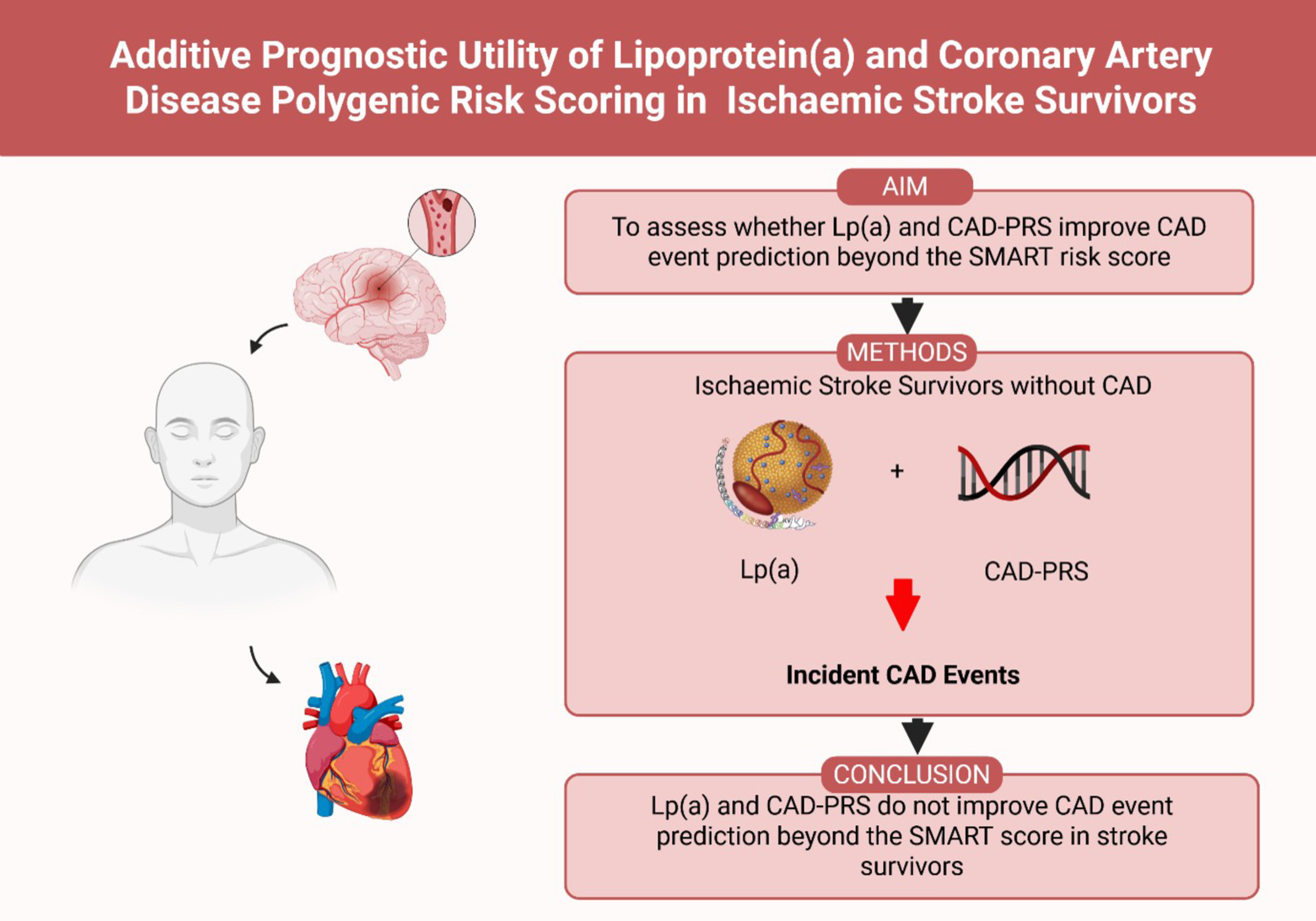
BACKGROUND: Survivors of ischemic stroke are at high risk for coronary artery disease (CAD), but individual risk varies. Lipoprotein(a) [Lp(a)] and CAD polygenic risk scores (CAD-PRS) improve risk prediction in primary prevention; however, their prognostic value after stroke remains uncertain. We assessed whether Lp(a) and CAD-PRS add predictive value to the Secondary Manifestations of Arterial Disease (SMART) secondary prevention score. METHODS: We analyzed 1202 UK Biobank participants of European ancestry with prior ischemic stroke and no CAD at baseline (2006-2022). Baseline clinical characteristics, Lp(a), and CAD-PRS were recorded. The primary outcome was incident CAD, identified from hospital, primary care, and death records. Competing-risk models compared SMART alone with SMART plus Lp(a), CAD-PRS, or both. Ten-year model performance was assessed using the area under the receiver operating characteristic curve and Brier score. Prespecified subgroup analyses examined age, sex, diabetes, and low-density lipoprotein cholesterol. RESULTS: During a median follow-up of 13.4 years, 155 participants (12.9%) developed CAD. SMART alone provided moderate discrimination (area under the receiver operating characteristic curve, 0.69 [95% CI, 0.64-0.75]) and a Brier score of 0.08. Adding Lp(a), CAD-PRS, or both did not improve prediction (change in area under the receiver operating characteristic curve, ≤0.002; all P>0.6; continuous net reclassification improvement, ≤0.03; all P>0.20). Results were consistent across subgroups, with no significant interactions after correction for multiple comparisons. CONCLUSIONS: Among survivors of ischemic stroke without CAD, neither Lp(a) nor CAD-PRS improved prediction of incident CAD beyond the SMART score. These findings do not support their incremental use for coronary risk stratification in this population.
The paper
Monash University Victorian Heart Institute 631 Blackburn Road Melbourne VIC Australia
Journal of the American Heart Association, 10 Oct 2026