Depression and sleep links to protein build-up varied by genetic risk
An observational study of 110 adults aged 65–88 with depression found separate, additive links to amyloid, a protein, only in carriers of a genetic variant.
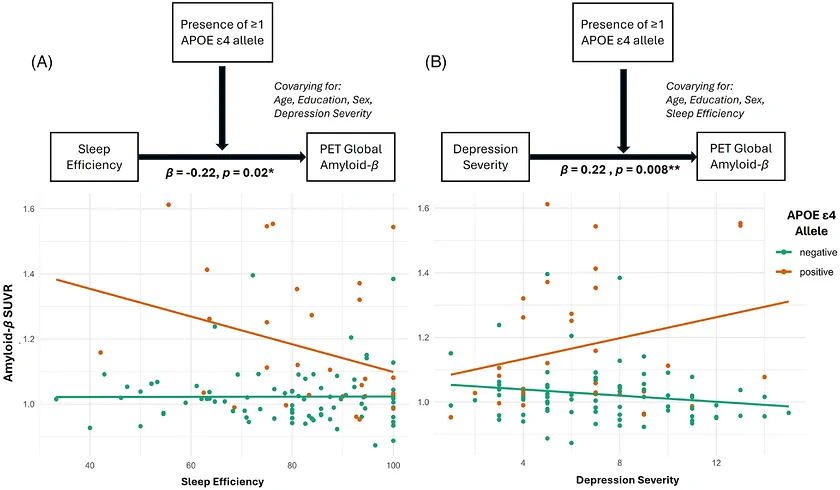
An observational study analysed 110 adults aged 65–88 with late-life depression; 66% were female. Researchers examined depression severity, sleep duration and sleep efficiency—the share of time in bed spent asleep—in relation to amyloid beta, a protein that can accumulate in the brain. They also assessed the ε4 variant of the apolipoprotein E gene, which is linked to Alzheimer’s risk.
Depression severity and both sleep measures had no direct association with amyloid burden. Only carriers of the variant showed links between more severe depression, lower sleep efficiency and greater amyloid burden. Both were also linked to a greater likelihood of reaching clinical cutoffs for a positive amyloid result. The depression and sleep-efficiency associations were separate and additive.
Why it matters
Late-life depression has been studied as a possible risk factor for Alzheimer’s disease. Genetic differences may partly explain why that evidence has been mixed.
Caveats
This observational study cannot show that depression or inefficient sleep caused amyloid build-up. Its findings came from 110 older adults with late-life depression.
From the paper
- Participants
We analyzed 110 older adults (ages 65–88, 66% female) with LLD to jointly model depression severity and sleep disturbance's relationship with Aβ, and to examine the moderating role of APOE ɛ4 genotype.
Quoted word for word from the full text on alz-journals.onlinelibrary.wiley.com.
The paper
Department of Psychiatry and Behavioral Sciences University of California
Alzheimer's & Dementia, 9 Oct 2026