Hidden metabolic obesity phenotypes and risk of incident type 2 diabetes among BMI-defined non-obese adults: a secondary analysis of the NAGALA cohort
Dose-response
Abstract
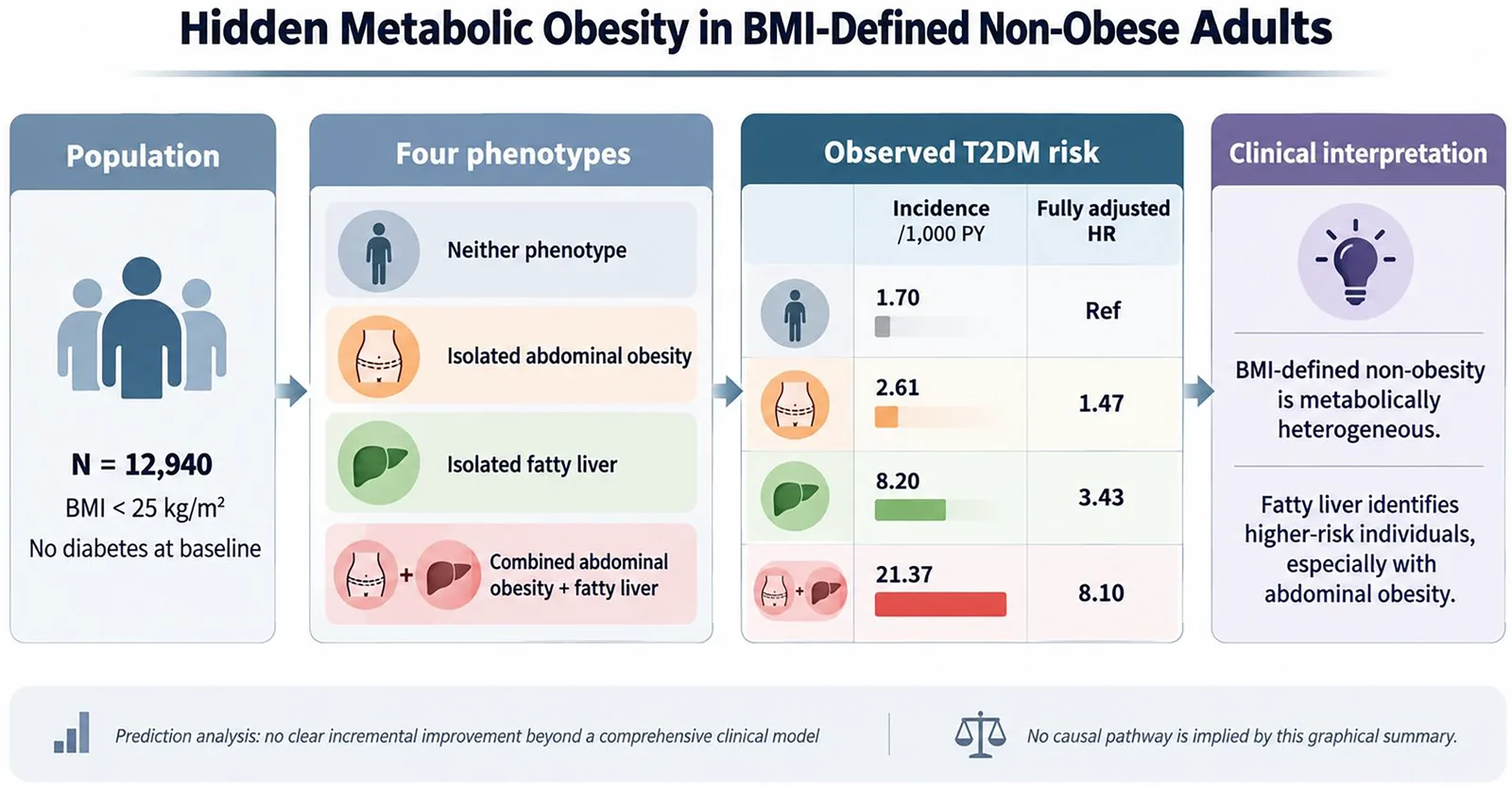
BACKGROUND: Body mass index (BMI) may fail to capture clinically relevant heterogeneity in adiposity-related diabetes risk, particularly among Asian adults who are not classified as obese. We investigated whether abdominal obesity and fatty liver identify distinct risks of incident type 2 diabetes mellitus (T2DM) among adults with BMI <25 kg/m². METHODS: This secondary analysis used data from the Japanese NAGALA cohort. A total of 12,940 adults without diabetes at baseline and with BMI <25 kg/m² were classified into four phenotypes: neither abdominal obesity nor fatty liver, isolated abdominal obesity, isolated fatty liver, and combined abdominal obesity and fatty liver. Cox proportional hazards models were used to estimate hazard ratios (HRs) for incident T2DM. We additionally assessed adiposity-component burden, multiplicative and additive interaction, sex-specific associations, multiple sensitivity analyses, and incremental 5-year predictive performance. RESULTS: During 78,694.5 person-years of follow-up, 201 incident T2DM events occurred. Incidence rates were 1.70, 2.61, 8.20, and 21.37 per 1,000 person-years across the four phenotypes, respectively. In the fully adjusted model, isolated abdominal obesity was not significantly associated with T2DM (HR 1.47, 95% CI 0.66-3.31), whereas isolated fatty liver (HR 3.43, 95% CI 2.41-4.87) and combined abdominal obesity and fatty liver (HR 8.10, 95% CI 4.65-14.12) were strongly associated with higher risk. Risk increased progressively with the number of non-BMI adiposity components (P for trend <0.001). Associations with fatty liver were observed in both sexes, with no clear evidence of effect modification by sex (P for interaction=0.176), and remained robust in sensitivity analyses, including restriction to BMI <23 kg/m². Adding abdominal obesity, fatty liver, or the four-level phenotype to a comprehensive clinical model did not clearly improve 5-year predictive performance. CONCLUSIONS: Among BMI-defined non-obese adults, fatty liver-especially when accompanied by abdominal obesity-identified substantial heterogeneity in incident T2DM risk. These findings highlight the limitations of BMI alone for characterizing adiposity-related metabolic risk, while not establishing incremental predictive utility beyond established clinical risk factors.
From the paper
- Participants
Among 12,940 BMI-defined non-obese participants included in the primary analysis, 11,102 had neither abdominal obesity nor fatty liver, 501 had isolated abdominal obesity, 1,196 had isolated fatty liver, and 141 had combined abdominal obesity and fatty liver.
Results, 3.1 Baseline characteristics according to hidden metabolic obesity phenotypes
- Result
In Model 1 adjusted for age and sex, isolated abdominal obesity was associated with a higher but non-significant risk of incident diabetes compared with participants with neither abdominal obesity nor fatty liver [HR 1.78, 95% CI 0.82–3.89; P = 0.147].
Results, 3.3 Associations of hidden metabolic obesity phenotypes with incident type 2 diabetes
- Limitation
First, as a secondary analysis of observational data, residual confounding cannot be fully excluded despite multivariable adjustment.
Quoted word for word from the full text on frontiersin.org.
The paper
Fujian University of Traditional Chinese Medicine
Frontiers in Endocrinology, 25 Sep 2026


