East Asian GWAS reveals shared and distinct diabetes pathways
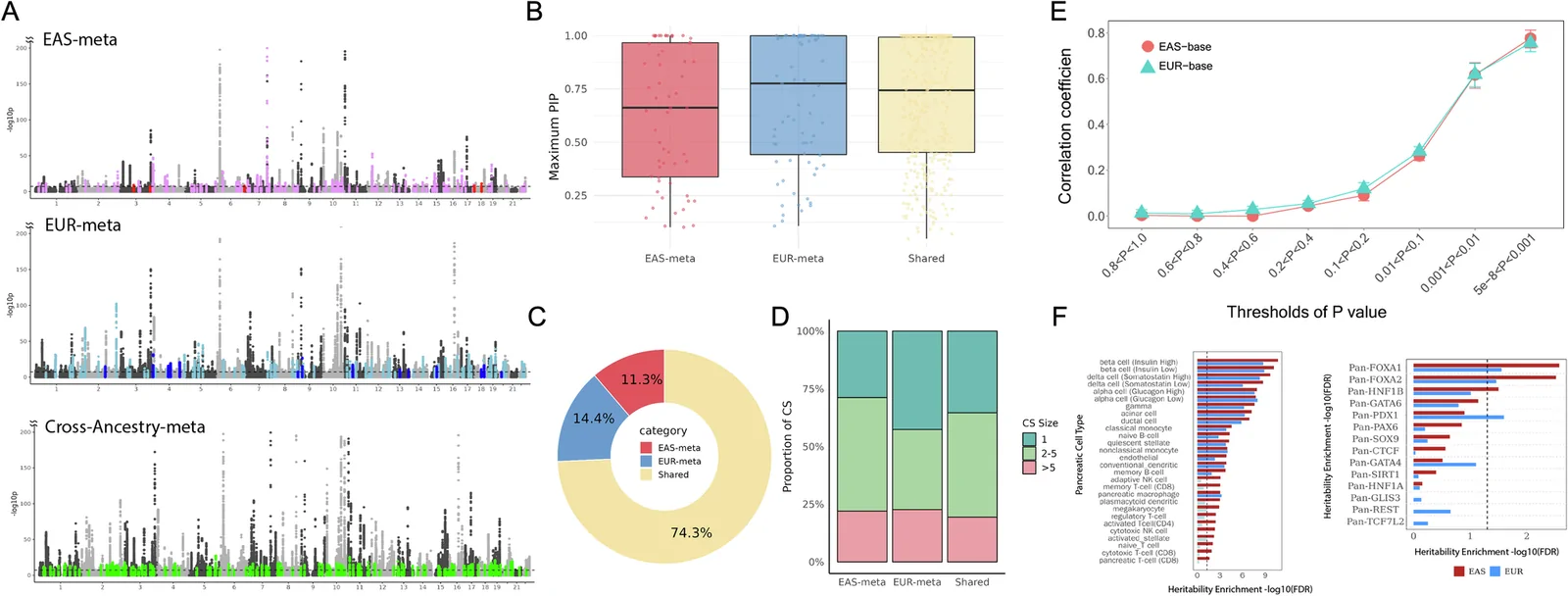
In nearly 600,000 individuals, multi-ancestry fine-mapping resolved 521 causal signals for type 2 diabetes, with 74% shared between East Asian and European ancestries.
Our read
Biomarkers- Studied:
- Genetic association study of 596,778 people
- In the record:
- The 172nd paper on polygenic risk score with results in people; 489 on record in all. Its result on Type 2 diabetes agrees with all 8 other findings on record.
Editor of record: Boris Djordjevic · AgingResearch.News
In a study of 596,778 individuals of East Asian ancestry, researchers evaluated the genetic architecture of type 2 diabetes and compared it directly to a European cohort of comparable size. The genome-wide association study identified 196 loci, including three previously unreported loci.
Subsequent multi-ancestry fine-mapping resolved 521 independent causal signals with high precision. The researchers found that 74% of these signals are shared across ancestries, while the remainder are strictly ancestry-specific. Beyond this shared genetic structure, the team observed population differences in regulatory and pathway-level contributions, particularly involving pancreatic regulation and lipid- or adipose-related pathways. Finally, a polygenic risk score constructed from cross-ancestry meta-analysis yielded the most robust predictive performance, achieving an area under the curve of 0.788.
Why it matters
Type 2 diabetes is a major driver of age-related metabolic dysfunction and chronic disease. Pinpointing both shared and ancestry-specific biological pathways helps explain how metabolic risk factors differ across diverse human populations.
Caveats
The findings are observational and derived specifically from East Asian and European cohorts, which limits direct generalization to other ancestral backgrounds. Functional experiments are still required to confirm the precise biological mechanisms of the mapped causal variants.
From the paper
- Participants
In summary, the Japanese cohort comprised 1488 cases and 9044 controls, sourced from Shizuoka General Hospital (SGH) and the National Center for Geriatrics and Gerontology (NCGG), with an average age of 69.0 ± 13.8 and a proportion of 52.0% females.
- Result
The cross-ancestry PRS showed the strongest risk stratification: individuals in the highest decile (90th–100th percentile) had a markedly increased risk of T2D (OR = 3.52; 95% CI, 3.18–3.90), slightly exceeding that observed for the East Asian–only PRS (OR = 3.46; 95% CI, 3.13–3.82).
Results, Comparative performance of Polygenic Risk Scores (PRS)
- Limitation
First, we focused only on EAS and EUR populations, leaving open the question of whether these findings are generalizable to other population groups, especially groups with high T2D burdens, such as South Asians.
Quoted word for word from the full text on PubMed Central.
The paper
Keio University; Fujita Health University
Communications Biology, Sep 30, 2026, Open access


Comments
Be the first to comment.