Urine dipstick test for assessing albumin-to-creatinine ratio: a pilot study and the potential impact on chronic kidney disease screening
Abstract
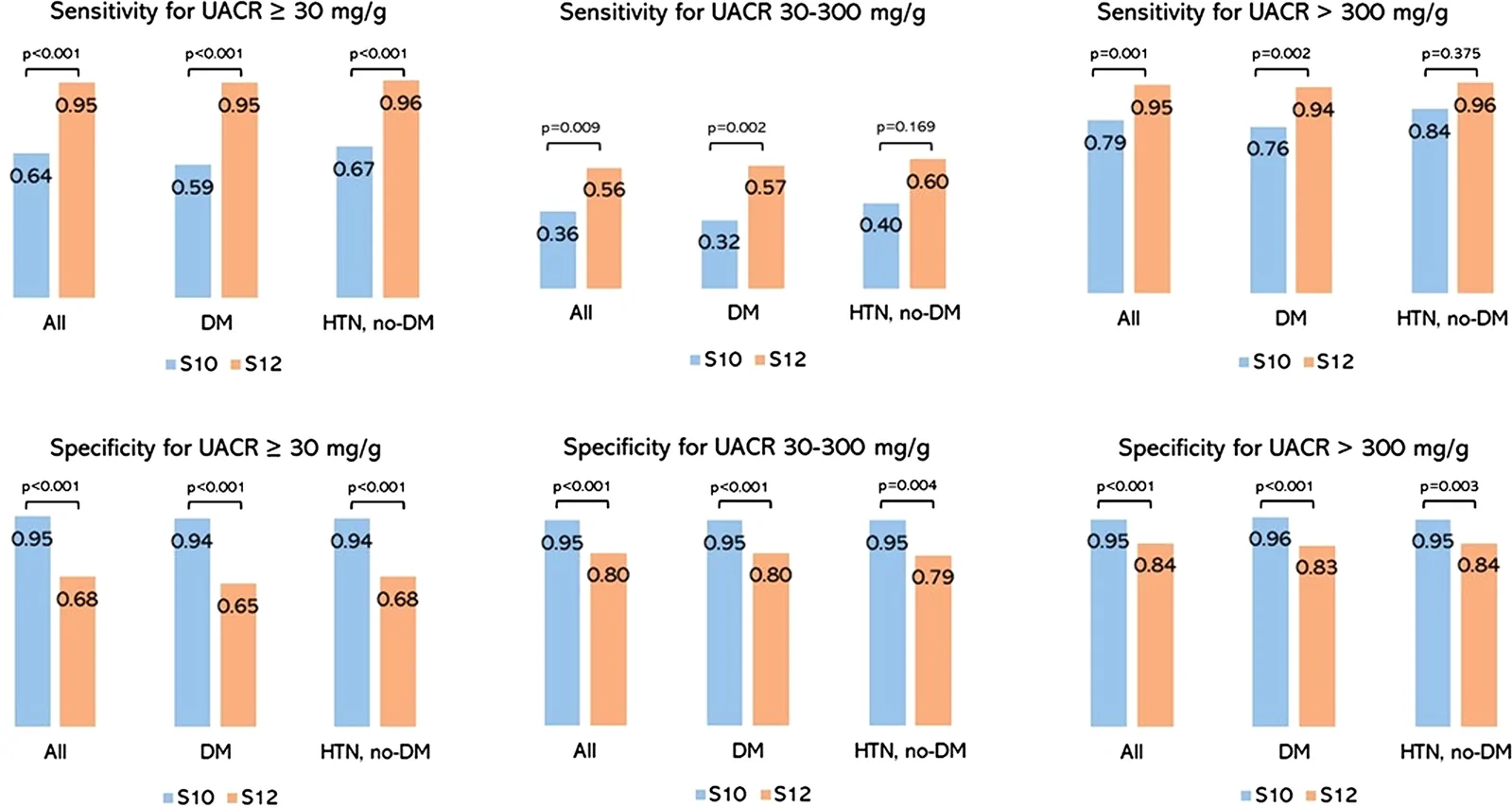
BACKGROUND: The objectives of this study were to compare the sensitivity of two urine dipstick tests commercially available for detecting proteinuria and to project the potential impact of replacing one with the other for chronic kidney disease (CKD) screening in a large Brazilian health insurance company. METHODS: Urine spot tests were prospectively collected from a convenience sample of 410 adults with ≥ 1 CKD risk factor from a specialized outpatient clinic. Proteinuria was assessed by three methods: (1) total protein strip ("S10", the method currently used); (2) albumin-to-creatinine ratio strip ("S12", the index test), and (3) quantitative measurement of albumin-to-creatinine ratio (UACR, the standard reference test). The UACR measurements were categorized into three severity levels, in accordance with current guidelines: mild (< 30 mg/g), moderate (30-300 mg/g), and severe (> 300 mg/g). To project the potential impact of replacing S10 with S12, the one-year amount of ambulatory routine urinalysis tests was assessed. RESULTS: Out of 410 study participants, 200 had quantitative UACR ≥ 30 mg/g. S12 showed greater sensitivity than S10 for detecting UACR ≥ 30 mg/g (95% [95%CI: 92-98%] vs. 64% [95%CI: 57-71%], p < 0.001), UACR 30-300 mg/g (56% [95%CI: 47-65%] vs. 36% [95%CI: 27-45%], p = 0.009), and UACR > 300 mg/g (95% [95%CI: 90-100%] vs. 79% [95%CI: 70-88%], p = 0.001). Considering the 777,096 routine urinalysis performed within the private health insurance and the prevalence of the main CKD risk factors in Brazilian population, replacing S10 with S12 would reduce the number of false negatives individuals with UACR ≥ 30 mg/g, UACR 30-300 mg/g, and UACR > 300 mg/g by 12,045 (86%), 6,217 (31%), and 1,243 (76%), respectively. CONCLUSION: This diagnostic accuracy pilot study revealed that the albumin/creatinine urine dipstick had higher sensitivity than the total protein strip currently used by a private health insurance provider. The projection impact of replacing one with another suggests a significant reduction of undiagnosed cases. Further studies in representative screening populations are warranted to determine whether its implementation improves CKD detection in clinical practice.
- Albumin-to-creatinine ratio strip
- Chronic kidney disease
- Proteinuria
- Urinary albumin-to-creatinine ratio
- Urinary total protein
- Humans
The paper
Instituto Dante Pazzanese de Cardiologia; Universidade Federal de São Paulo
BMC Nephrology, 3 Sep 2026