Baicalein reduces disuse-driven skeletal senescence and alters gut microbes in rats
Oral treatment restored bone density and mechanical strength while suppressing inflammatory markers and rebalancing intestinal bacteria in a disuse model.
Our read
Interventions- Studied:
- Experiments in rats (4 weeks)
- In the record:
- One of 30 papers on baicalein on record: 4 with results in people, 15 in animals. Its result on cellular senescence agrees with 3 of 4 other findings on record; 1 points the other way.
Editor of record: Boris Djordjevic · AgingResearch.News
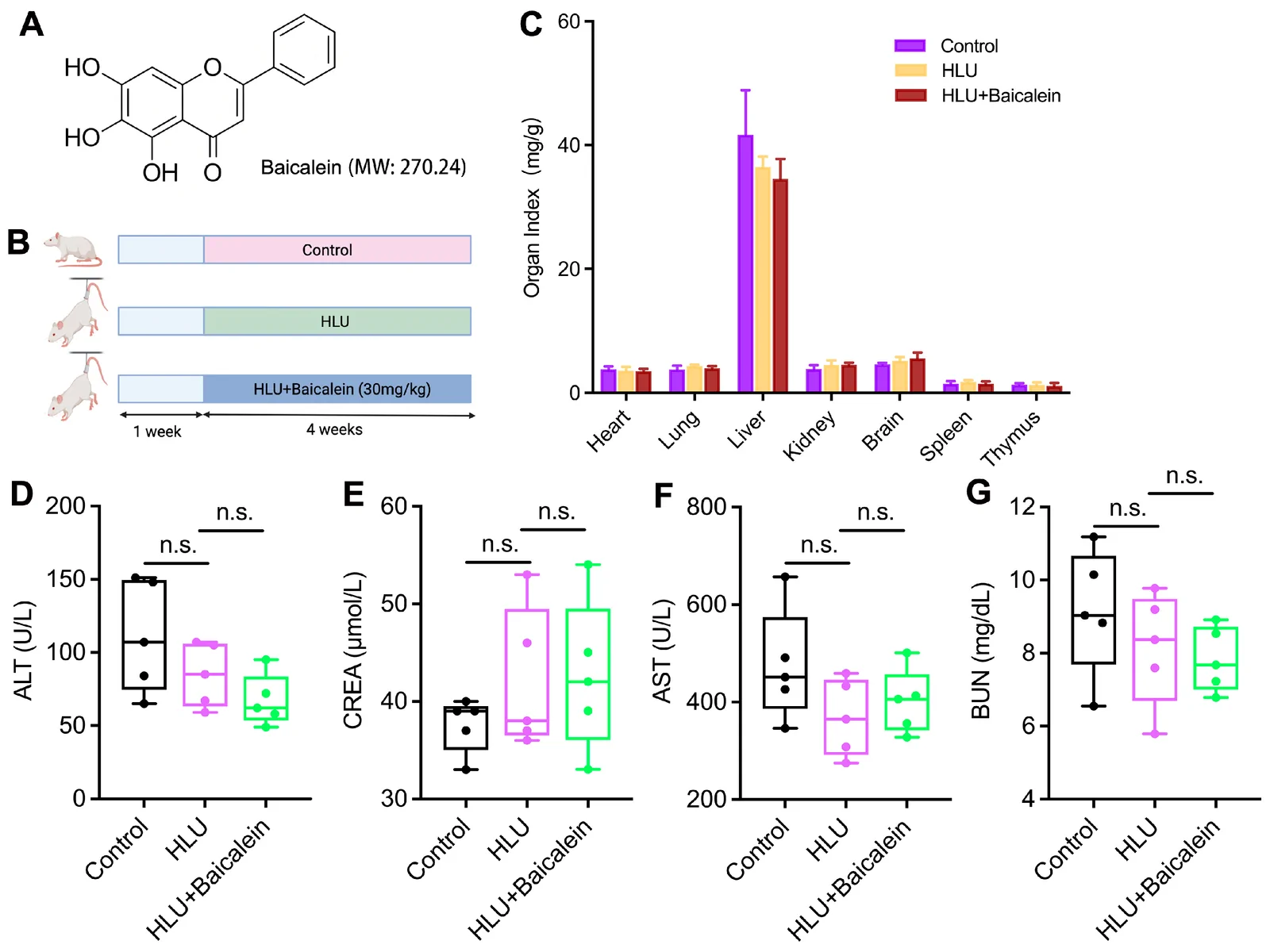
In a hind limb unloading rat model simulating disuse, researchers administered baicalein by gavage at 30 mg per kilogram daily for four weeks. The treatment mitigated skeletal aging, increasing bone mineral density by 1.20-fold, trabecular number by 38.04 percent, bone mineral apposition rate by 42.76 percent, and biomechanical ultimate load by 31.64 percent. Baicalein also lowered tibial senescence markers p16, p21, and p53, while attenuating high bone turnover markers in serum. In addition, the flavonoid decreased pro-inflammatory cytokines, raised anti-inflammatory factors, and shifted the gut microbiota by reducing Proteobacteria and increasing Actinobacteria and Firmicutes.
Why it matters
Mechanical disuse accelerates skeletal senescence and bone deterioration, presenting challenges in long-term immobility and spaceflight. Linking microbiome remodeling to lower bone senescence and inflammation supports the gut-bone axis as a target for protecting skeletal homeostasis.
Caveats
The findings are limited to a rodent model of mechanical unloading, meaning efficacy and safety cannot yet be assumed in humans. Additionally, the data do not establish whether gut microbiota alterations directly caused the observed improvements in bone tissue.
From the paper
- Events by group
HLU led to a notable rise in Proteobacteria abundance when compared with the control group (16.35% vs. 63.88%, p < 0.01).
Results, 2.8. Baicalein Ameliorated the Composition of the Intestinal Flora in HLU-Induced Rats
Quoted word for word from the full text on PubMed Central.
The paper
Baicalein Attenuates Disuse-Driven Skeletal Senescence in Association with Gut Microbiota Modulation
Northwestern Polytechnical University
Molecules, Sep 20, 2026, Open access, CC BY


Comments
Be the first to comment.