Gastrodia elata polysaccharide extends worm lifespan and mitigates age-related deficits in mice
The treatment reduced oxidative stress, suppressed inflammation, and remodeled the gut microbiome in naturally aging mice while prolonging survival in nematodes.
Food Science & Nutrition
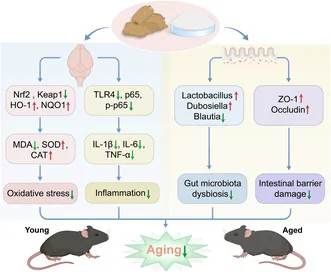
Researchers evaluated Gastrodia elata polysaccharide in BV2 microglia, Caenorhabditis elegans, and naturally aging mice. In cell models, the polysaccharide relieved d-galactose-induced senescence. It also extended the lifespan of nematodes. In naturally aging mice, the treatment ameliorated cognitive impairment, muscle dysfunction, and hippocampal neuronal damage while elevating neuroprotective BDNF levels. The compound reduced malondialdehyde, increased superoxide dismutase and catalase activities, and activated Nrf2/Keap1 antioxidant signaling. It also lowered pro-inflammatory markers TNF-α, IL-1β, and IL-6 in serum and brain tissue while inactivating TLR4/NF-κB signaling. In the gut, the polysaccharide restored microbial diversity, enriched Akkermansia and Lactobacillus, and elevated tight junction proteins ZO-1 and occludin.
Why it matters
The findings demonstrate that targeting multiple hallmarks—such as oxidative imbalance, chronic inflammation, and gut dysbiosis—with bioactive macromolecules can support healthy aging in preclinical models.
Caveats
These results come from cell and animal models rather than humans. Additionally, the researchers did not perform fecal microbiota transplantation to confirm whether the altered gut bacteria directly caused the observed improvements.
The paper
Zhaotong University
Food Science & Nutrition · 30 Sep 2026