Diet-related blood proteins are linked to Alzheimer's risk
Higher scores on a brain-healthy diet were associated with lower odds of Alzheimer's disease, with an odds ratio of 0.75, in 206 participants.
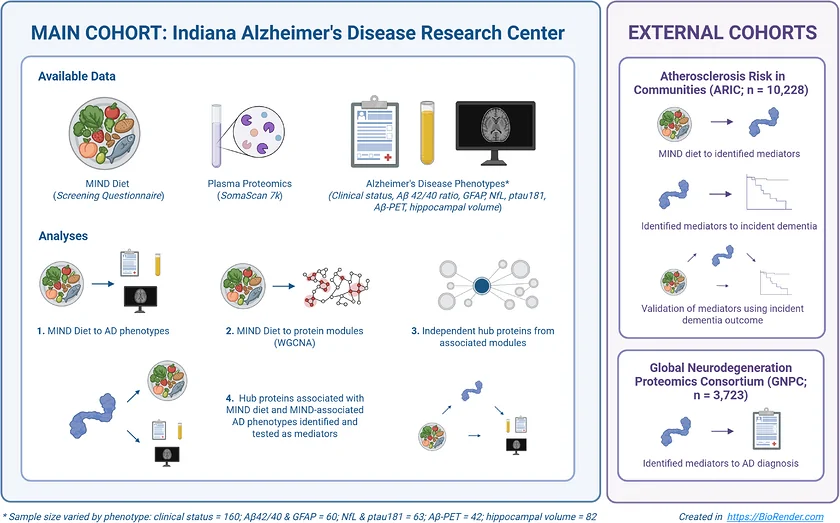
In an observational study of 206 people at the Indiana Alzheimer's Disease Research Center, researchers analysed blood plasma proteins to investigate how the MIND diet relates to dementia risk. Higher MIND diet scores were associated with lower odds of Alzheimer's disease, with an odds ratio of 0.75, and lower levels of neurofilament light chain, a marker of nerve damage. Two proteins, MCTS1 and cytidylate kinase, were associated with both MIND diet scores and Alzheimer's disease risk, and may mediate this relationship. Validation analyses in two separate groups of 10,228 and 3,723 people supported the finding for MCTS1. The authors noted that vascular-related biological mechanisms may underlie associations between diet and dementia risk.
Why it matters
Alzheimer's disease is an age-related neurodegenerative condition, and understanding how dietary patterns relate to circulating proteins bears on how lifestyle factors are linked to the aging brain. Identifying specific blood proteins associated with diet could help clarify biological pathways related to dementia risk.
Caveats
The findings come from observational data, which cannot determine whether dietary habits or the identified proteins alter dementia risk. In addition, the initial network was analysed in a cohort of 206 participants.
From the paper
- Participants
… individuals were excluded based on the criteria outlined in Figure S1 in supporting information and the final analytic sample included 10,228 participants from this cohort with available proteomics, MIND diet …
- Follow-up
Further, Cox proportional hazard analysis in the ARIC cohort found that baseline abundance of MCTS1 predicted incident dementia over a median follow-up of 21 years (hazard ratio = 1.059 [1.016, 1.104]; p = 0.007; Table S22 in supporting information).
Results, 3.6.2 MCTS1 as a mediator of the relationship between MIND diet and AD diagnosis
- Result
Higher MIND diet scores were associated with lower odds of AD diagnosis (odds ratio [OR: CU vs. AD] = 0.75 [95% confidence interval [CI] = 0.60, 0.93] …
Results, 3.2 Association of MIND diet with AD diagnosis and AD biomarkers
- Limitation
Dietary intake was assessed using different scales across the IADRC and ARIC cohorts, both of which were self-reported and therefore subject to recall bias and measurement error particularly in individuals with cognitive impairment.
Quoted word for word from the full text on alz-journals.onlinelibrary.wiley.com.
The paper
MIND diet-related plasma proteins are associated with Alzheimer's disease risk
Indiana University Indianapolis
Alzheimer's & Dementia, 1 Oct 2026, Open access


