Incidence and Predictors of Hyperglycemia Among Adults Receiving Dolutegravir-Based Antiretroviral Therapy at Mbarara Regional Referral Hospital HIV Clinic, Uganda: A Retrospective Cohort Study
Abstract
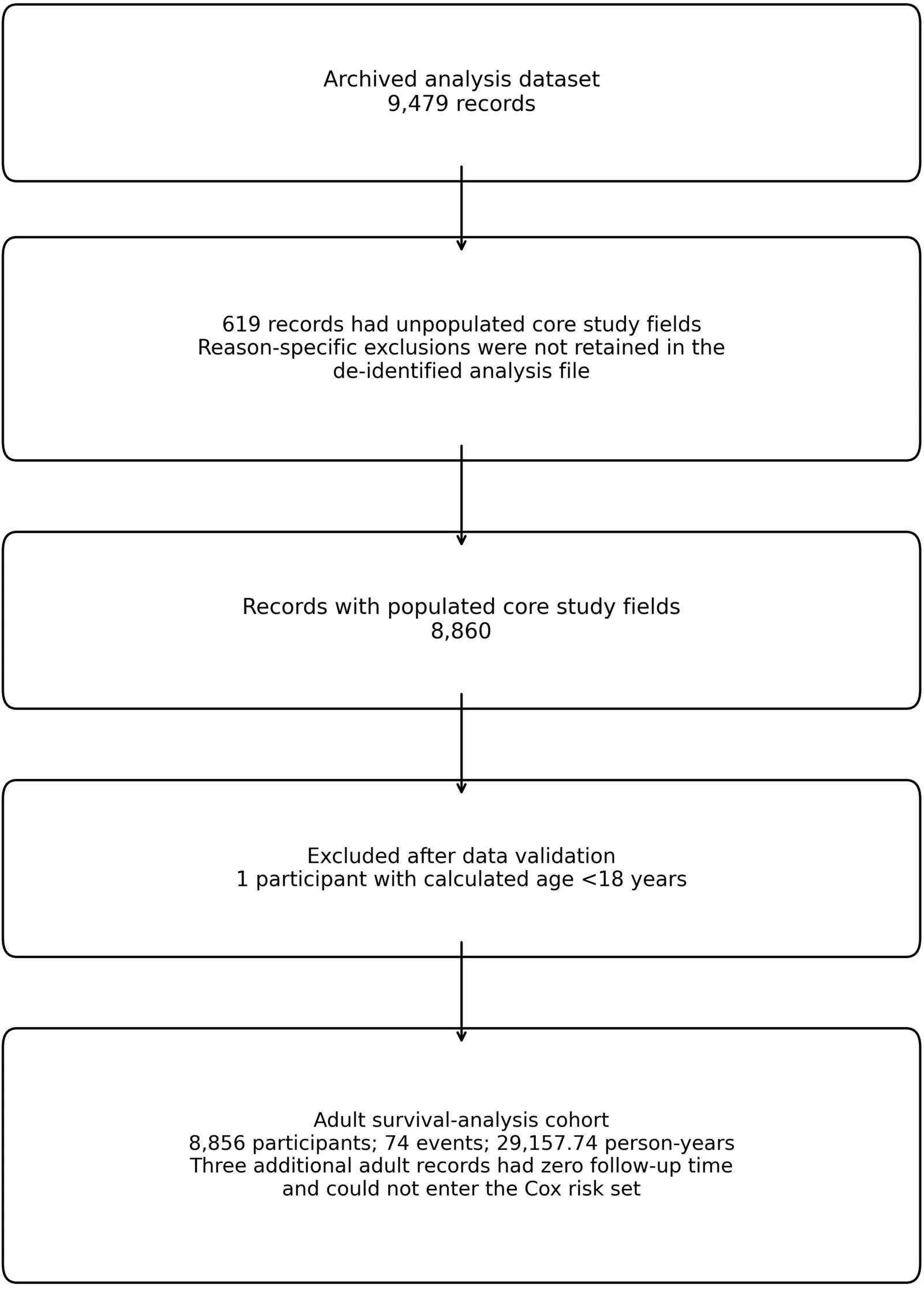
BACKGROUND: Dolutegravir (DTG)-based antiretroviral therapy is widely used in sub-Saharan Africa, but routine-care evidence on incident hyperglycemia after DTG initiation or substitution remains limited in southwestern Uganda. PURPOSE: To determine the incidence and predictors of documented hyperglycemia among adults receiving DTG-based antiretroviral therapy at Mbarara Regional Referral Hospital. PATIENTS AND METHODS: We conducted a retrospective cohort study using routine clinical records of adults who initiated or switched to DTG-based ART between 1 January 2019 and 31 December 2023. Documented incident hyperglycemia was defined as fasting glucose ≥7.0 mmol/L or random glucose ≥11.1 mmol/L with documented classic symptoms. Cox proportional hazards regression estimated adjusted hazard ratios (aHRs); age was modeled per 10-year increase. The proportional-hazards assumption was assessed using Schoenfeld residuals. RESULTS: Of 8,859 adults in the descriptive cohort, 8,856 contributed positive follow-up time. Seventy-four documented hyperglycemia events occurred over 29,157.74 person-years, an incidence rate of 2.54 per 1,000 person-years (95% CI 1.99-3.19). The smoothed hazard increased after DTG initiation/substitution, peaked at approximately 1.1 years, and declined thereafter. Higher hazard was associated with older age (per 10 years: aHR 1.70, 95% CI 1.33-2.18), prior thymidine analogue NRTI exposure (aHR 3.27, 95% CI 1.20-8.89), and ≥15 years of ART before DTG (aHR 5.63, 95% CI 1.39-22.77). The global proportional-hazards test was not significant (p=0.70). CONCLUSION: Documented hyperglycemia was uncommon but was associated with older age and markers of long-term ART exposure. Risk-stratified glucose monitoring should be considered, particularly during the first year after DTG initiation/substitution and among higher-risk patients.
From the paper
- Participants
The final adult descriptive cohort included 8,859 participants.
- Result
In the multivariable Cox model, each 10-year increase in age was associated with a 70% higher hazard of documented hyperglycemia (aHR 1.70, 95% CI 1.33–2.18; p<0.001).
- Limitation
First, glucose testing was not protocolized, and the archived analysis file did not retain repeated glucose-test records or assay-method fields; testing frequency could therefore not be quantified, creating potential outcome under-ascertainment and detection bias.
Quoted word for word from the full text on dovepress.com.
- Dolutegravir
- Antiretroviral therapy
- Thymidine analogue nucleoside reverse transcriptase inhibitors
- Hyperglycemia
- HIV infection
- Humans
The paper
Mbarara University of Science and Technology
HIV/AIDS, 2 Oct 2026, Open access


