Older adults with muscle weakness had less steady force
A measure of force variability rose about 35% when adults with muscle weakness subtracted numbers during ankle contractions, compared with the muscle task alone.
Non-randomised trial, declared no competing interests
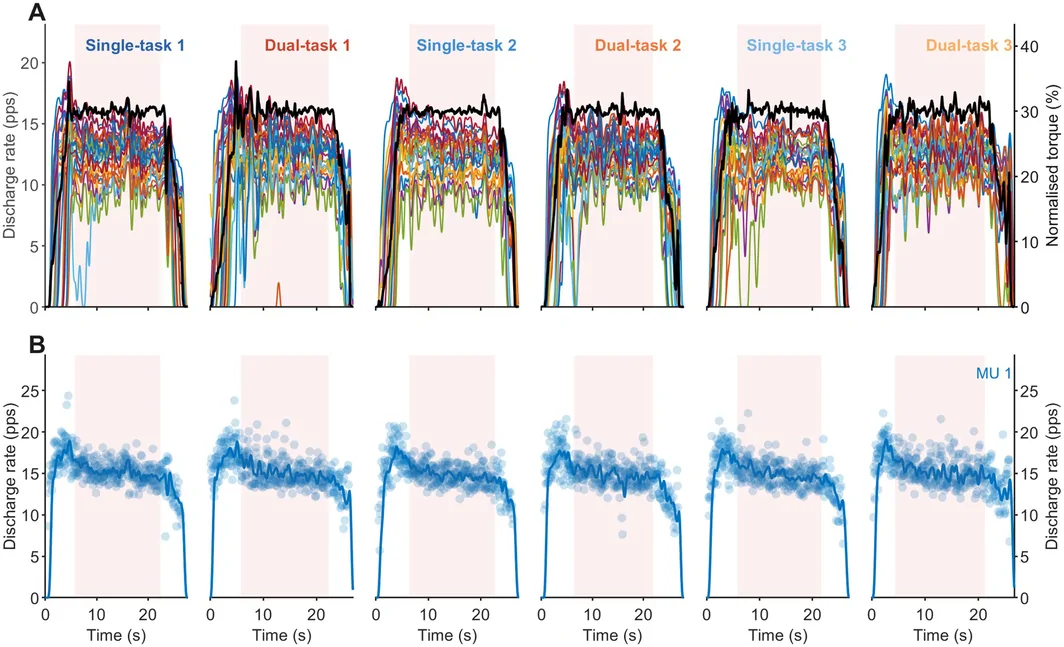
In an observational study, 11 older adults with sarcopenia, 22 adults without it and 19 older athletes performed ankle contractions. Participants averaged 74.3 years of age; half were female. Researchers defined sarcopenia, a condition involving muscle weakness, by low grip strength and slow walking speed. Participants held contractions at 30% of their maximum turning force, either while subtracting numbers or without a mental task. Electrical recordings from muscles allowed researchers to assess the timing of signals activating muscle fibres.
The sarcopenia group produced less steady force than both comparison groups during both tasks. Their force variability rose about 35% when they also subtracted numbers. The intervals between signals activating muscle fibres became more variable in this group during the combined task. That timing measure stayed unchanged in controls and became less variable in athletes.
Why it matters
Sarcopenia is associated with impaired physical function in older age. The findings support expanding muscle-centric views of the condition to include neural mechanisms when studying how to preserve mobility.
Caveats
The observational group comparison cannot establish that sarcopenia caused the differences in control. Only 11 participants had sarcopenia, and the researchers measured performance during a specific laboratory task.
From the paper
- Result
There was no main effect of condition on plateau torque [β = −0.01% MVT, 95% CI (−0.18, 0.16), t = −0.08], or group × condition interaction [β = −0.01% MVT, 95% CI (−0.24, 0.22), t = −0.07].
Results, 3.2 Torque and High-Density Electromyography Outcomes
- Limitation
Second, the sarcopenic group was relatively small, which limits precision and warrants caution when interpreting interaction-heavy analyses, particularly for coherence outcomes.
Quoted word for word from the full text on onlinelibrary.wiley.com.
The paper
Dual-Tasking Exacerbates Force and Neural Control Unsteadiness in Older Adults With Sarcopenia
Deakin University
Journal of Cachexia, Sarcopenia and Muscle, 1 Oct 2026, Open access