Ferroptosis inducers shorten lifespan in fruitflies
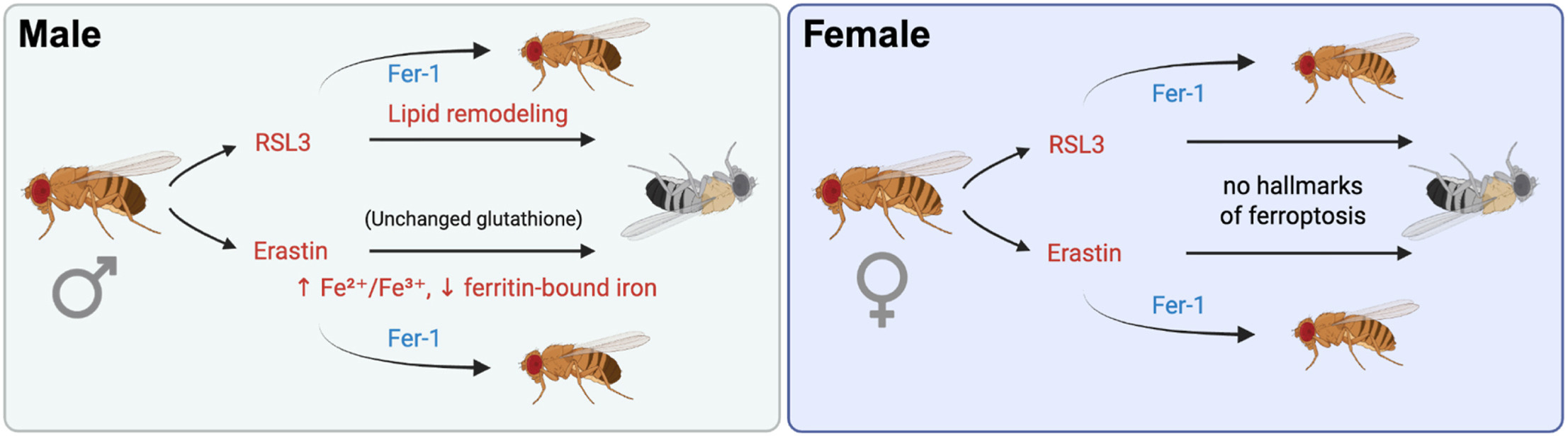
Erastin and RSL3 shortened survival dose-dependently, an effect rescued by ferrostatin-1, while altering iron and lipid profiles selectively in males.
Redox Biology
Researchers investigated whether the fruitfly Drosophila melanogaster could serve as an in vivo model for ferroptosis by testing the effects of erastin and RSL3 on lifespan, iron metabolism, and lipids. Both compounds dose- and diet-dependently shortened lifespan in both sexes, an effect rescued by ferrostatin-1. In male w1118 flies, erastin increased the Fe2+/Fe3+ ratio and reduced ferritin-bound iron, while RSL3 remodeled lipid composition consistent with lipid peroxidation. Neither iron nor lipid changes occurred in females despite their reduced lifespan. Erastin left total glutathione unchanged. Additionally, complete knockout of the fly GPX4 ortholog Gtpx caused early lethality that was not rescued by ferrostatin-1.
Why it matters
Clarifying how iron-dependent cell death pathways operate in whole organisms may help untangle how iron handling and lipid peroxidation contribute to aging biology across species.
Caveats
Hallmark iron and lipid changes were restricted to male w1118 flies, and fruitflies lack a clearly defined xCT ortholog. Furthermore, the fly GPX4 counterpart uses thioredoxin rather than glutathione, and its lethal deletion was not rescued by ferrostatin-1.
The paper
The fruitfly Drosophila melanogaster as an in vivo model of ferroptosis
Show 6 more authors
Yasminn Akele, Bernhard Michalke, Konstantin Beckschäfer, Christoph Thiele, Eva-Maria Hanschmann, Vivek Venkataramani,Johannes Gutenberg University Mainz
Redox Biology · 28 Sep 2026