Alternate-day fasting curbs liver fibrosis in mice
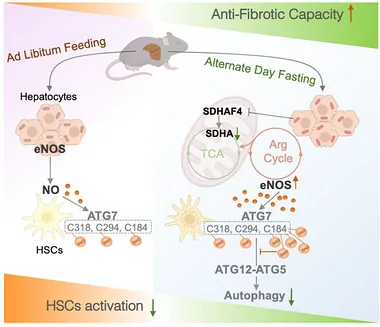
In mouse models, alternate-day fasting stimulated hepatocyte nitric oxide production to suppress stellate cell activation, an effect abolished by hepatocyte eNOS deletion.
Advanced Science
In mouse models and human fibrotic liver samples, researchers found that eNOS expression was markedly suppressed during liver fibrosis. Deleting eNOS specifically in mouse hepatocytes aggravated liver injury and fibrosis. When mice underwent alternate-day fasting, hepatocyte eNOS expression increased, helping restrain hepatic stellate cell activation and fibrotic progression. However, deleting hepatocyte eNOS abolished these protective metabolic and anti-fibrotic effects of fasting. Mechanistically, fasting downregulated the mitochondrial chaperone SDHAF4 in hepatocytes, suspending complex II assembly and promoting nitric oxide production. This nitric oxide acted on hepatic stellate cells to induce S-nitrosylation of ATG7 at cysteine 184, which constrained autophagic flux and prevented stellate cell transdifferentiation.
Why it matters
Intermittent fasting regimens are widely studied for healthy aging, but their tissue-specific anti-fibrotic mechanisms remain incompletely mapped. This work suggests a dietary intervention may help preserve organ integrity by coupling hepatocyte mitochondrial signaling to stellate cell autophagy.
Caveats
The mechanistic signaling pathway and dietary fasting interventions were tested in mouse models rather than clinical trials. Although human liver samples showed suppressed eNOS during fibrosis, whether alternate-day fasting triggers the same signaling cascade in patients remains to be seen.
The paper
Show 14 more authors
Yuhan Gou, Zhaode Feng, Weiqiang Lv, Chaoying Yan, Hansen Wu, Pengfei Zhang, Jie Xu, Ke Cao, Hao Li, Mingge Ding, Zhongbo Liu, Xing Zhang, Jiankang Liu, Xuan Zou,Second Affiliated Hospital of Xi'an Jiaotong University
Advanced Science · 27 Sep 2026 · CC BY