Routine versus standardized blood pressure measurements: Agreement and association with cardiovascular disease
Abstract
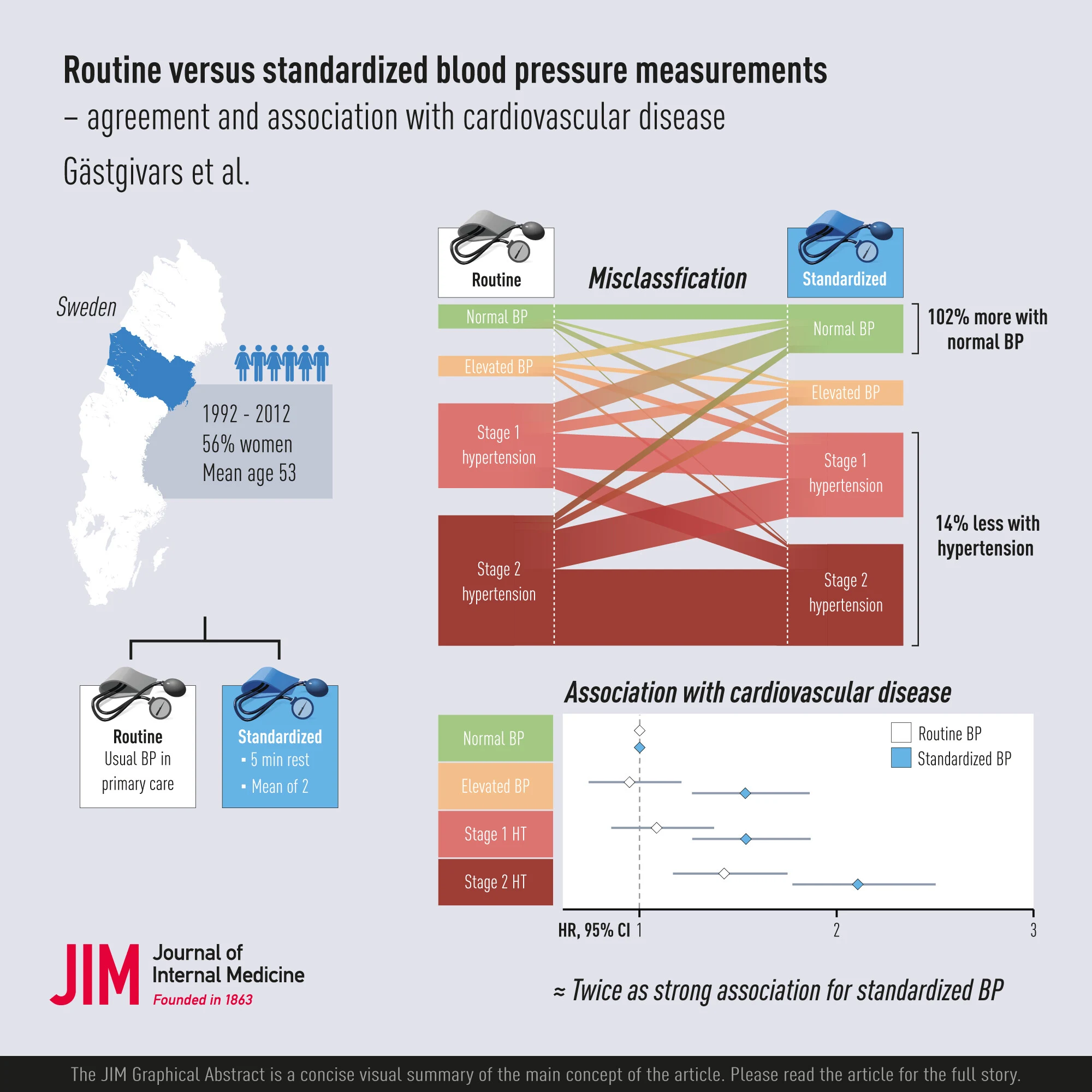
BACKGROUND: Recommendations for blood pressure (BP) measurement are poorly followed in clinical practice, possibly leading to inaccurate BP estimates. OBJECTIVES: To assess the agreement between routine and standardized BPs, and the association between BP level and cardiovascular disease (CVD) for each measurement type. METHODS: Standardized BPs were recorded in a screening program for middle-aged people during 1992-2012 in Sweden. Intraindividual differences between standardized BP and routine BP from primary care were calculated. Association between BP level and composite CVD, and population-attributable fraction (PAF) explained by BP, were determined through adjusted Cox regression for each measurement type. RESULTS: In 9567 participants, routine BPs were on average 4.0/1.7 mmHg higher than standardized BPs. Routine measurements frequently misclassified people into higher BP categories; 16% more had hypertension (≥130/80 mmHg), and 50% less had normal BP (<120/80 mmHg), compared with standardized measurements. Analysis of 19,720 participants found a stronger association between BP level and CVD for standardized than for routine measurements, with increased risk from ≥120/80 and ≥140/90 mmHg, respectively. Adjusted hazard ratio for ≥140/90 mmHg compared to <120/80 mmHg was 2.11 (95% confidence interval 1.77-2.51) for standardized BPs and 1.43 (1.15-1.77) for routine BPs. BP ≥120/80 mmHg explained 41.8% (32.0-50.1) of CVD events with standardized measurements and 19.3% (1.5-33.8) with routine measurements. CONCLUSION: Routine BPs deviate from standardized BPs, resulting in significant misclassification and attenuated association with CVD, reducing the PAF for BP to less than half. Our findings emphasize the need for accurate BP measurement in clinical practice.
From the paper
- Participants
A total of 9567 participants were included in the agreement analyses (Fig. S2).
- Result
Adjusted hazard ratio for ≥140/90 mmHg compared to <120/80 mmHg was 2.11 (95% confidence interval 1.77–2.51) for standardized BPs and 1.43 (1.15–1.77) for routine BPs.
- Limitation
This study is limited to a middle-aged Western European population in a primary care setting; extrapolation to other regions, age groups, and health care settings should be made with caution.
Quoted word for word from the full text on onlinelibrary.wiley.com.
- Standardized blood pressure
- Blood pressure
- Cardiovascular disease
- Hypertension
- Routine blood pressure
- Humans
The paper
Umeå University
Journal of Internal Medicine, 24 Sep 2026, Open access

