Association of long-term care facility ownership and location on residents' mortality and hospitalisations: A population-based retrospective cohort study in Australia
12 months, declared no competing interests
Abstract
OBJECTIVES: Long-term care facility (LTCF) ownership and location can influence resident outcomes in multiple ways, with concern that they are associated with quality of care and resident outcomes. The aim of this study was to assess whether LTCF ownership was associated with risks of mortality, emergency department (ED) presentations, unplanned hospitalisations and hospital days during the first 12 months after LTCF entry, and whether these associations varied by geographical region in Australia. DESIGN: A retrospective propensity score-matched cohort study. SETTING: Registry of Senior Australians National Historical Cohort (2013-2018). PARTICIPANTS: Non-indigenous LTCF residents aged ≥65 years. EXPOSURE: LTCF ownership type: government, not-for-profit or for-profit. Analyses were stratified by LTCF geographical remoteness: metropolitan, inner regional or outer regional/remote/very remote area. PRIMARY AND SECONDARY OUTCOME MEASURES: Cox proportional hazards, Fine-Gray competing risks and negative binomial models were employed. We report adjusted HRs, sub-distribution HRs (sHR), rate ratios, CIs and cumulative incidence estimates. RESULTS: Of 205 079 residents studied, 8961 (4.4%) lived in government-run, 105 144 (51.3%) in not-for-profit and 90 974 (44.4%) in for-profit LTCFs. Compared with residents in not-for-profit LTCFs, mortality risk was higher in for-profit (HR=1.17, 95% CI 1.09 to 1.26) and government facilities (HR=1.20, 95% CI 1.08 to 1.35) located in inner regional areas (24.1% of residents). Residents in government LTCFs had lower ED presentation risk than residents in not-for-profit (sHR=0.68, 95% CI 0.57 to 0.82) and for-profit (sHR=0.61, 95% CI 0.52 to 0.72) LTCFs. Similar observations were made for unplanned hospitalisations and hospital days, and across regions. CONCLUSIONS: Government LTCF residents had fewer hospital-related events, while not-for-profit residents had lower mortality, with differences most evident in inner regional areas. Ongoing monitoring of LTCF ownership trends and their association with resident outcomes is vital for policy development.
From the paper
- Result
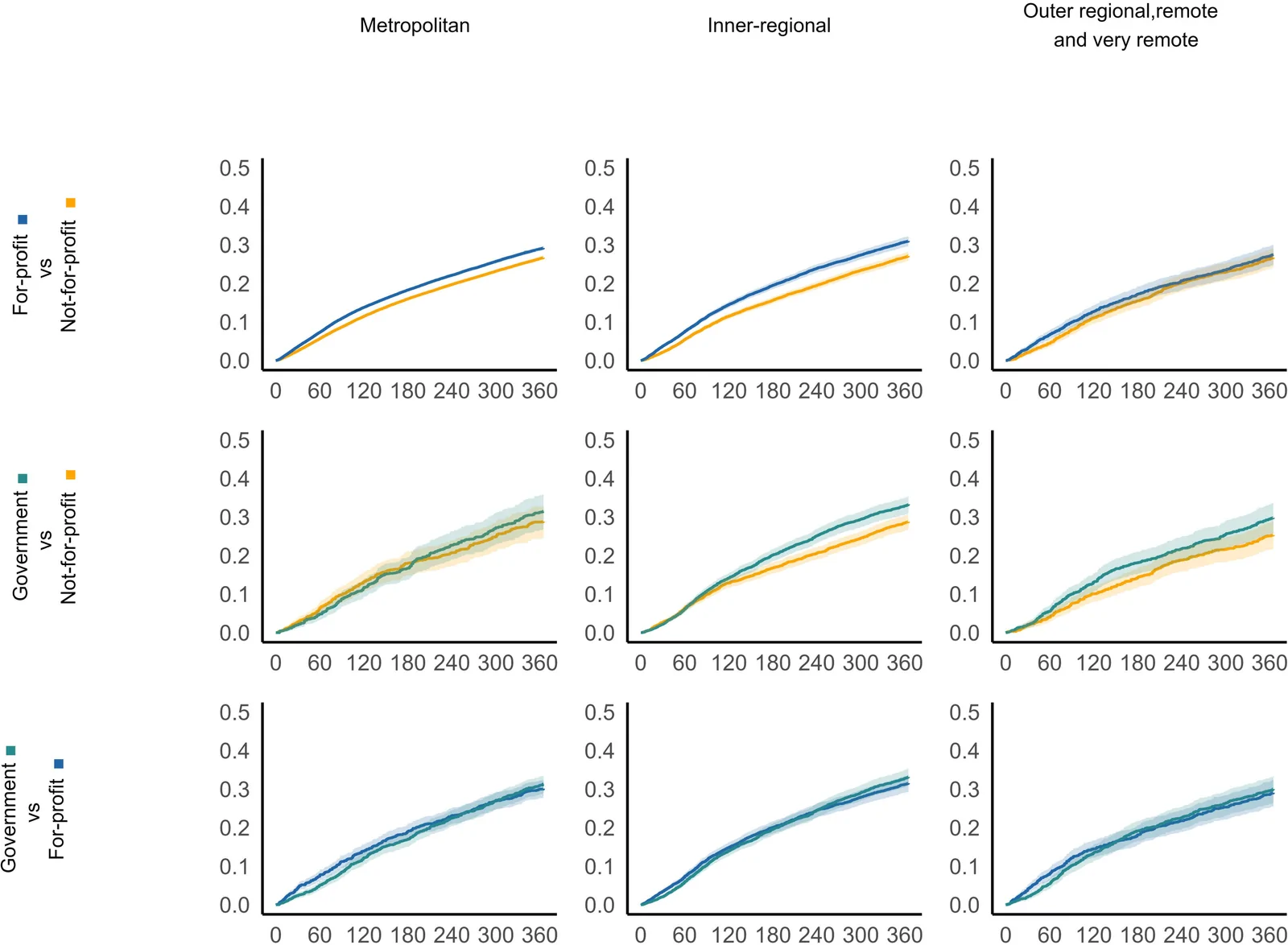
Residents of for-profit LTCFs in metropolitan and inner regional areas had a higher mortality risk than residents of not-for-profit LTCFs (HR=1.13, 95% CI 1.09 to 1.18 and HR=1.17, 95% CI 1.09 to 1.26, respectively;, ).
- Limitation
While we included multiple outcomes (mortality, ED presentations, unplanned hospitalisations and hospital length of stay), these measures may not fully capture differences in care quality across LTCFs.
Quoted word for word from the full text on PubMed Central.