Immune protein has age-dependent effects in Alzheimer’s mice
Experiments in mice modeling Alzheimer’s disease found that dectin-1 reduced dense protein deposits at six months but impaired memory and learning at nine months.
Our read
Mechanisms- Studied:
- Experiments in 5xFAD mice, against CKO mice
- What changed:
- Microglial dectin-1 reduced amyloid pathology in mid-life but worsened cognition and anxiety-related behavior in later life compared to CKO mice
- The catch:
- Synapses, neuronal circuits, and soluble amyloid-beta were not measured
- Stake:
- Ono Pharmaceutical funded the study.
- In the record:
- One of 18 papers on CLEC7A on record: none yet with results in people, 3 in animals.
Editor of record: Boris Djordjevic · AgingResearch.News
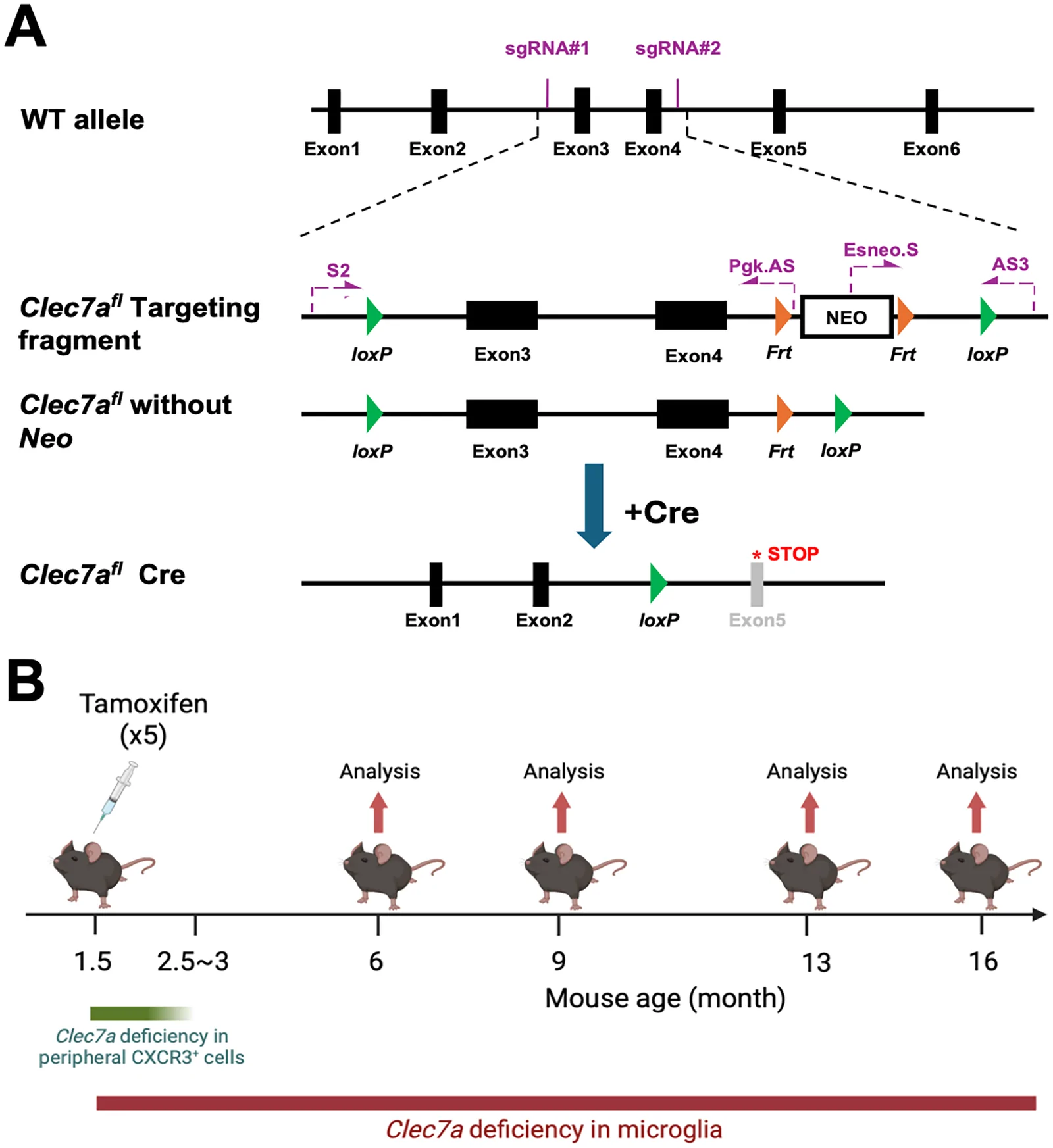
In experiments with 5xFAD mice, a model of Alzheimer’s disease, researchers removed the protein dectin-1 from microglia, the brain’s resident immune cells. They triggered the genetic change at six to seven weeks of age and compared the mice with controls retaining dectin-1.
At six months, dectin-1 reduced dense amyloid-beta plaques, clumps of protein, in a brain region called the subiculum. Behavioral tests detected no difference. At nine months, dectin-1 impaired short-term memory and spatial learning. At 16 months, it increased freezing behavior, suggestive of heightened emotional reactivity.
Why it matters
The authors suggest that efforts to target dectin-1 to protect the brain during Alzheimer’s disease need to consider age, the cells carrying it and the molecules that activate it.
Caveats
The experiment removed dectin-1 early in life; it did not test a drug started later in the disease course. These results came from a mouse model, not people.
- CLEC7A
- Immune response
- Alzheimer's disease
- Brain infiltration of Ly6Glo neutrophils
- Dense Aβ plaques
- Mice
The paper
Microglial dectin-1/Clec7a in an alzheimer's disease model: a double-edged sword across the lifespan
Duke University
Frontiers in Immunology, Sep 3, 2026, Open access


Comments
Be the first to comment.