Empagliflozin improves serum uric acid and early cardiometabolic outcomes in asymptomatic hyperuricemia among patients with type 2 diabetes: A 6-month observational study
6 months, declared no competing interests
Abstract
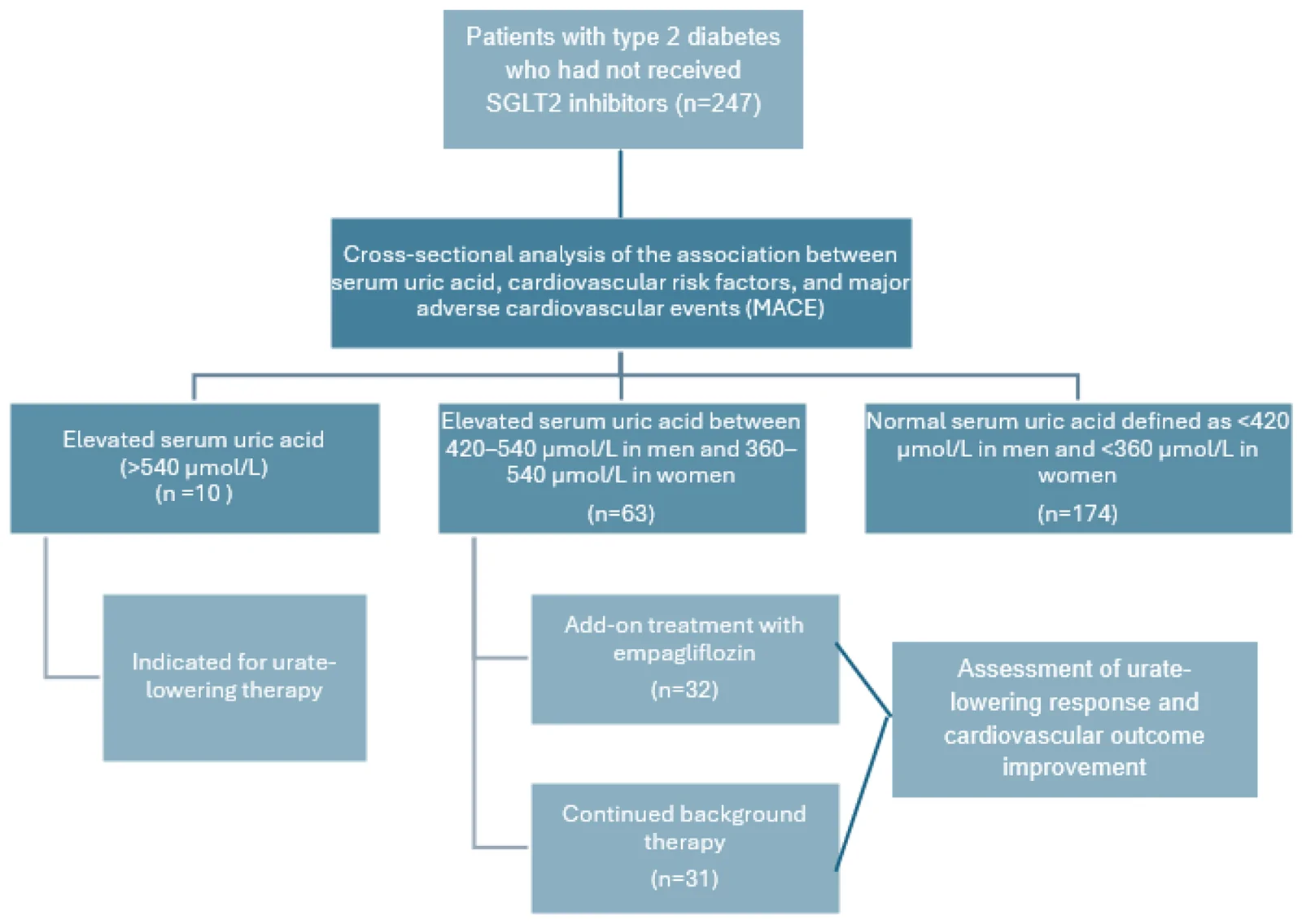
Asymptomatic hyperuricemia is common among patients with type 2 diabetes and has been associated with increased cardiovascular risk. However, evidence regarding the effects of empagliflozin on serum uric acid (SUA) and cardiovascular outcomes in this population remains limited. This study aimed to evaluate the impact of empagliflozin on SUA levels and early cardiometabolic outcomes in patients with type 2 diabetes and asymptomatic hyperuricemia. This 6-month observational study was conducted at a tertiary hospital in Vietnam. A total of 247 patients with type 2 diabetes were included in the cross-sectional analysis. Among them, 63 patients with asymptomatic hyperuricemia who did not meet indications for urate-lowering therapy were followed prospectively for 6 months and received either empagliflozin (10-25 mg/d) or background therapy without empagliflozin. Changes in SUA, HbA1c, fasting plasma glucose, and major adverse cardiovascular events (MACE) were assessed. Among the 247 participants, 73 (29.6%) had asymptomatic hyperuricemia and showed a significantly higher incidence of MACE than those without hyperuricemia (34.2% vs 8.6%; adjusted odds ratio 5.77, 95% CI: 2.49-13.39). SUA demonstrated good predictive performance for MACE (AUC 0.741), cardiovascular mortality (AUC 0.804), and myocardial infarction (AUC 0.745). After 6 months, SUA decreased more significantly in the empagliflozin group than in the control group (-101.66 ± 76.44 vs -45.90 ± 86.36 µmol/L; P = .009). Fasting plasma glucose also improved significantly, whereas the reduction in HbA1c was not statistically significant. In patients with type 2 diabetes and asymptomatic hyperuricemia, elevated SUA was associated with increased cardiovascular risk. Empagliflozin significantly reduced SUA and improved fasting plasma glucose, with a potential trend toward favorable cardiovascular outcomes.
From the paper
- Participants
Among 312 patients screened, 247 with type 2 diabetes who met inclusion criteria were enrolled in the cross-sectional analysis examining the association between SUA and MACE.
- Follow-up
Kaplan–Meier curves for MACE-free survival (, Supplemental Digital Content 4) showed a consistently higher probability of remaining event-free in the EMPA group than in controls over the 6-month follow-up.
Results, 3.4. Six-month effects of empagliflozin and cardiovascular outcomes
- Result
In unadjusted analysis, hyperuricemia was strongly associated with MACE (OR 5.52; 95% CI: 2.70–11.31; P <.001).
Results, 3.3. Association between SUA and cardiovascular outcomes
- Events by group
Our study found that the EMPA group had a lower incidence of MACE compared with the control group (21.9% vs 38.7%), with an odds ratio (OR) of 0.44 (95% CI: 0.15–1.34; P =.146), although the difference did not reach statistical significance.
Results, 3.4. Six-month effects of empagliflozin and cardiovascular outcomes
Quoted word for word from the full text on PubMed Central.
- Empagliflozin
- Serum uric acid
- Asymptomatic hyperuricemia
- Type 2 diabetes
- Major adverse cardiovascular events
- Humans
The paper
Can Tho University of Medicine and Pharmacy
Medicine, 11 Sep 2026, Open access