Demographic shifts in referral to and completion of lung cancer screening after the 2021 United States Preventive Services Task Force update
Declared competing interests
Abstract
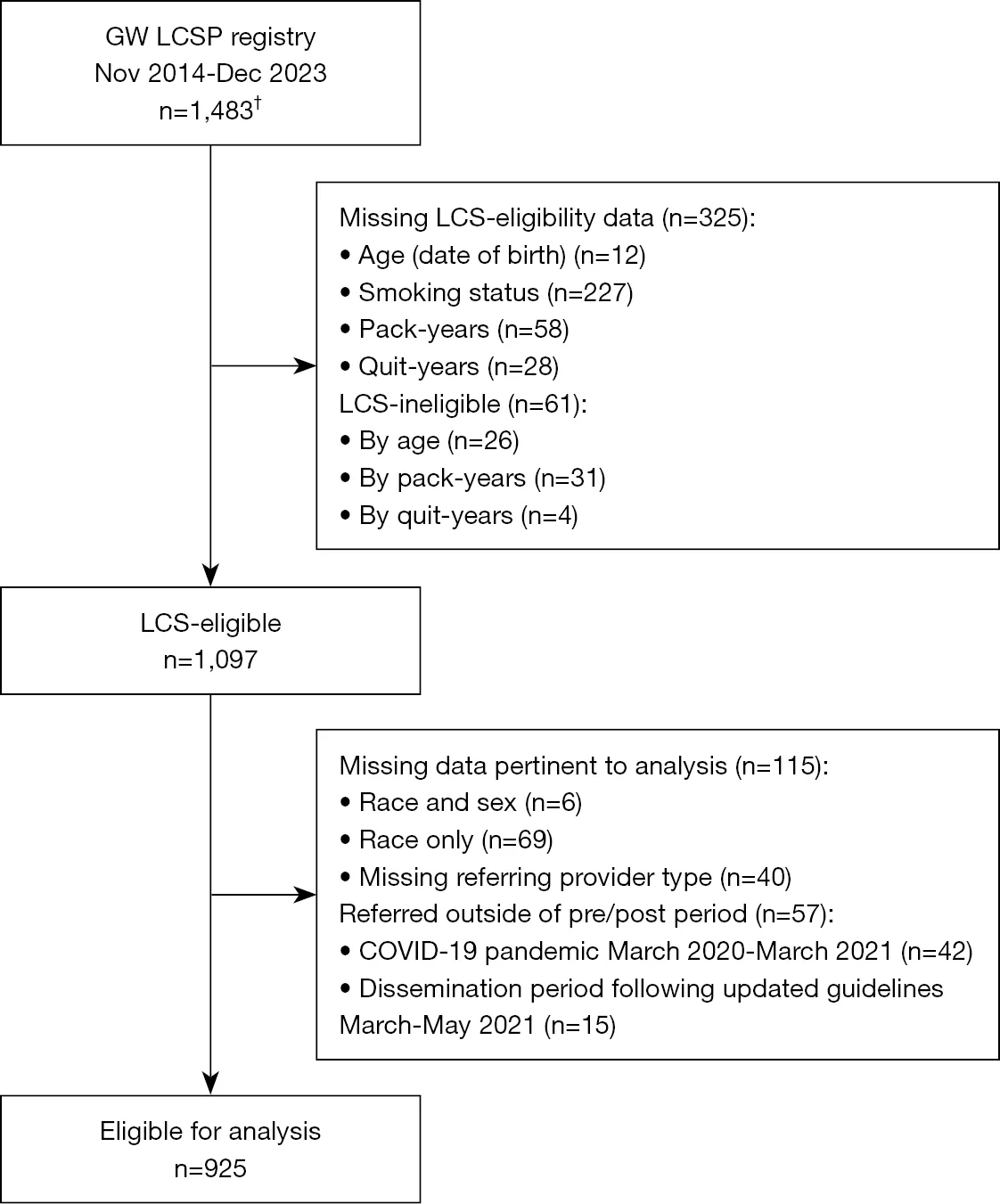
BACKGROUND: The United States Preventive Services Task Force (USPSTF) expanded the age and pack-year criteria for lung cancer screening (LCS) in 2021 in part to improve equity in eligibility for women and racial minority groups. Prior research has examined characteristics of patients who participated in LCS (screened) based on completed low-dose computed tomography (LDCT) pre- and post-USPSTF update in majority White patient populations, but has not done so in more diverse settings. No prior studies have assessed changes in referral patterns related to the update. We therefore examined both screening and referral patterns pre- vs. post-update in our majority Black LCS program (LCSP). METHODS: We analyzed LCSP registry data from 2014 to 2023 in a large, urban outpatient health system in Washington, DC, USA with a majority Black population. We performed a pre-/post-update comparison of sex and race among screened patients, defined as those who completed LDCT. We additionally compared pre-/post-update sex and race among referred patients, regardless of whether they completed LDCT. We modeled the odds of LDCT completion after referral with logistic regression, stratified by pre-/post- group. RESULTS: The proportion of female patients referred significantly increased from 43% pre-update to 53% post-update, and in Black patients from 67% to 74%. Increases in referrals directly translated to significant increases in screening, where the proportion of female patients screened also rose from 40% pre-update to 53% post-update, and in Black patients from 65% to 74%. Screening rates (percent screened among referred) in female patients rose from 66% pre-update to 90% post-update, and in Black patients from 69% to 90%. In multivariable analysis among referred patients, the odds of LDCT completion were not independently associated with sex or race either pre- or post-update after adjusting for other demographic factors and smoking history [female (vs. male) pre-update: 0.66 (0.43, 1.02), post-update: 0.84 (0.46, 1.56); Black (vs. White) pre-update: 0.89 (0.52, 1.52), post-update: 1.13 (0.52, 2.45)]. CONCLUSIONS: We found that following the 2021 USPSTF update to LCS eligibility criteria, the proportion of Black and female individuals increased among both screened and referred patients in an urban, majority Black setting. Observed increases were even greater than that reported in prior literature from majority White populations. Our findings add evidence that changes in guidelines can translate to real-world improvement in equitable access to early detection of lung cancer.
The paper
George Washington University
Journal of Thoracic Disease, 28 Aug 2026