Website raised test scores in older adults with low reasoning scores
At 12 months, adjusted differences versus brain-health advice were 0.50 reasoning-test points for the website and 0.97 points for the website plus support.
Registered ISRCTN17349359
Limit: Dropout was higher in website groups, and baseline cognitive scores predicted missing data
Edited by Boris Djordjevic · AgingResearch.News
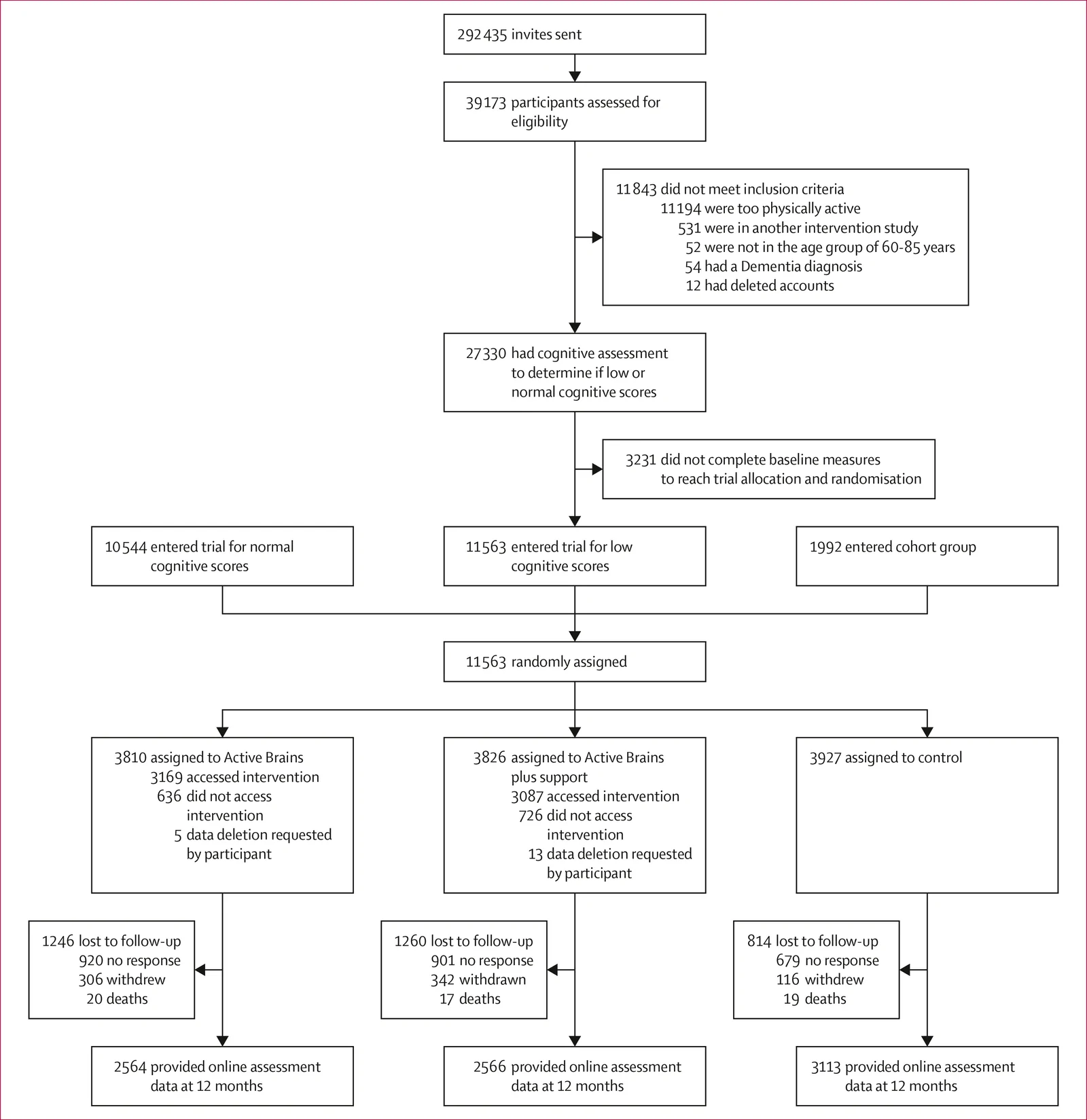
An open-label randomized trial enrolled 11,563 adults aged 60–85 with internet access and low verbal reasoning scores; 57.9% were female and 95.8% were White. Participants received brain-health advice, the Active Brains website, or the website plus an offer of three roughly 10-minute support sessions. The website encouraged physical activity, a Mediterranean diet and thinking exercises.
After 12 months, mean reasoning scores were 18.3 with advice, 18.7 with the website and 19.2 with added support. Serious adverse events affected 33 (0.87%) website participants, 32 (0.84%) with added support and 28 (0.71%) controls. Deaths numbered 20 (0.5%), 17 (0.4%) and 19 (0.5%), respectively. All serious adverse events and deaths were judged unrelated to the intervention.
Why it matters
Cognitive impairment creates health and social care needs in later life. The trial addressed whether primary care could support cognitive health with brief approaches rather than intensive programs.
Caveats
Participants knew their assignments, and missing 12-month scores—32.7% and 32.9% in the website groups versus 20.7% in controls—required statistical estimation. Results do not cover adults outside ages 60–85 or without internet access; five-year dementia follow-up is ongoing.
From the paper
- Participants
From Oct 3, 2020, to Oct 30, 2023, 11 563 participants from 670 practices, who were found to have low cognitive scores on the Baddeley verbal reasoning test, were recruited and randomly assigned.
- Who took part
There were two populations of interest: individuals with low cognitive functioning (a low cognitive score meeting the cognitive criteria for AACD) and with normal cognitive functioning (a normal cognitive score, thus not meeting the cognitive criteria for AACD).
- Ages
Adults aged 60–85 years were included in the study.
- Duration
We report the 12-month follow-up of the trial among participants with lower cognitive scores, and a 5-year follow-up is planned.
- Result
At 12 months, compared with the control group, mean Baddeley scores were higher in the Active Brains group (mean 18·7 adjusted mean difference compared with control +0·50, 95% CI 0·13–0·87) and the Active Brains plus support group (mean 19·2, +0·97; 0·59–1·34; ).
- Events by group
… approximately 20% more of the control group never accessed websites for brain health, and approximately 10% more of the control group never accessed other brain health programmes.
- Harms
Serious adverse events occurred in 33 (0·87%) of 3810 in the Active Brains group, 32 (0·84%) of 3826 in the Active Brains plus support group, and 28 (0·71%) of 3927 in the control group.
- Mild cognitive impairment
1919 (62%) of 3113 of the control group met the cognitive criteria for MCI at baseline, and by 12 months this had improved to 48% (1493 of 3113), consistent with the mean scores, but the Active Brains plus support group did slightly better at 44% (an 8% relative reduction compared with the control group; risk ratio 0·92 [95% CI 0·87–0·97 …
- Severe cognitive impairment
Similarly in the control group, of those meeting the cognitive criteria for MCI at baseline, 329 (17·1%) of 1919 met the cognitive criteria for SCI at 12 months, and compared with the control group, there was a significant 18% reduction meeting the cognitive criteria for SCI in the Active Brains plus support group (0·82 [0·70–0·96 …
Quoted word for word from the full text on PubMed Central.
The paper
University of Southampton; University of Bristol
The Lancet Primary Care, Aug 2026, Open access


