Quantum-optimized spatio-temporal transformer for multimodal cardiovascular risk prediction from clinical and wearable data
Abstract
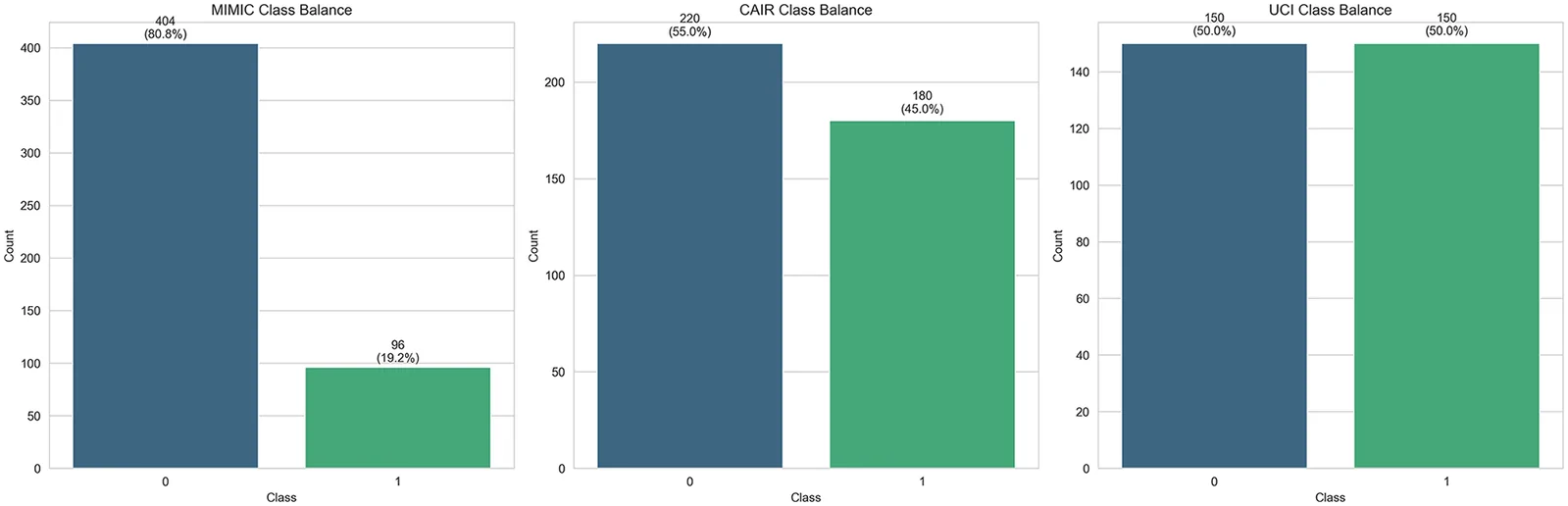
INTRODUCTION: Cardiovascular risk prediction remains a difficult problem due to the extreme class imbalance, time sparsity, non-uniform sampling, and heterogeneity of electronic health record and wearable sensor streams in the real world. METHODS: A multimodal cardiovascular risk prediction framework called Quantum-Optimized Spatio-Temporal Transformer (QST-Trans) was designed. The framework combines Contextual Dual-Stream Synchronization to facilitate alignment between irregular clinical and wearable measurements, Enhanced Quantum-Inspired Binary Grey Wolf Optimization to select features with feature redundancy, a spatio-temporal transformer including attention gating and Kolmogorov-Arnold Network (KAN) layers, and time-aware SHAP to interpret the model's predictions at the patient level based on their longitudinal risk courses. The MIMIC-III and CAIR-CVD-2025 and UCI Heart Disease data sets were used to evaluate. CONCLUSIONS: The proposed QST-Trans framework successfully achieved AUC-ROC 0.99, F1-score 0.98, and sensitivity 97.5%, outperforming the considered baseline methods. DISCUSSION: The results suggest that multimodal synchronization, quantum-inspired feature optimization, spatio-temporal learning and the inclusion of time-aware explainability are a promising approach to cardiovascular risk stratification. But a multi-center validation and clinical testing in the real world should be required before clinical adoption.
The paper
Hindustan Institute of Technology and Science; Bannari Amman Institute of Technology
Frontiers in Cardiovascular Medicine, 20 Aug 2026