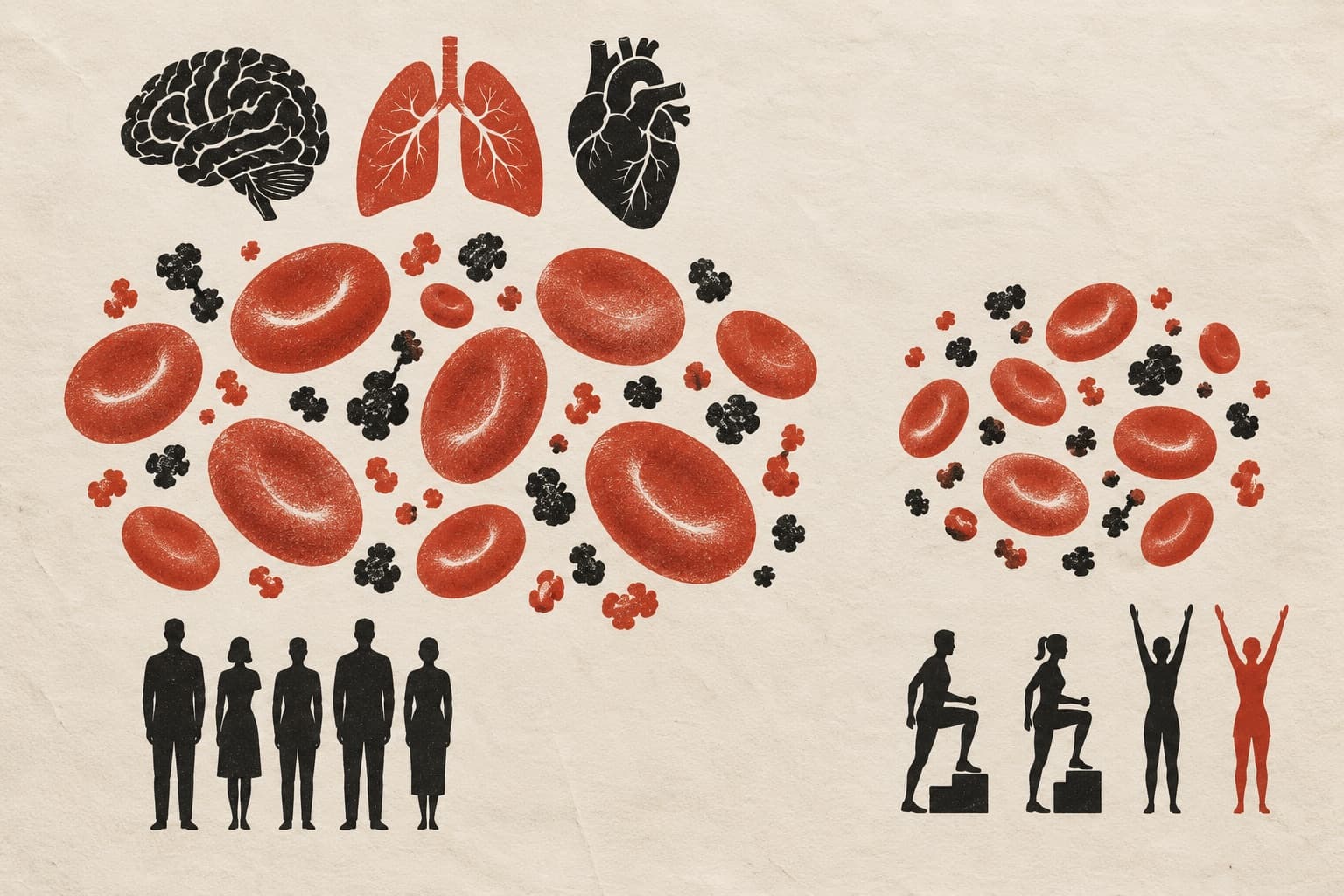
Transformer model predicts human disease across partial proteomes
Across 144 diseases, median AUC fell from 0.679 with 2,920 proteins to 0.637 when evaluated on 1,460 proteins without model refitting.
medRxiv
In 53,014 participants from the UK Biobank Pharma Proteomics Project, researchers evaluated a self-supervised protein-token Transformer designed to handle varying protein measurements without imputation. The encoder was pretrained by masked-protein reconstruction to map observed plasma proteins into fixed-dimensional representations. The authors tested whether risk models trained on 2,920 proteins could predict 144 diseases when restricted to a subset of 1,460 proteins. Across all 144 conditions, median AUC reached 0.679 with full coverage and 0.637 under partial coverage without refitting. Retraining only the disease-specific heads raised the median AUC to 0.673. Under partial coverage, the model exceeded coefficient-truncated LASSO scores by a median paired AUC difference of 0.027. Discrimination improved beyond clinical covariates for 10 of 12 focused diseases under partial coverage without refitting, with performance remaining relatively stable across cardiovascular-kidney-metabolic conditions but more variable in autoimmune diseases.
Why it matters
Circulating proteomic profiles track systemic aging and multi-organ disease risk, but differences in assay platforms limit their clinical translation. This approach suggests flexible computational representations could allow proteomic risk scores to transfer across distinct biomarker panels.
Caveats
The study relies on observational cohort data, tested a single predefined subset of proteins, and has not yet undergone peer review as a preprint. Predictive performance was also heterogeneous across certain conditions, particularly autoimmune diseases.
The paper
Show 9 more authors
Jaehyun Joo, Matthew Lee, Michelle L. McKeague, Amy E. Baxter, Shwetank, Matei Ionita, Sokratis A. Apostolidis, Allison R. Greenplate, E. John Wherry,University of Pennsylvania
medRxiv · 12 Sep 2026 · Preprint, not peer-reviewed