Epilepsy rose after Alzheimer’s symptoms in adults with Down syndrome
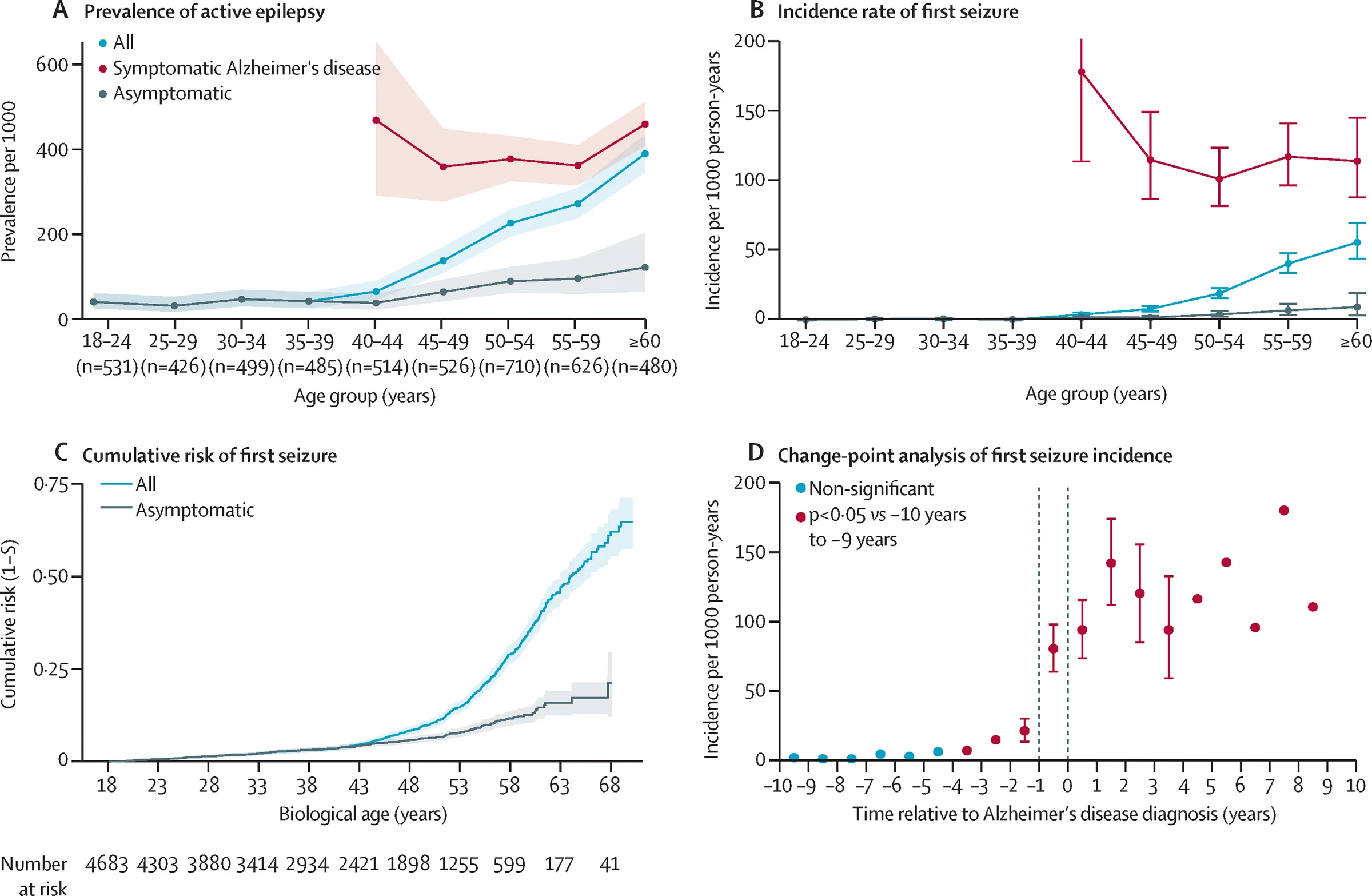
The share who had developed epilepsy rose from 9.5% at symptomatic Alzheimer’s diagnosis to 56.9% nine years later in adults with Down syndrome.
Multicenter
Limit: Consensus-based Alzheimer’s staging could misdate symptom onset, distorting the apparent timing of epilepsy
Edited by Boris Djordjevic · AgingResearch.News
An observational study followed 4,804 adults with Down syndrome aged 18 or older, with a mean age of 43, across seven international cohorts. The combined observation window ran from October 2012 to July 2025. Clinicians assessed Alzheimer’s disease stage by consensus. Researchers counted epilepsy as active when participants had a diagnosis plus ongoing antiseizure medication or a seizure within the previous five years.
Epilepsy became more common with age, particularly after symptomatic Alzheimer’s disease began. A form of late-onset epilepsy involving sudden muscle jerks was associated with faster cognitive decline and higher mortality, with a hazard ratio of 2.10, a relative measure. Electrical brain recordings taken between seizures had little diagnostic value.
Why it matters
Adults with Down syndrome face high risks of Alzheimer’s disease and epilepsy as they age. The authors called for targeted strategies to prevent and treat the development of Alzheimer’s-related seizures.
Caveats
This observational study cannot show that epilepsy caused faster cognitive decline or earlier death. Its results concern adults with Down syndrome, not the wider Alzheimer’s population.
- Epilepsy
- Down syndrome
- Alzheimer's disease
- Late-onset myoclonic epilepsy in Down syndrome
- Intellectual disability
- Humans
The paper
Universitat Autònoma de Barcelona
Lancet, Sep 3, 2026, Open access
doi.org/10.1016/s0140-6736(26)00980-3PubMed 42692040
Corrected, Oct 24, 2026
