Death rates rose similarly with age for diseases of the same organs
An observational study of 12 high-income populations found similar age-related increases in death rates for infectious and noninfectious diseases affecting the same organs.
Limit: Early records and cooccurring diseases in older people can distort cause-of-death attribution
Edited by Boris Djordjevic · AgingResearch.News
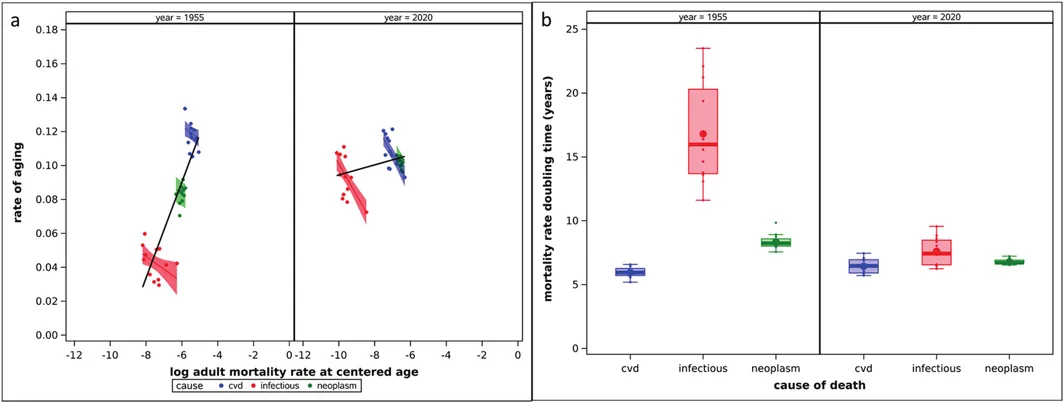
An observational study analyzed death records for people of both sexes in 12 high-income countries, using World Health Organization data from 1955 and 2020. Researchers modeled how quickly death rates increased with age from ages 30 to 85. Overall, infectious diseases had slower age-related increases than cardiovascular diseases or cancer.
But infectious and noninfectious diseases affecting the same organs had similar increases. This held for respiratory diseases in both years and digestive diseases in 1955. For infectious diseases overall and respiratory infections, changes in how tightly deaths clustered at similar ages between 1955 and 2020 were linked mainly to shifts from early-life deaths toward deaths in adulthood. Changes in the age-related rise in mortality contributed much less.
Why it matters
The authors suggested that shared mechanisms for tolerating disease might help shape how mortality changes with age, regardless of what causes a disease.
Caveats
The analysis used population death rates, not measurements of aging within individuals. It combined both sexes and covered only high-income countries.
From the paper
- Limitation
We only analyzed a sample of 12 high‐income countries at two time periods; therefore, the results only apply to these specific conditions.
Quoted word for word from the full text on PubMed Central.
The paper
A Comparative Analysis of Aging Across Causes of Death
Centre National de la Recherche Scientifique
Evolutionary Applications, Sep 1, 2026, Open access


