Organ age acceleration and mortality risk reflect distinct biological processes
Multi-omics clocks across fourteen organs reveal divergent molecular programs and uncover thirteen candidate genes separating age acceleration from mortality.
Our read
Biomarkers- Studied:
- Preprint: cohort study of 409,206 people (Independent replication)
- In the record:
- One of 32 papers on age acceleration on record: 16 with results in people.
Editor of record: Boris Djordjevic · AgingResearch.News
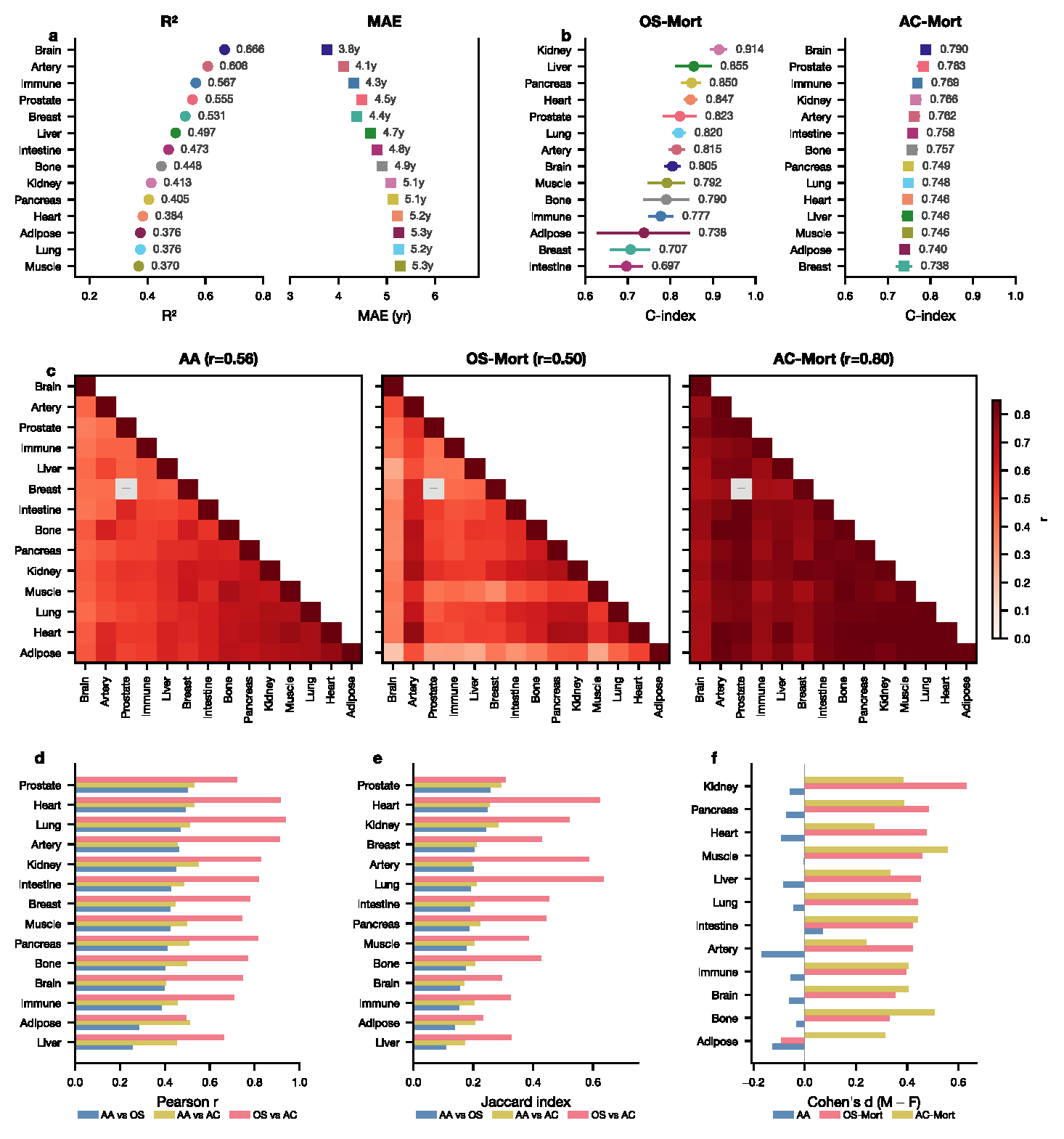
In a preprint analyzing 409,206 human participants from the UK Biobank, researchers built multi-omics clocks to measure the aging of 14 organs. The team integrated nuclear magnetic resonance metabolomics, plasma proteomics, and clinical phenotypes to assess both organ-specific age acceleration and mortality.
They found that chronological age acceleration and mortality risk represent distinct biological dimensions with separate molecular and genetic architectures. Single-platform models missed complementary biology spanning three distinct molecular layers. For example, clocks trained on all-cause mortality missed incident prostate cancer signals that an organ-specific mortality clock detected. Using a validation cohort of 383,227 individuals and bidirectional Mendelian randomization, the authors prioritized 13 candidate genes driving these divergent aging dimensions.
Why it matters
The findings show that conventional single-rate aging clocks overlook critical tissue-level differences, establishing that biological age acceleration and death risk operate via separable biological programs. Disentangling these mechanisms could improve organ-resolved risk profiling and support targeted therapeutic interventions.
Caveats
This work is a preprint that has not yet undergone peer review. The findings are based on observational data from the UK Biobank, which may not capture variations in more diverse global populations.
The paper
Age Acceleration and Mortality Risk Constitute Distinct Dimensions of Organ Aging
University of Hong Kong; Sun Yat-sen University
Research Square, Sep 30, 2026, Open access, Preprint, not yet peer-reviewed


Comments
Be the first to comment.