Longitudinal Serum Uric Acid Variation and Risk of Major Adverse Cardiovascular Events and Mortality: A Systematic Review and Meta-Analysis
Abstract
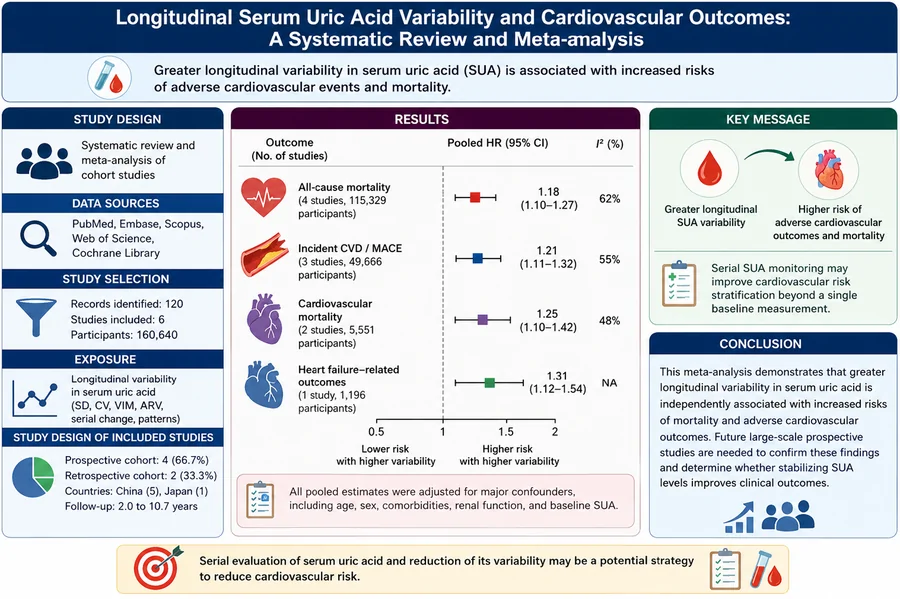
BACKGROUND: Longitudinal variability in serum uric acid (SUA) has emerged as a potential predictor of adverse cardiovascular outcomes beyond a single baseline measurement. However, the relationship between temporal changes in SUA and major adverse cardiovascular events (MACE) and mortality remains unclear. This systematic review and meta-analysis evaluated the association between longitudinal variation in SUA and cardiovascular events and mortality. METHODS: A systematic search of PubMed/MEDLINE, Embase, Scopus, Web of Science, and the Cochrane Library was conducted from database inception to June 2026 following PRISMA 2020 guidelines. Prospective and retrospective cohort studies involving repeated SUA measurements in adults and reporting adjusted hazard ratios (HRs) for cardiovascular outcomes or mortality were included. Study quality was assessed using the Newcastle-Ottawa Scale, and pooled HRs with 95% confidence intervals (CIs) were calculated using a random-effects model. RESULTS: Six cohort studies involving 160 640 participants were included. Greater longitudinal SUA variation was associated with an increased risk of all-cause mortality (pooled HR 1.18, 95% CI 1.10-1.27; I² = 62%), incident cardiovascular disease/MACE (pooled HR 1.21, 95% CI 1.11-1.32; I² = 55%), and cardiovascular mortality (pooled HR 1.25, 95% CI 1.10-1.42; I² = 48%). One study also reported an increased risk of heart failure-related outcomes (HR 1.31, 95% CI 1.12-1.54). Sensitivity analyses demonstrated robust findings across all pooled outcomes. CONCLUSIONS: Greater longitudinal SUA variability is independently associated with increased risks of mortality and adverse cardiovascular outcomes. Serial SUA assessment may improve cardiovascular risk stratification beyond baseline SUA measurement.
From the paper
- Participants
Collectively, the studies enrolled 160 640 participants, with sample sizes ranging from 1196 to 55 717 participants.
- Result
Individuals with greater longitudinal SUA variability had an 18% higher risk of all‐cause mortality compared with those with lower variability (pooled HR = 1.18, 95% CI: 1.10–1.27).
Quoted word for word from the full text on PubMed Central.
The paper
Croydon University Hospital; Ibn E Seena Hospital Kabul Afghanistan
Clinical Cardiology, 1 Sep 2026, Open access