Weight Regain Trajectories After Discontinuation of Semaglutide or Tirzepatide: A Reconstructed Aggregate-Data Bayesian Longitudinal Meta-Analysis
1,776 participants, meta-analysis
Abstract
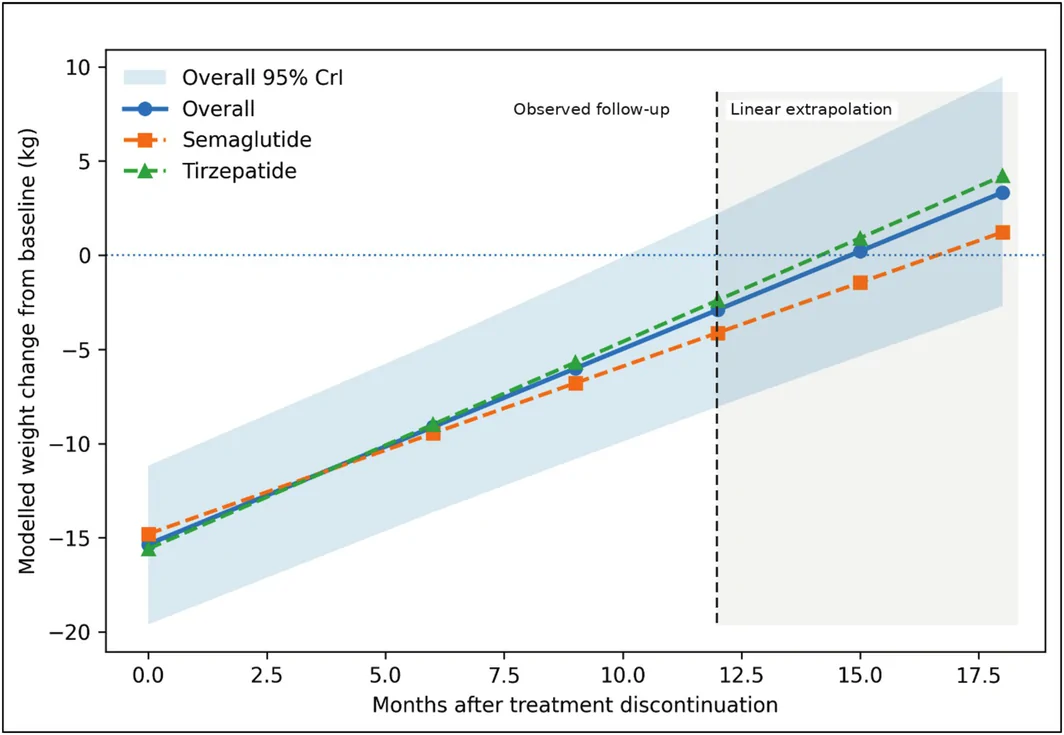
BACKGROUND: Semaglutide and tirzepatide produce substantial weight loss during treatment, but the trajectory of weight regain after discontinuation remains uncertain. OBJECTIVE: To estimate post-discontinuation weight-regain trajectories and explore predictors of faster regain. METHODS: We used published timepoint-level aggregate data from studies evaluating weight change after discontinuation of semaglutide or tirzepatide to perform a Bayesian hierarchical longitudinal re-analysis. The model estimated weight loss at cessation, monthly regain rate, time to 50% regain, and time to return to baseline weight. Bayesian meta-regression examined medication type, magnitude of initial weight loss, and post-discontinuation behavioural or lifestyle support. Longer-term estimates assumed a constant linear regain rate. RESULTS: Six studies comprising 10 intervention arms and 1776 participants were included, with observed follow-up ranging from 4 to 52 weeks. Estimated weight loss at cessation was 15.35 kg (95% credible interval [CrI] 11.18-19.60), followed by regain of 1.04 kg/month (95% CrI 0.80-1.29). Based on the linear model, 50% of initial weight loss was projected to be regained by 7.50 months (95% CrI 5.05-10.57), with return to baseline weight by 15.00 months (95% CrI 10.10-21.13). Tirzepatide showed numerically faster regain than semaglutide in unadjusted analyses, but no clear independent drug-specific difference was evident after adjustment. Greater initial weight loss showed the strongest directional association with faster regain, although the credible interval included zero. Behavioural or lifestyle support was directionally associated with slower regain, but the estimate was imprecise. CONCLUSIONS: Weight regain after discontinuation of semaglutide or tirzepatide was rapid and clinically meaningful. Because estimates beyond 52 weeks were model-based extrapolations, they should be interpreted cautiously. Early monitoring and proactive maintenance planning may be warranted after treatment cessation.
From the paper
- Follow-up
The return‐to‐baseline estimate extends beyond the maximum observed follow‐up of 52 weeks and is therefore an extrapolation rather than an observed outcome.
- Result
Within the observed follow‐up window, the modelled average weight change remained below baseline at 6 months (−9.12 kg; 95% CrI −13.64 to −4.68), 9 months (−6.01 kg; 95% CrI −10.82 to −1.26) and 12 months (−2.90 kg; 95% CrI −8.04 to 2.22).
Quoted word for word from the full text on PubMed Central.
The paper
University of Huddersfield; Ministry of Health
Endocrinology, Diabetes & Metabolism, 31 Aug 2026, Open access