Mental tasks on walks linked to thinking gains in dementia
A 24-week randomized trial of 100 older adults linked walking with mental tasks to greater improvements in thinking scores and walking speed than walking alone.
24 weeks, registered KCT0010602
Limit: Repeated cognitive testing could inflate thinking gains in both groups through practice effects
Edited by Boris Djordjevic · AgingResearch.News
A cluster randomized trial enrolled 100 adults aged 65 or older with dementia and mild to moderate cognitive impairment at 11 community dementia care centers. Researchers assigned centers to two exercise programs, each delivered three times weekly for 24 weeks. Both included strength, balance and walking exercises adapted from the Otago Exercise Program. For 10 minutes per session, one group walked while naming animals or counting backward; the other walked without mental tasks.
At 12 and 24 weeks, walking with mental tasks was associated with greater improvements in a combined thinking-test score and walking speed. Balance, knee strength and repeated chair-standing performance improved similarly in both groups, with no additional benefit from the mental tasks.
Why it matters
Dementia affects both thinking and mobility. The trial addressed whether practicing mental and physical tasks together may add value to exercise programs for older adults with the condition.
Caveats
Instructors knew group assignments, and researchers created the combined thinking score after the fact from tests specified in advance. Participants had to walk independently or with minimal help, and the supplied text does not report adverse events.
From the paper
- Participants
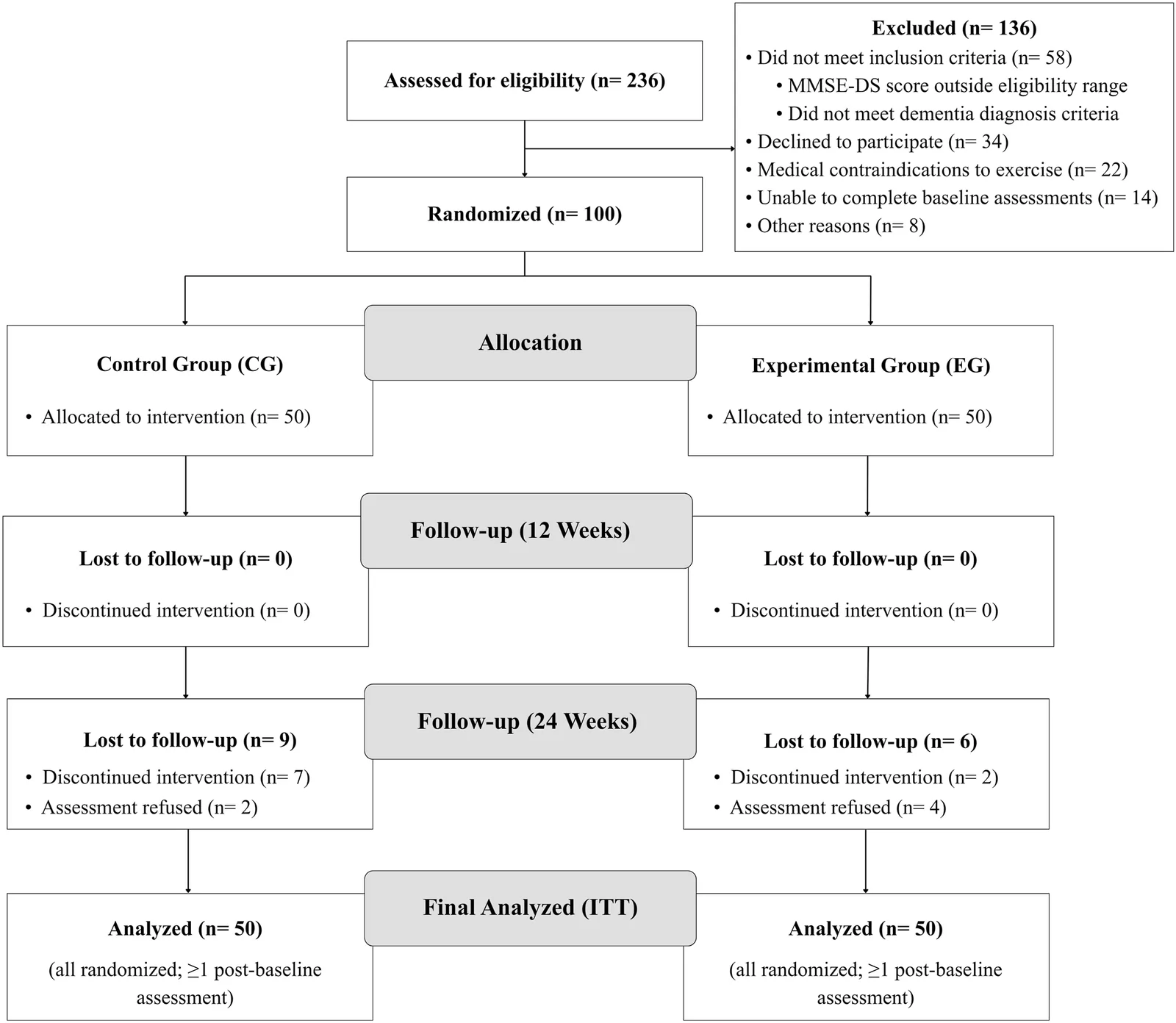
A total of 236 individuals were assessed for eligibility, of whom 100 were randomized to the CG (n = 50) or EG (n = 50) across 11 community dementia care centers (5 centers allocated to the CG and 6 to the EG).
- Who took part
This prospective, two-arm cluster randomized controlled trial investigated the effects of dual-task walking in older adults with dementia.
- Ages
Eligible participants were aged 65 years or older with a prior clinical diagnosis of dementia established by physicians at affiliated medical institutions.
- Duration
Both groups participated in a 24-week structured exercise program conducted at participating dementia care centers.
- Limitation
First, although sensitivity analyses indicated that the group × time interaction results were robust regardless of whether a center-level random effect was included …
- Cognitive function
For the composite cognitive score, the LMM showed a significant group × time interaction (p <.001), together with a significant main effect of time (p <.001).
- Gait speed
For gait speed, there was also a significant group × time interaction (p <.001), and a significant main effect of time was detected (p <.001).
- Physical function
The estimated within-group changes from baseline are presented in, and the between-group differences in change from baseline were not statistically significant at either 12 or 24 weeks for any secondary outcome.
Quoted word for word from the full text on PubMed Central.
The paper
Korea National Sport University
Journal of Exercise Science and Fitness, Aug 10, 2026, Open access

