Impact of Frailty on Activities of Daily Living in Hospitalized Older Adults: A Systematic Review and Meta-Analysis
Declared no competing interests
Abstract
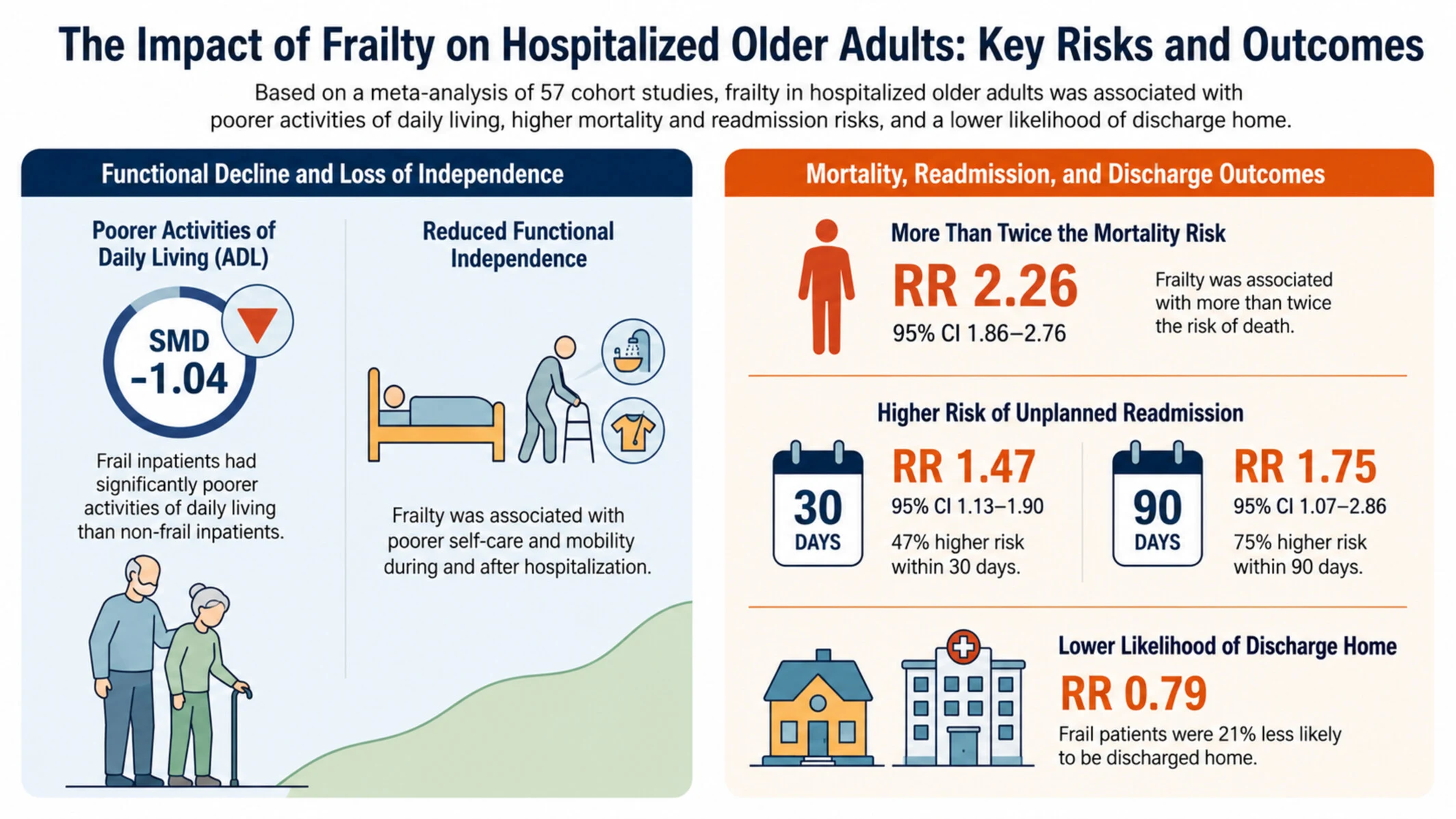
AIM: To determine whether frailty is associated with activities of daily living (ADL) and other clinical outcomes in hospitalized older adults. METHODS: MEDLINE, Embase and CENTRAL were searched for English-language cohort studies published from 1 January 2001 to 23 October 2025. Eligible studies included hospitalized adults aged ≥ 65 years (or samples with ≥ 80% aged ≥ 65 years), used a defined frailty measure and compared frail with non-frail participants. Two reviewers independently selected studies, extracted data and assessed risk of bias using the Quality In Prognosis Studies tool. Random-effects meta-analyses generated standardized mean differences (SMDs) or risk ratios (RRs) with 95% confidence intervals (CIs). RESULTS: Fifty-seven cohort studies were included. Frailty was associated with worse ADL status (SMD -1.04, 95% CI -1.89 to -0.20), higher mortality (RR 2.26, 95% CI 1.86-2.76), lower likelihood of discharge home (RR 0.79, 95% CI 0.73-0.86), and higher 30-day (RR 1.47, 95% CI 1.13-1.90) and 90-day readmission risks (RR 1.75, 95% CI 1.07-2.86). Pneumonia risk was not statistically significant. Heterogeneity was substantial to considerable for all pooled outcomes. CONCLUSIONS: Frailty identifies hospitalized older adults at increased risk of functional dependence, mortality, non-home discharge, and readmission. Substantial heterogeneity and residual confounding warrant cautious interpretation and support standardized frailty and functional-outcome assessment.
The paper
Gumma Paz College; Takasaki University of Health and Welfare
Geriatrics & Gerontology International, 26 Aug 2026