Assessing the reliability and validity for metabolic syndrome diagnosis using point-of-care analyzers in a mobile setup - a pilot study
Non-randomised trial, declared no competing interests
Abstract
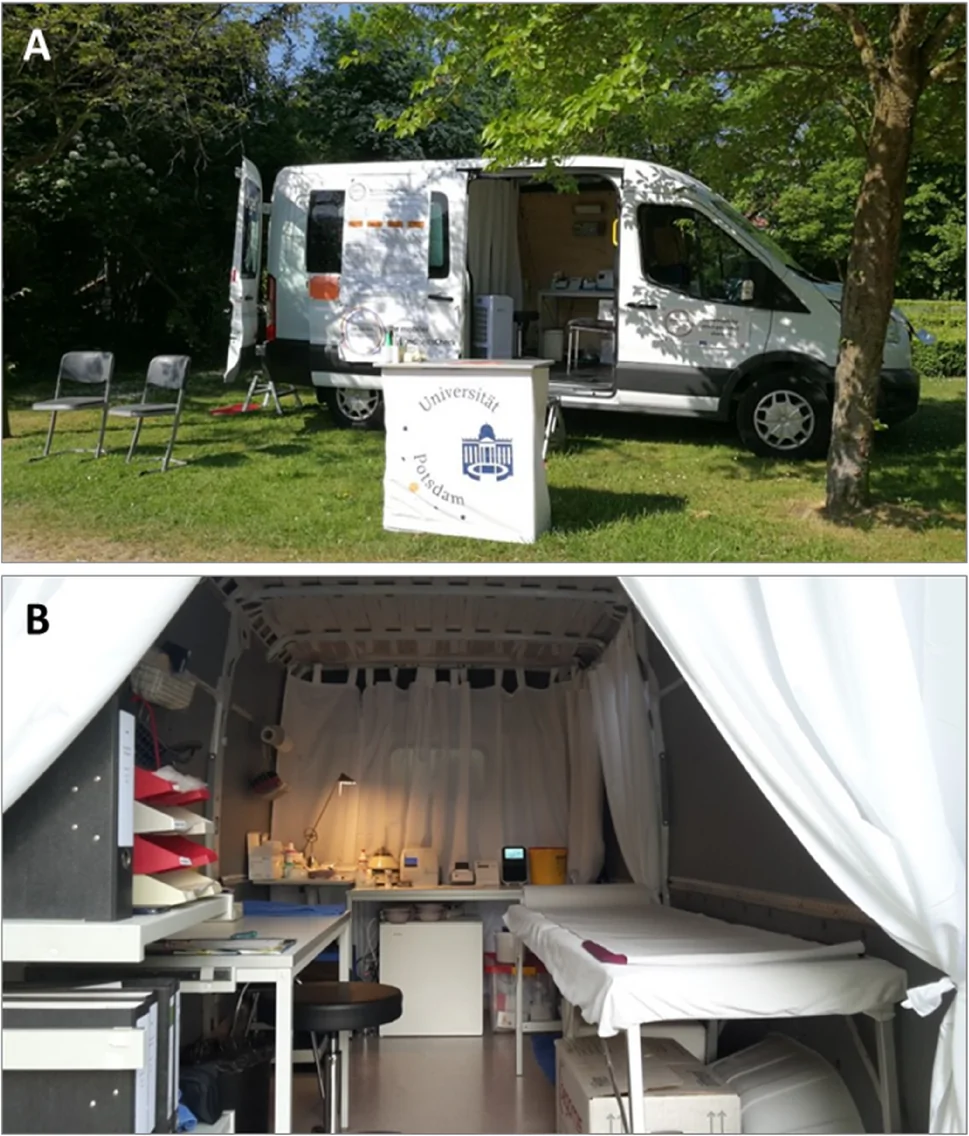
BACKGROUND: The metabolic syndrome (MetS) is characterized by having three or more of these risk factors: increased blood glucose (Glc), serum triglycerides (TG), blood pressure (BP), waist circumference (WC), and reduced high-density lipoprotein (HDL). Mobile diagnostics using point-of-care (POC) blood analyzers could help identify individuals at risk. This pilot study assessed reliability and validity of MetS risk factor analysis using POC analyzers in a mobile examination unit. METHODS: Fifty participants (52 ± 7y; 170 ± 10 cm; 80 ± 19 kg, m/f: 21/29) were included for analysis. The mobile examination unit was equipped with different POC analyzers (Alere, LABGEO, CardioChek for Glc, HDL, TG; Quo-Test-A1C Testkit for HbA1c'). Agreement compared to a reference laboratory (RefLab) was analyzed by Bland-Altman (bias, Limits of Agreement (LoA)), ICC, SEM and McNemar's test. Test-retest analysis was assessed on two different days (max. two weeks apart) using Spearman's rho, ICC, test-retest variability (TRV%) and McNemar's test. RESULTS: Based on the smallest bias and low number of missing values (Glc: -5 [LoA - 25 to 6] mg/dl; TG: 8 [LoA - 58 to 30] mg/dl; HDL: -2 [LoA - 14 to 9] mg/dl), and the highest agreement in MetS diagnosis compared to the results of RefLab, the Alere POC device was chosen. Test-retest reliability (n = 16) for MetS risk factors and HbA1c measured in the mobile setup ranged from poor to excellent with low TRV (0.9-5.8%). Risk factor classification and MetS diagnosis did not differ between measurement days. CONCLUSIONS: A mobile setup using the Alere POC analyzer could be used as a valid mobile screening method for MetS to ensure early detection of risk factors.
The paper
University of Potsdam
BMC Primary Care, 19 Aug 2026, Open access