Feasibility of a Progressive High-Intensity Interval Training Model of Exercise for Patients With Type 2 Diabetes Mellitus Enrolled in Cardiac Rehabilitation
12 weeks
Abstract
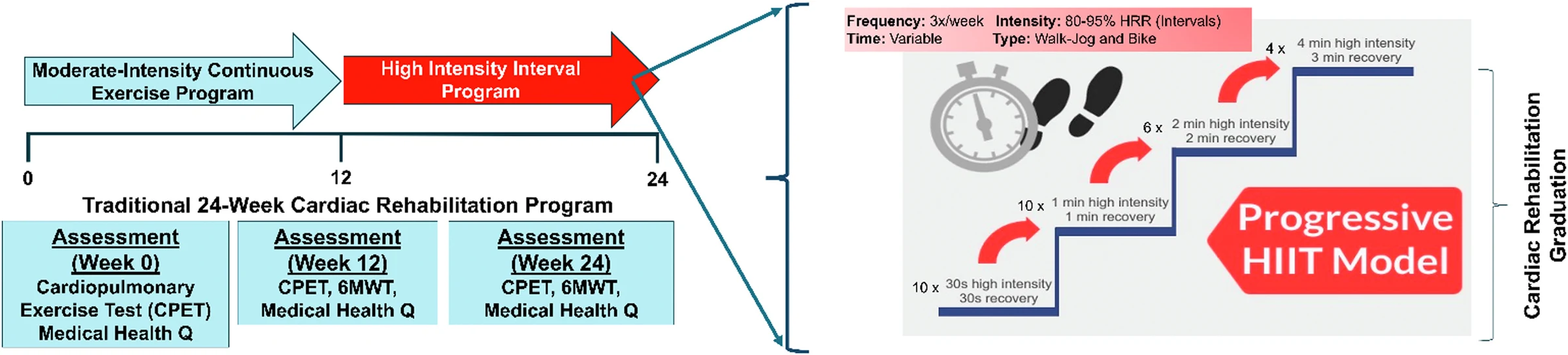
OBJECTIVE: A link exists between type 2 diabetes mellitus (T2DM) and developing cardiovascular disease. Lifestyle interventions targeting T2DM and cardiovascular disease are required. Cardiac rehabilitation offers a multidisciplinary approach for management. High-intensity interval training (HIIT) may provide equivalent benefits compared to moderate-intensity continuous exercise in improving cardiorespiratory fitness and glycemic control. HIIT should be considered when prescribing exercise for patients living with T2DM; however, further feasibility research is required. The objective of this study was to determine the feasibility of progressive HIIT in patients living with T2DM. METHODS: Patients in a 24-week cardiac rehabilitation program provided research consent at 12 weeks. Feasibility was assessed using intervention adherence, dropout rate and reason, patient satisfaction, and safety. Patients completed the HIIT protocol 3 times per week, at 80% to 95% heart rate reserve. Patients started at Stage 1 (10×30-s high intensity:30-s recovery) and progressed to Stages 2 to 4 every 3 weeks according to patient desire and achievement of target work rate without adverse events. Possible progressions included Stage 2 (10×1-min high intensity:1-min recovery), Stage 3 (6×2-min high intensity:2-min recovery), and Stage 4 (4×4-min high intensity:3-min recovery). RESULTS: Twenty-two participants consented to participation, and 17 (60.2±12.4 years) completed the program (23% dropout rate). Adherence to on-site HIIT sessions was 79%, and to at-home unsupervised sessions was 70%. Five patients (4 females) remained at Stage 1; 4 (2 females) progressed to Stage 2; 7 (2 females) progressed to Stage 3; and 1 (male) progressed to Stage 4. Satisfaction surveys revealed that patients enjoyed HIIT as much as moderate-intensity continuous exercise (p=0.29). No HIIT-related adverse events were reported. CONCLUSIONS: Progressive HIIT is feasible, enjoyable, and safe among patients living with T2DM.
The paper
Toronto Rehabilitation Institute
Canadian Journal of Diabetes, 21 Aug 2026

