Impact of HPV vaccination on cervical precancer and invasive cervical cancer twelve years after vaccine introduction in the Brazilian Public Health System
Abstract
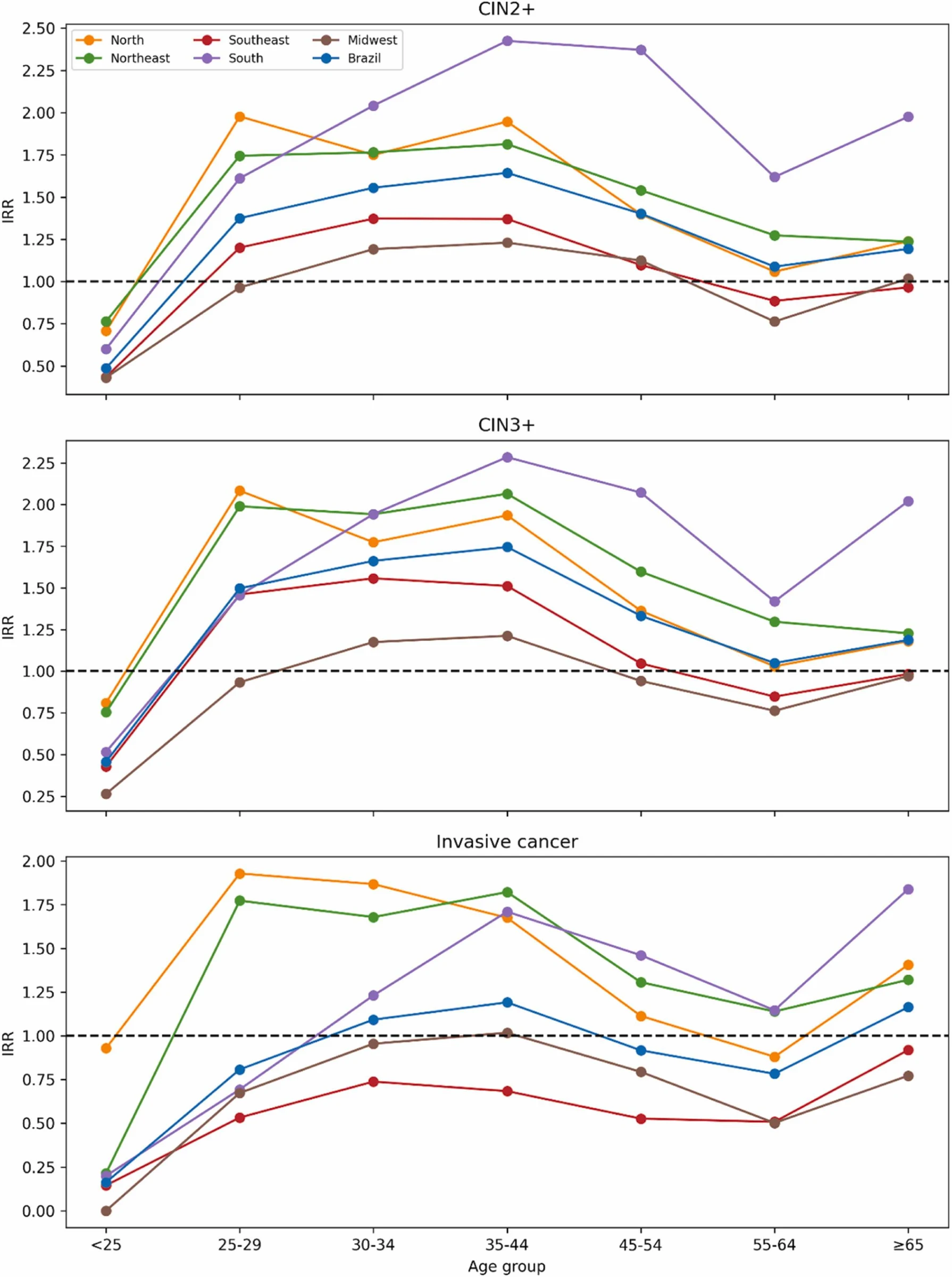
BACKGROUND: The national HPV vaccination program was introduced into the Brazilian public health system for children and adolescents in 2014. However, its population-level impact remains poorly characterized, particularly in the context of regional disparities. METHODS: We compared the incidence of cervical precancer and invasive cancer between the pre-vaccination period (2010-2012) and the post-vaccination period (2025) among screened women aged < 25 years (vaccine-eligible women) and ≥ 25 years (non-vaccine-eligible women) in Brazil and across its geographic regions. RESULTS: Among vaccine-eligible women, the incidence of CIN2 +, CIN3 +, and invasive cervical cancer was significantly lower in the post-vaccination period than in the pre-vaccination period in Brazil. Incidence rates were lower across all regions; however, statistically significant reductions in all three outcomes were observed only in the Southeast, South, and Midwest. In the Northeast, significant reductions were observed for CIN2 + and invasive cervical cancer, whereas no significant reductions were observed in the North. The reduction in invasive cervical cancer incidence was significantly greater than those observed for CIN2 + and CIN3 +. Among non-vaccine-eligible women, significant reductions were observed primarily for invasive cervical cancer. Nationally, reductions were observed among women aged 25-29 and 55-64 years. Regionally, reductions occurred in the Southeast among women aged 25-64 years, in the South among those aged 25-29 years, and in the Midwest among those aged 55-64 years. Significant reductions in CIN2 + and CIN3 + were limited to women aged 55-64 years in the Southeast and Midwest. In all other age groups, outcome and regions, incidence showed either significant increases or no statistically significant changes. CONCLUSIONS: Twelve years after the introduction of HPV vaccination, these findings support a population-level impact of HPV vaccination in Brazil and most regions among vaccine-eligible women. Among non-vaccine-eligible women, the findings suggest possible indirect protection, varying by outcome, age group and region.
The paper
Universidade de Brasília
Journal of Infection and Public Health, 24 Jul 2026