Share of egg cells starting to grow stays steady in aging mice
In mice aged 5–60 weeks, egg cells beginning to grow made up about 14% of the reserve, despite declining total egg-cell numbers.
85,000 mice
Limit: Changes in activation share within individual ovaries over time were not measured
Edited by Boris Djordjevic · AgingResearch.News
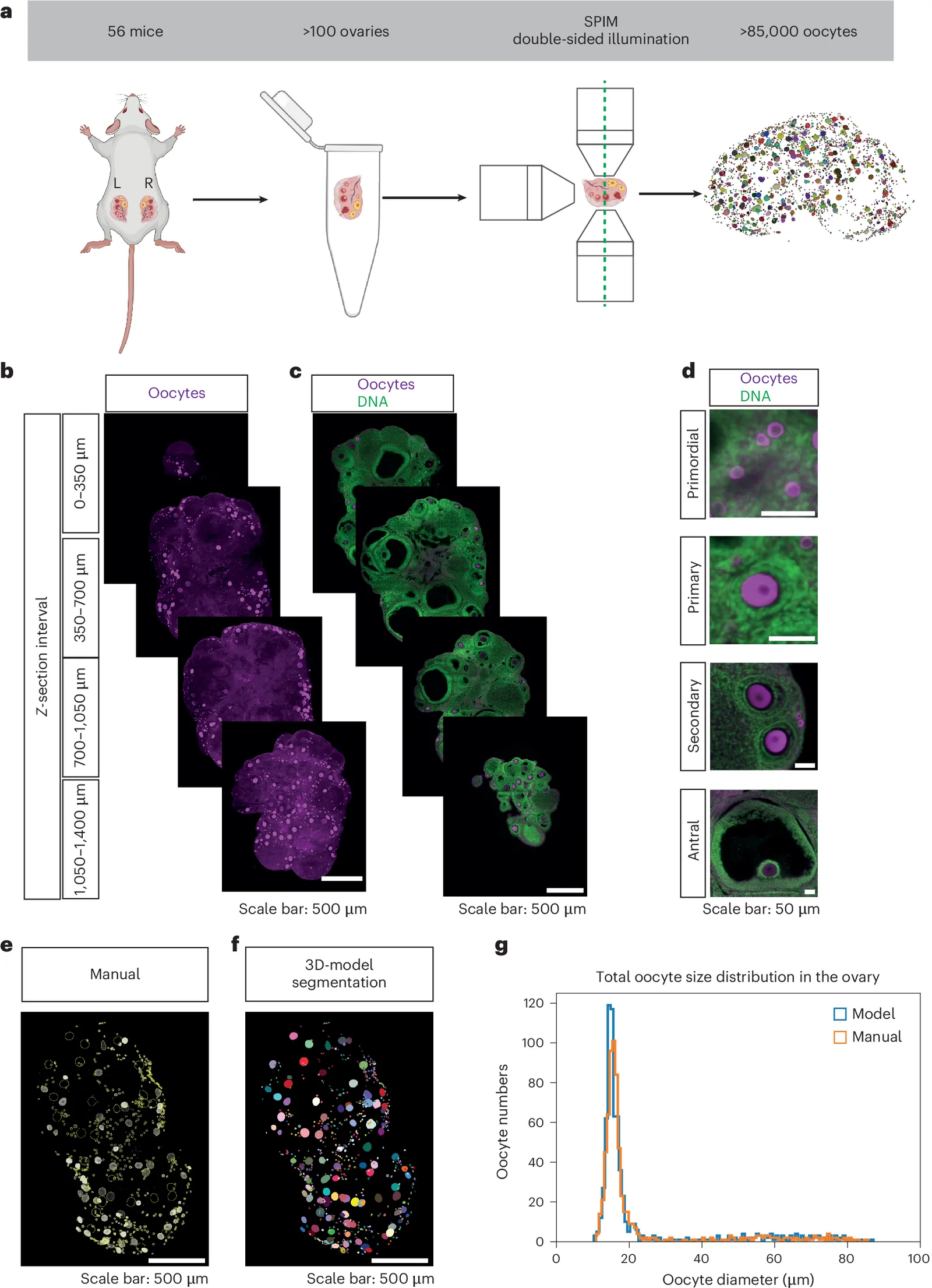
In a cross-sectional animal study, researchers examined ovaries from 56 unmated C57BL/6J house mice aged 5 to 60 weeks. They combined three-dimensional microscopy, artificial intelligence and mathematical modeling to map more than 85,000 oocytes, or immature egg cells, in more than 100 intact ovaries.
As egg-cell numbers fell with age, newly activated cells—those beginning to grow—remained about 14% of the reserve. Egg cells were more common along the ovary’s sides, and higher local egg-cell density was associated with activation. Two distinct peaks in egg-cell sizes suggested a bottleneck in development. The authors suggested that regulation across the whole organ may coordinate the age-related decline in egg-cell numbers.
Why it matters
The finite supply of immature egg cells helps define reproductive lifespan. Mapping this reserve offers a quantitative framework for studying how ovaries change with age.
Caveats
The researchers compared different mice at different ages, rather than following the same ovaries over time. These mouse results do not establish whether the same patterns occur in people.
The paper
Three-dimensional mapping of intact ovaries reveals the aging dynamics of the ovarian reserve
Barcelona Institute of Science and Technology; Institució Catalana de Recerca i Estudis Avançats
Nature Aging, Aug 12, 2026, Open access
doi.org/10.1038/s43587-026-01178-zPubMed 42587142
Corrected, Sep 16, 2026


