A protein eased harm from its misfolded form in lab-grown eye cells
In experiments with lab-grown retinal cells, the normal protein bound its misfolded variant and reduced disruption of the cells’ protein-handling systems.
Our read
Mechanisms- Studied:
- Experiments in retinal pigment epithelium cells
- What changed:
- RGR binding to its misfolded variant reduced harm to lab-grown retinal cells
- The catch:
- Cells were engineered to overproduce both proteins
Editor of record: Boris Djordjevic · AgingResearch.News
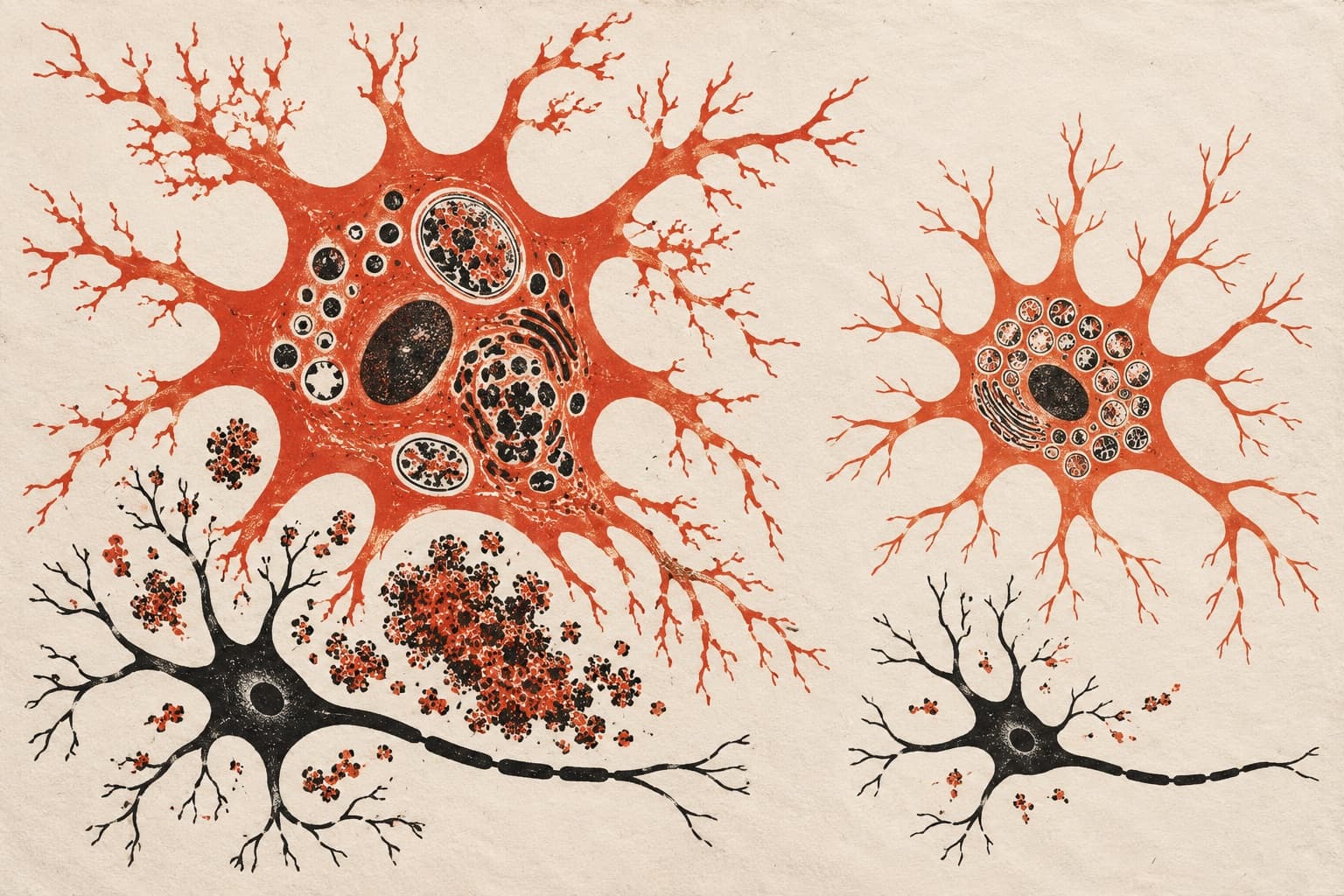
ARPE-19 retinal pigment epithelium cells—a laboratory model of the cell layer supporting the retina—were engineered to produce high levels of RGR, a retinal protein, and RGR-d, its misfolded variant. The researchers tested the cells with and without a chemical that inhibits a protein-disposal system.
RGR bound its misfolded variant, forming a complex that reduced harm to the cells. The findings suggested that this binding could help the variant fold correctly in the endoplasmic reticulum, a compartment where proteins take shape. The complex also eased stress in that compartment and reduced disruption of autophagy, the cell’s recycling process. The authors described the interaction as an internal defense against harm caused by misfolded proteins.
Why it matters
For dry age-related macular degeneration, the authors proposed targeting RGR-d as a possible way to address the disease’s protein-misfolding pathology.
Caveats
The main findings came from cells engineered to overproduce both proteins, not from people with age-related macular degeneration. These experiments did not test whether targeting the misfolded variant would benefit people with the disease.
The paper
Peking University People's Hospital
Experimental Eye Research, Jul 17, 2026



Comments
Be the first to comment.