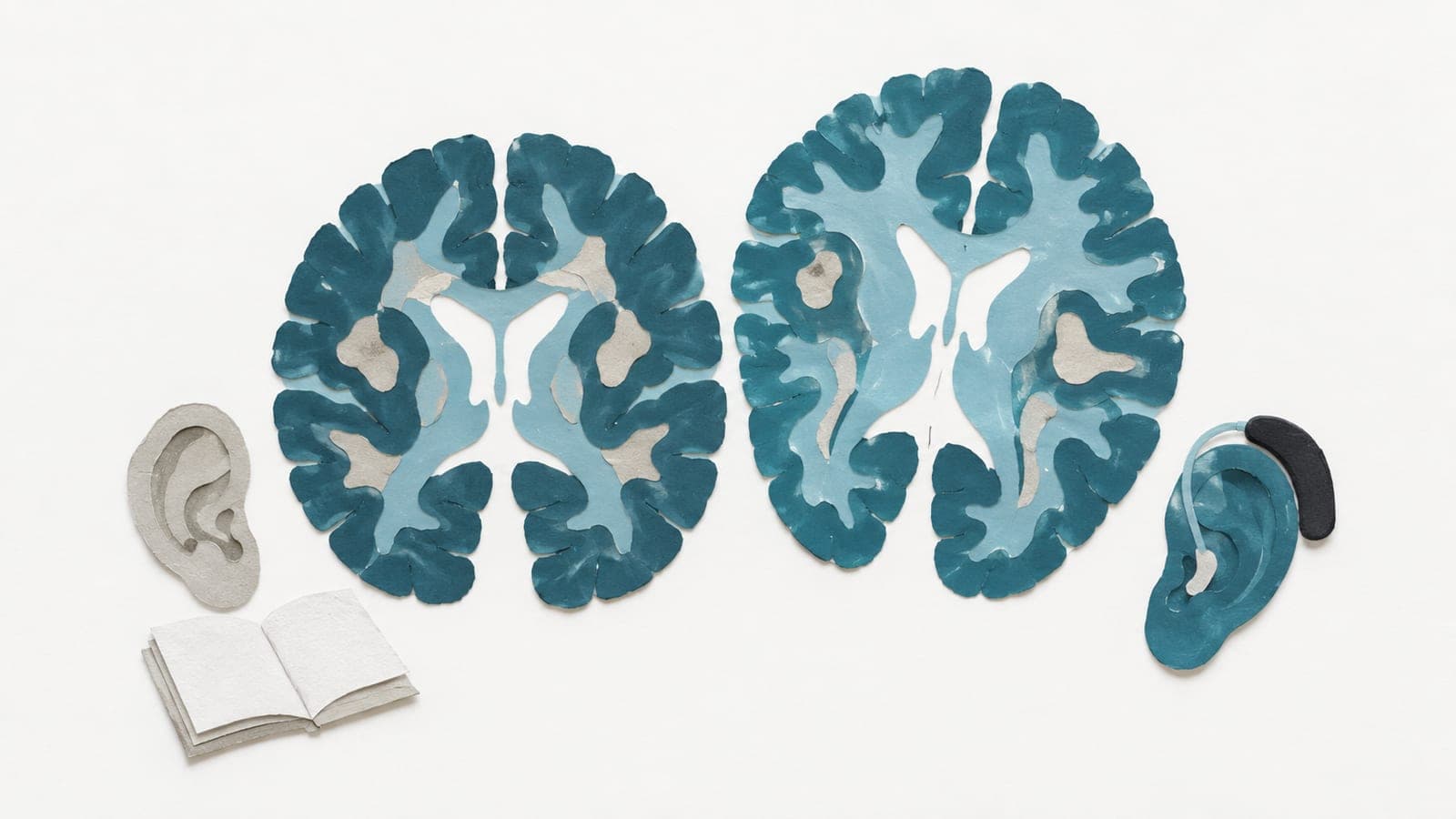
Increased hemispheric functional connectivity compensates speech perception in older adults with hearing loss
Abstract
Age-related hearing loss (ARHL) is associated with widespread cortical reorganization, yet the adaptive mechanisms of functional connectivity across disease stages and brain states remain unclear. Using functional near-infrared spectroscopy (fNIRS), we examined both resting-state and speech perception-evoked functional connectivity (FC) in older adults with normal hearing, mild hearing loss, or moderate-to-severe hearing loss. FC alterations were found to be both state-dependent (i.e., varying with the cognitive state) and stage-dependent (i.e., depending on the severity of hearing loss). At rest, only the most impaired group showed localized increases in right-hemispheric FC. During speech perception, the mildly impaired group exhibited widespread FC enhancements across cross-hemispheric networks. These task-evoked enhancements were absent in the severely impaired group, suggesting a breakdown in adaptive recruitment. Subnetwork-level analyses further revealed spatially specific alterations in right-lateralized frontoparietal and frontotemporal circuits, as well as interhemispheric pathways linking left-hemisphere language hubs with right-hemisphere regions supporting attention, executive function, and top-down linguistic prediction. Collectively, our findings delineate a nonlinear trajectory of neural adaptation in ARHL, highlight a temporally bounded window of plasticity in early stages, and underscore the essential role of cross-hemispheric reorganization in sustaining speech processing under cognitive load.
The paper
Beijing Tongren Hospital
Brain Research, 7 Feb 2026
doi.org/10.1016/j.brainres.2026.150201PubMed 41662986
Corrected, 15 Nov 2026