Senescence-Associated Transcriptome Reversal Prioritizes Repurposing Candidates for Diabetic Kidney Disease: A Computational Study
Abstract
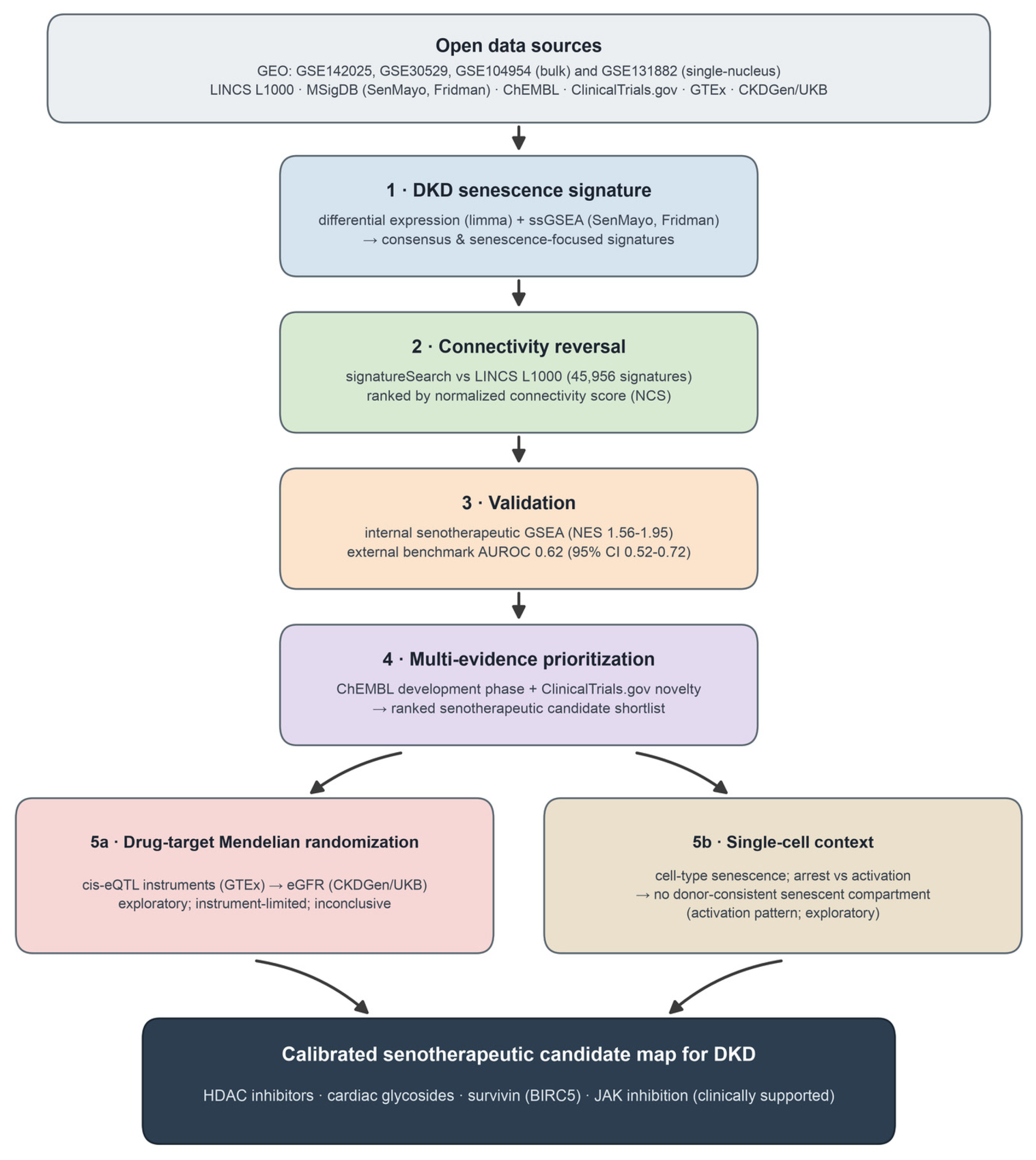
Background/Objectives: Diabetic kidney disease (DKD) is a leading cause of end-stage kidney disease, and cellular senescence is a tractable therapeutic target; yet prioritizing credible repurposing candidates is difficult because bulk-tissue senescence signals are weak, single-dataset analyses are unstable, and transcriptome-reversal screens overstate novelty. The objective was to build a senescence-anchored, multi-evidence computational prioritization of repurposing candidates for DKD entirely from open data. Methods: Per-sample senescence activity was quantified by single-sample gene set enrichment across three DKD kidney cohorts, and consensus signatures were reversed against 45,956 LINCS L1000 signatures. Candidates were ranked by reversal strength, mechanism, ChEMBL stage, and ClinicalTrials.gov novelty, then assessed for robustness by senotherapeutic enrichment, an external senolytic benchmark, leave-one-cohort-out analysis, drug–target Mendelian randomization, and single-nucleus profiling. Results: Senescence activity was consistently elevated in DKD across all three cohorts, with moderate-to-large effect sizes (rank-biserial 0.32–0.78). Reversal recovered established senotherapeutic classes and nominated the approved JAK inhibitor fedratinib (within the same class, baricitinib reduced albuminuria in a Phase 2 DKD trial); curated senolytics were modestly separated from negatives (AUROC 0.62, 95% CI 0.52–0.72). Filtering yielded 867 mechanism-annotated compounds robust to cohort removal. Drug–target Mendelian randomization was inconclusive, and single-nucleus profiling highlighted endothelial activation rather than a stable senescent compartment. Conclusions: The result is an externally benchmarked, novelty-annotated senotherapeutic candidate map, offered as convergent confirmation of repurposable mechanisms rather than a claim of new drug classes.
- Fedratinib
- Resources: datasets, atlases and tools
- Cellular senescence
- Senescence
- Diabetic kidney disease
- Humans
The paper
Ege University; Giresun University
Biomedicines, 9 Oct 2026, CC BY